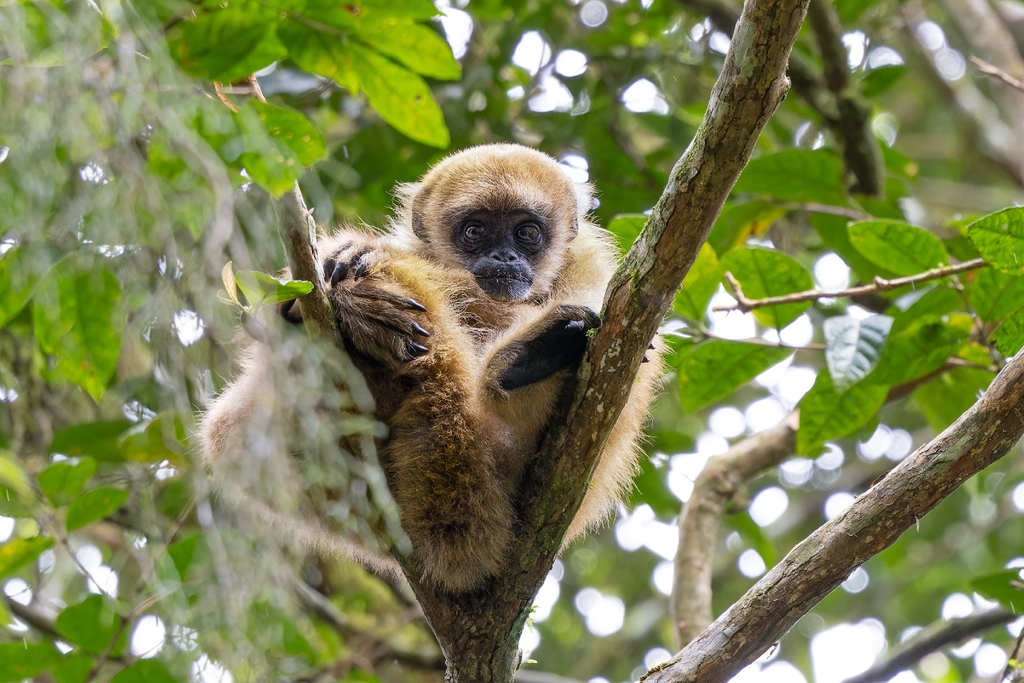
Southern Muriqui
Photo © Paulo Mascaretti
Photo © Paulo Mascaretti — CC0 1.0 — Source: iNaturalist photo #583871331Identification
The southern muriqui is the largest New World monkey and the biggest native primate in the Americas. Males are noticeably larger than females, with head-body lengths of 55–78 cm and fully prehensile tails of 74–80 cm, weighing 9.6–15 kg. Females measure 46–63 cm in head-body length, with tails of 65–74 cm and weights of 8–11 kg. The species is distinguished by its entirely black face, which sets it apart from its northern cousin, the northern muriqui, whose face is mottled with pink. Their long, muscular tail is crucial for arboreal locomotion, providing balance and grip as these primates move through the forest canopy.
Range & Habitat
Southern muriquis are endemic to Brazil, found exclusively in Atlantic rainforest fragments scattered across five southeastern Brazilian states: Paraná, São Paulo, Rio de Janeiro, Espírito Santo, and Minas Gerais. Known locally as mono carvoeiro (charcoal monkey), this species has experienced severe range contraction due to habitat loss. The species is now restricted to specific protected areas within its former Atlantic rainforest range, making it one of Brazil's most geographically limited primate species.
Behaviour & Diet
Southern muriquis are primarily frugivores with the most diverse fruit diet known in the Atlantic rainforest, supplementing their diet with leaves, flowers, and seeds of species such as sapucaia, Inga, Bicuiba, and jatobá. They play a critical ecological role as seed dispersers, even providing foraging opportunities for tapirs through the fruits they consume and drop. Socially, these primates are notably peaceful within their own groups; males are philopatric and tolerant of one another, earning them the nickname "hippie monkey." However, intergroup dynamics are far less harmonious—males display aggression toward outsiders, with documented cases of infanticide, a behavior also seen in chimpanzees. Female muriquis immigrate between groups to promote genetic diversity and prevent inbreeding.
Best Time & Places to See It
Southern muriquis are best encountered through organized visits to protected areas within their range, particularly in São Paulo and neighboring states where forest fragments persist. Carlos Botelho State Park in São Paulo is home to the only long-term study population in continuous forest and represents one of the most reliable locations for observation. The species is diurnal and arboreal, typically active in the canopy during daylight hours. Patience and early morning excursions offer the best chances for sightings, though encounters remain challenging given the species' small remaining population.
Photography Tips
Photograph southern muriquis in their preferred habitat—high in the forest canopy—where morning light filtering through the Atlantic rainforest creates dramatic backlighting opportunities. Their dark faces and robust builds photograph well with telephoto lenses (200–400mm). Capture their prehensile tails in action for dynamic shots showing their arboreal prowess. Early morning provides the best lighting and highest activity levels. Work with local guides at protected areas; they know individual groups and can position you for optimal angles while maintaining conservation ethics and the animals' wellbeing.
No community photos yet. Log in to add the first one.
No community observations of this species yet.