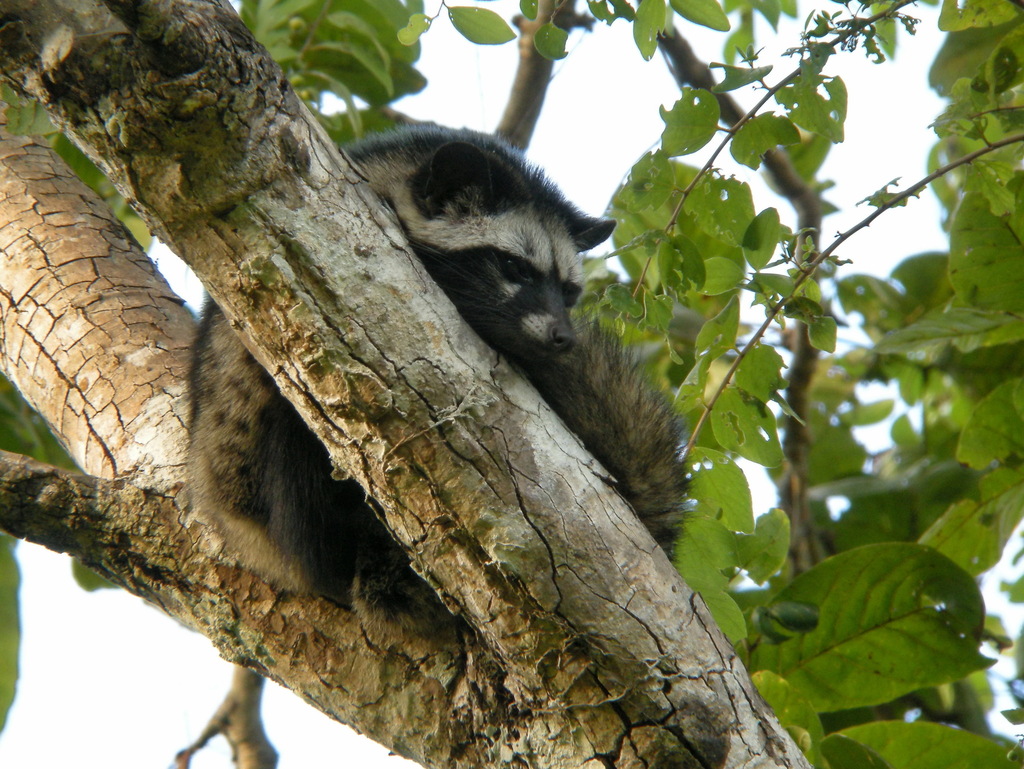
Southern Palm Civet
Photo © Ian Dugdale
Photo © Ian Dugdale — CC BY 4.0 — Source: iNaturalist #302048937Identification
The Southern Palm Civet is a small, elongated carnivoran with a distinctive appearance that makes it recognizable in the field. Adults typically measure around 40–45 cm in body length, with a tail of similar or slightly greater length, giving them a total length of roughly 80–90 cm. Their fur is generally greyish-brown to dark brown, often with a slightly grizzled texture. A key identifying feature is the presence of dark markings or "eye patches" that run from the eyes toward the muzzle, creating a distinctive facial pattern somewhat resembling a mask. The ears are relatively small and rounded, and the body is sleek and somewhat flattened, an adaptation for navigating through dense vegetation and climbing.
The species is closely related to the Common Palm Civet, and distinguishing between them requires attention to range and specific morphological details. The Southern Palm Civet generally has darker coloration than some related species, and the facial markings are typically quite prominent. Their semi-retractable claws and flexible spine aid their arboreal lifestyle, though they spend time both in trees and on the ground.
Range & Habitat
The Southern Palm Civet is found in parts of Southeast Asia, with populations occurring in peninsular Malaysia and other regions of the Thai-Malay Peninsula. They inhabit a variety of forested and semi-forested environments, showing a preference for areas with good tree cover. Their habitat includes primary and secondary tropical forests, as well as more disturbed areas such as plantations, gardens, and forest edges where fruit trees are abundant. They are primarily arboreal and nocturnal, making them well-suited to life among the canopy and mid-story vegetation of tropical forests.
These civets are adaptable animals and can tolerate a degree of habitat modification, though they prefer areas with sufficient tree density and fruiting trees. Their presence is often indicative of relatively intact forest structure, even in human-modified landscapes.
Behaviour & Diet
Southern Palm Civets are primarily nocturnal and solitary or found in pairs. They are excellent climbers with a semi-arboreal lifestyle, spending much of their time in trees foraging and moving along branches. They are generally cryptic and elusive, making them difficult to observe in the wild. When threatened, they can produce a musky odor from anal glands, a defense mechanism shared with many civets.
Their diet is omnivorous and highly opportunistic. They feed extensively on fruits, particularly figs and other tropical fruits, making them important seed dispersers in their forest ecosystems. They also consume small mammals, insects, eggs, and carrion when available. Their role as frugivores makes them particularly active during fruiting seasons, when they may visit fruiting trees regularly at night.
Best Time & Places to See It
Southern Palm Civets are nocturnal, so night-time wildlife surveys and spotlight drives through suitable habitat offer the best opportunities for observation. They are most active in the early evening and before dawn. Visiting protected forest areas and nature reserves in their range during the wet season, when fruit availability is high, increases the chances of encounter. Local guides familiar with civet activity patterns can significantly improve sighting odds.
The species is more commonly recorded in forested regions of Malaysia's peninsula, particularly in areas with mature or secondary forest. Patience and quiet movement through suitable habitat are essential for viewing this elusive species.
Photography Tips
Photographing Southern Palm Civets requires preparation for low-light conditions. High ISO settings and a fast lens (f/2.8 or faster) are essential for capturing usable images in the dim light of the forest understory at night. A headlamp with a red filter can help preserve night vision and minimize disturbance to the animal. Monopods or lightweight supports are useful for stabilizing longer exposures without the bulk of a full tripod in dense forest.
Approach slowly and quietly, and avoid direct light in the animal's eyes. Patience is crucial—waiting quietly near fruiting trees at night may reward you with extended observation opportunities. Capturing their distinctive facial markings and arboreal posture will require positioning yourself to use available moonlight or subtle artificial light strategically.
Khao Yai National Park
Prachantakham District, Thailand
+377 birds+46 mammals
Evergreen dipterocarp forest blankets the rolling terrain of this national park in eastern Thailand, where limestone hills rise abruptly from the forest floor and seasonal streams…
VIEW NATIONAL PARKTaman Negara National Park
Kampong Samas, Malaysia
+393 birds+48 mammals
Where ancient rainforest meets limestone peaks, one of Southeast Asia's oldest protected wilderness preserves sprawls across 4,343 square kilometers of primordial landscape. Dipterocarp giants tower overhead,…
VIEW NATIONAL PARKWest Bali National Park
Gerokgak, Indonesia
+240 birds+8 mammals
Across West Bali's northwestern reaches, where the Indian Ocean meets volcanic slopes and limestone cliffs plunge toward turquoise shallows, sprawls a protected realm of roughly 325…
VIEW NATIONAL PARKKomodo National Park
Komodo, Indonesia
+155 birds+14 mammals
Where volcanic peaks rise dramatically from turquoise waters, a primordial landscape unfolds across three main islands and countless smaller ones scattered throughout the Lesser Sunda archipelago.…
VIEW NATIONAL PARKNo community photos yet. Log in to add the first one.
No community observations of this species yet.