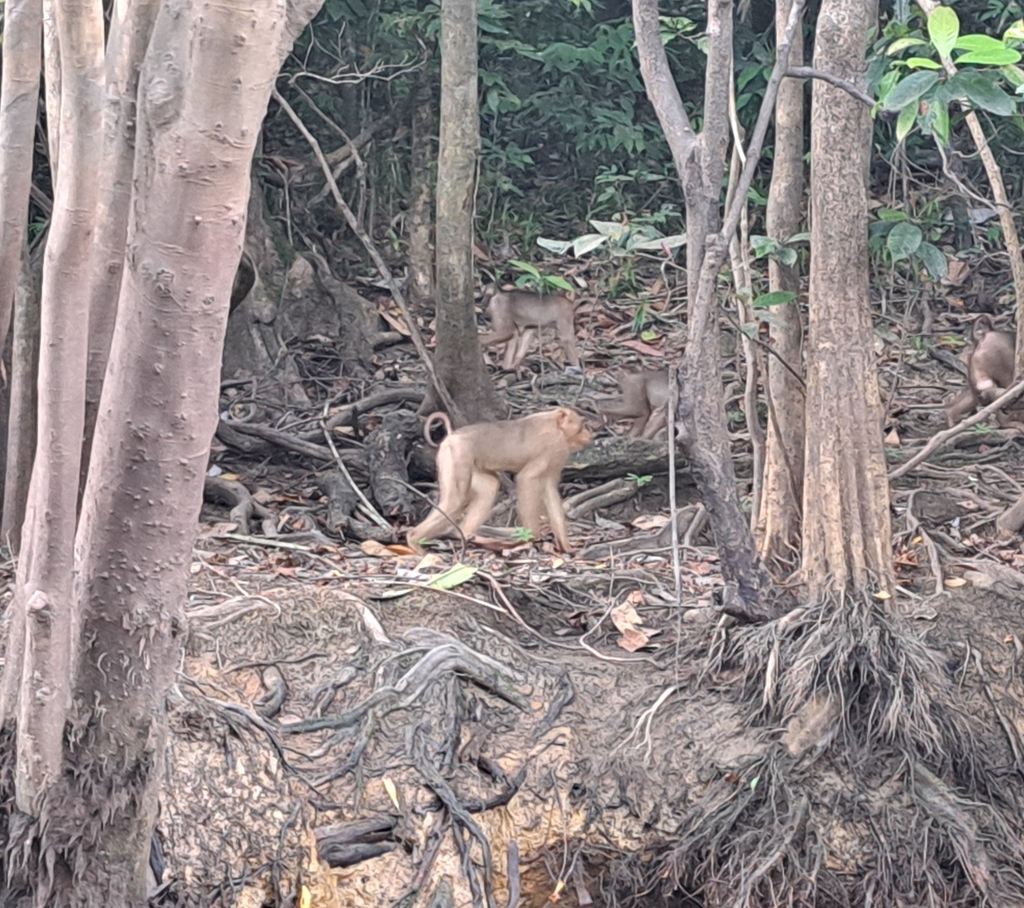
Southern Pig-tailed Macaque
Photo © Andreas Manz
Photo © Andreas Manz — CC0 1.0 — Source: iNaturalist #349128157Identification
The southern pig-tailed macaque is a medium-sized primate with a distinctive appearance that makes it readily recognizable in the field. Males are noticeably larger than females, measuring 50–58 cm in length and weighing 5–12 kg, while females are more compact at 38–48 cm long and 4.5–6 kg. The species displays characteristic buff-brown fur with a darker dorsal surface contrasting against a lighter underside. Most distinctive is the short tail, held semi-erect in a manner that gives the species its common name—it resembles the tail of a pig rather than the typical pendant tail of other macaques.
Range & Habitat
Native to Sundaland and Southeast Asia, the southern pig-tailed macaque occurs across southern Thailand, Malaysia, and Indonesia, including the islands of Sumatra, Borneo, and Bangka Island. The species is found only in the southern half of the Malay Peninsula, with range just extending into southernmost Thailand. Historically present in Singapore, wild populations there are now extinct, with only introduced individuals remaining.
These macaques are primarily rainforest dwellers, found up to elevations of 2,000 metres. However, they are adaptable and readily venture into plantations and gardens, where they sometimes raid crops. Known locally as beruk, they remain widespread throughout suitable habitat within their range.
Behaviour & Diet
Southern pig-tailed macaques are unusually fond of water for primates and combine terrestrial and arboreal lifestyles with considerable climbing ability. They live in large groups that subdivide into smaller foraging parties during the day. Social structure is hierarchical: males establish dominance based on strength and compete to manage conflict and defend the group, while females rank according to heredity, with the alpha female's daughter automatically assuming high status.
The species is omnivorous, feeding primarily on fruits—including figs, mangoes, rambutan, and durian—along with seeds, berries, cereals, and fungi. They also consume invertebrates such as swarming insects, spiders, and grasshoppers. In the wild, they serve as crucial seed dispersers for rattan species. Females give birth to a single infant every two years after a gestation of approximately 5.7 months, with weaning at 4–5 months and sexual maturity reached between 3–5 years of age.
Best Time & Places to See It
Borneo, Sumatra, and the southern Malay Peninsula offer the best opportunities for encountering southern pig-tailed macaques in their natural rainforest habitat. Primary rainforest reserves and national parks within these regions are your most reliable destinations. Look for them in forested areas up to 2,000 metres elevation, though they may also be spotted in plantations and cultivated areas adjacent to forest.
Photography Tips
The macaques' water-loving nature and semi-terrestrial habits offer excellent opportunities for photography. Early morning foraging sessions provide good lighting and active subject behaviour. Their large group sizes and daytime subdivisions into smaller parties mean you may encounter manageable numbers. The contrast between their buff-brown coloration and the dark rainforest understory can be striking; use natural light to capture the colour variation between dorsal and ventral surfaces. The distinctive pig-like tail is a key identifying feature worth emphasizing in your images. Exercise caution and maintain a respectful distance, as these are wild animals that may be wary of humans.
Taman Negara National Park
Kampong Samas, Malaysia
+393 birds+48 mammals
Where ancient rainforest meets limestone peaks, one of Southeast Asia's oldest protected wilderness preserves sprawls across 4,343 square kilometers of primordial landscape. Dipterocarp giants tower overhead,…
VIEW NATIONAL PARKKerinci Seblat National Park
Kerinci, Indonesia
+228 birds+16 mammals
Across nearly 67,000 square kilometres of Sumatra's spine, a mountainous realm of equatorial rainforest rises from steaming lowlands to volcanic peaks shrouded in cloud. Kerinci Seblat…
VIEW NATIONAL PARKWay Kambas National Park
Lampung Timur, Indonesia
+237 birds+20 mammals
Across the low swamplands of eastern Lampung, where freshwater wetlands merge into tidal mangrove forests along the Sunda Strait, sprawls one of Sumatra's most vital sanctuaries.…
VIEW NATIONAL PARKNo community photos yet. Log in to add the first one.
No community observations of this species yet.