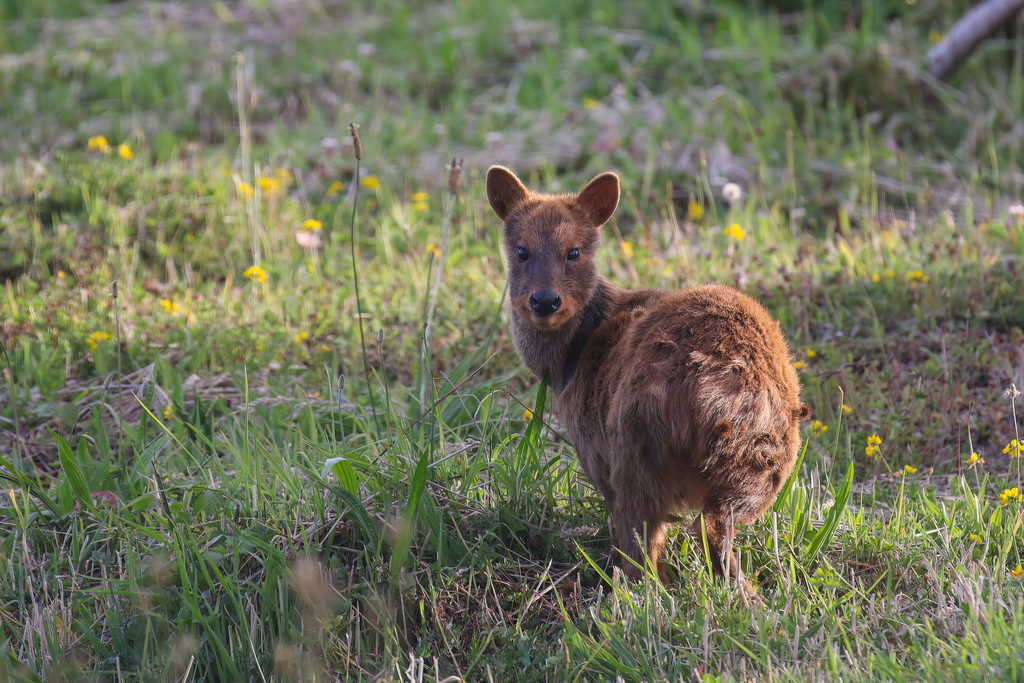
Southern Pudu
Photo © Thomas Galewski
Photo © Thomas Galewski — CC BY 4.0 — Source: iNaturalist photo #601529625Identification
The southern pudu is the third smallest deer species in the world, making it a diminutive and enchanting subject for wildlife enthusiasts. Standing just 35 to 45 centimetres tall at the shoulder and weighing between 6.4 and 13.4 kilograms, it is slightly larger than its close relatives, the northern pudu and Pudella carlae. Despite its tiny stature, the southern pudu is a perfectly proportioned deer with distinctive features that aid identification in the field.
The species displays a dark chestnut-brown coat that characteristically tufts at the front, creating a distinctive appearance. Males bear small antlers measuring 5.3 to 9 centimetres in length, which curve backward in a manner somewhat reminiscent of a mountain goat. These modest antlers are largely hidden beneath the tufted fur of the head, so observers may need to look carefully to spot them.
Range & Habitat
The southern pudu is native to the Valdivian temperate forests of south-central Chile and adjacent Argentina. Unlike its northern cousin, the southern pudu favours lower elevations, occurring from sea level up to 1,700 metres elevation. In the Chilean Coast Range, it inhabits primary and secondary broadleaf evergreen forests, as well as alerce forests dominated by Fitzroya cupressoides, and occasionally ventures into Eucalyptus plantations. Further south in the Andes, it is associated with thickets of bamboo and Nothofagus dombeyi forests.
The species thrives in forests with dense understory vegetation but shows a preference for open spaces where rich vegetation provides good feeding opportunities. Both mature and disturbed forests can harbour southern pudus, demonstrating their adaptability to various forest conditions across their range.
Behaviour & Diet
The southern pudu is a browser that feeds on the vegetation available in its forest habitat. The species forages in the understory and in open areas with abundant plant growth, consuming leaves, shoots, and other plant material. Research has shown that southern pudu foraging activity has implications for forest regeneration, particularly in burned forests of Pilgerodendron uviferum, where their feeding is thought to be detrimental to forest recovery.
Populations of southern pudu across their range show remarkable genetic distinctiveness, with each population exhibiting marked differences in mitochondrial DNA and relatively little genetic exchange between neighbouring groups. The population inhabiting Chiloé Island, isolated for more than 200 thousand years, may represent a separate subspecies, highlighting the evolutionary significance of maintaining distinct populations throughout the species' range.
Best Time & Places to See It
Travellers seeking southern pudus should explore the Valdivian temperate forests of south-central Chile and adjacent Argentina. The species' preference for areas with open vegetation and rich feeding opportunities makes forest edges, clearings, and disturbed areas promising locations for observation. The Chilean Coast Range and southern Andean regions, particularly areas with bamboo thickets and Nothofagus forests, offer the best chances of encounters.
The remote and reproductively isolated populations, such as those on Chiloé Island, may be of particular interest to naturalists concerned with conservation genetics and evolutionary distinctiveness. Visiting during the active feeding hours when pudus emerge into open spaces will increase the likelihood of sightings.
Photography Tips
Photographing the southern pudu presents both challenges and rewards. The species' diminutive size and preference for dense forest understory mean that patience and careful stalking are essential. Early morning or late afternoon light filtering through the forest canopy can create atmospheric images that convey the pudu's intimate forest habitat. Wide-angle lenses may be necessary to capture the forest setting and provide context for these tiny deer.
The pudu's characteristic tufted chestnut-brown coat and modest antlers are key features to capture. When photographing males, try to position yourself to reveal the small backward-curving antlers that distinguish them from females. The species' status as Near Threatened makes every photograph a valuable record of this remarkable small deer.
Chiloé National Park
Dalcahue, Chile
+122 birds+6 mammals
Temperate rainforest cloaks the Chiloé archipelago's northwestern reaches, where granite ridges thrust through dense, moisture-laden canopy and freshwater streams carve ravines toward the Pacific. Across approximately…
VIEW NATIONAL PARKPuyehue National Park
Puyehue, Chile
+110 birds+4 mammals
Across the volcanic spine of the Los Lagos Region, where the Andes descend toward temperate rainforest, Puyehue National Park encompasses nearly 2,600 square kilometers of one…
VIEW NATIONAL PARKVicente Pérez Rosales National Park
Puerto Varas, Chile
+109 birds+8 mammals
Where the Andes descend toward the temperate rainforests of Chile's Lake District, nearly 4,641 square kilometers of pristine wilderness unfolds across Vicente Pérez Rosales National Park.…
VIEW NATIONAL PARKNahuel Huapi National Park
Argentina
+124 birds+11 mammals
Where the Andes descend toward Patagonia, vast glacial lakes cut through a landscape of southern beech forest and granite peaks, creating one of South America's most…
VIEW NATIONAL PARKLago Puelo National Park
Argentina
+109 birds+1 mammals
Where temperate forests descend to crystalline waters in the foothills of the Andes, Lago Puelo National Park sprawls across nearly 300 square kilometers of pristine wilderness…
VIEW NATIONAL PARKLos Alerces National Park
Argentina
+84 birds+3 mammals
Where the temperate rainforests of southern Patagonia sweep down towards crystalline lakes, Los Alerces National Park unfolds across nearly 3,000 square kilometres of one of South…
VIEW NATIONAL PARKNo community photos yet. Log in to add the first one.
No community observations of this species yet.