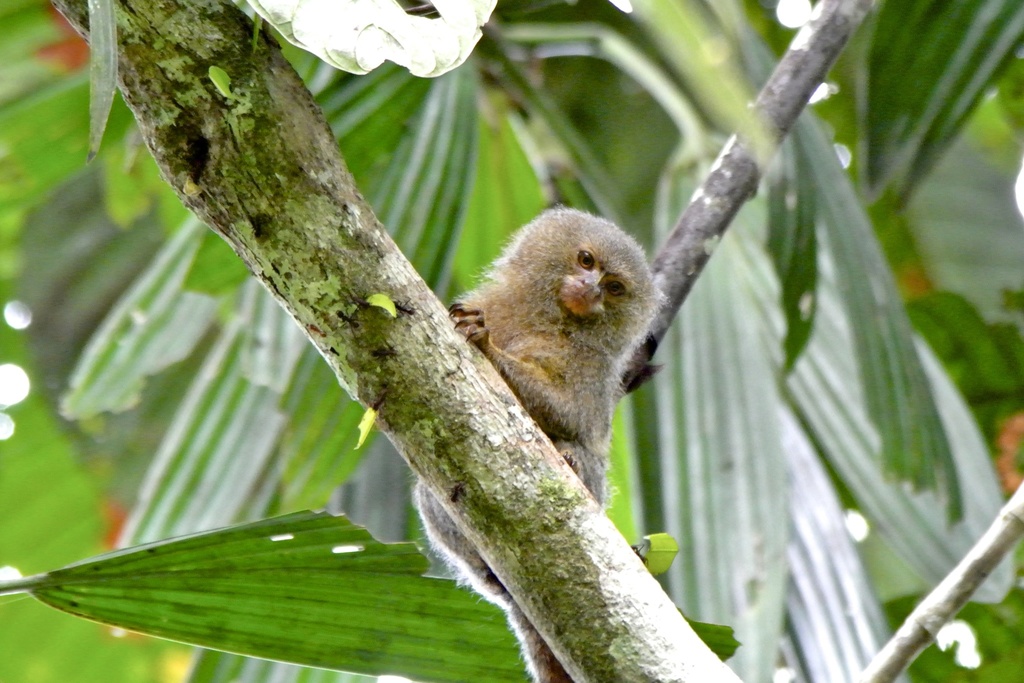
Southern Pygmy Marmoset
Photo © Kristiina Hurme
Photo © Kristiina Hurme — CC BY 4.0 — Source: iNaturalist photo #1618608The eastern pygmy marmoset (Cebuella niveiventris) is a marmoset species, a very small New World monkey, found in the southwestern Amazon rainforest in Bolivia, Brazil, Ecuador, and Peru. It was formerly regarded as conspecific with the similar western pygmy marmoset, but the eastern pygmy marmoset has whitish colored underparts. Although the eastern pygmy marmoset occurs further east than the western pygmy marmoset, the primary separators of their ranges are the Amazon River (Solimões River) and Maranon River, with the western occurring to the north of them and the eastern to the south. The species has recently been confirmed by DNA testing to exist in Ecuador, hundreds of kilometers north of the Maranon River. == Physical description == The eastern pygmy marmoset weighs around 119 grams and have a head size ranging from 33.7 to 38.9mm, being one of the smallest New World monkeys. In the wild, full grown adult males weigh approximately 110 grams whereas adult females can weigh around 120 grams. All pygmy marmosets share a common attribute where they have a mane of fur covering their ears, arms that are longer than their hind legs, and they have no protocone in their first upper premolar tooth. Due to…
Amacayacu National Park
Leticia, Colombia
+567 birds+25 mammals
Where the Rio Amazonas curves through the tri-border region where Colombia, Peru, and Brazil converge, Amacayacu National Park sprawls across more than 5,250 square kilometres of…
VIEW NATIONAL PARKSerra do Divisor National Park
Brazil
+448 birds+10 mammals
Where the western Amazon meets the Andes foothills, Serra do Divisor National Park sprawls across one of South America's most biodiverse and least accessible frontiers. Spanning…
VIEW NATIONAL PARKManu National Park
Manu, Peru
+892 birds+26 mammals
Across the eastern slopes of the Peruvian Andes, tropical rainforest descends into the Amazon basin with a complexity that few terrestrial ecosystems match. Manu National Park…
VIEW NATIONAL PARKNo community photos yet. Log in to add the first one.
No community observations of this species yet.