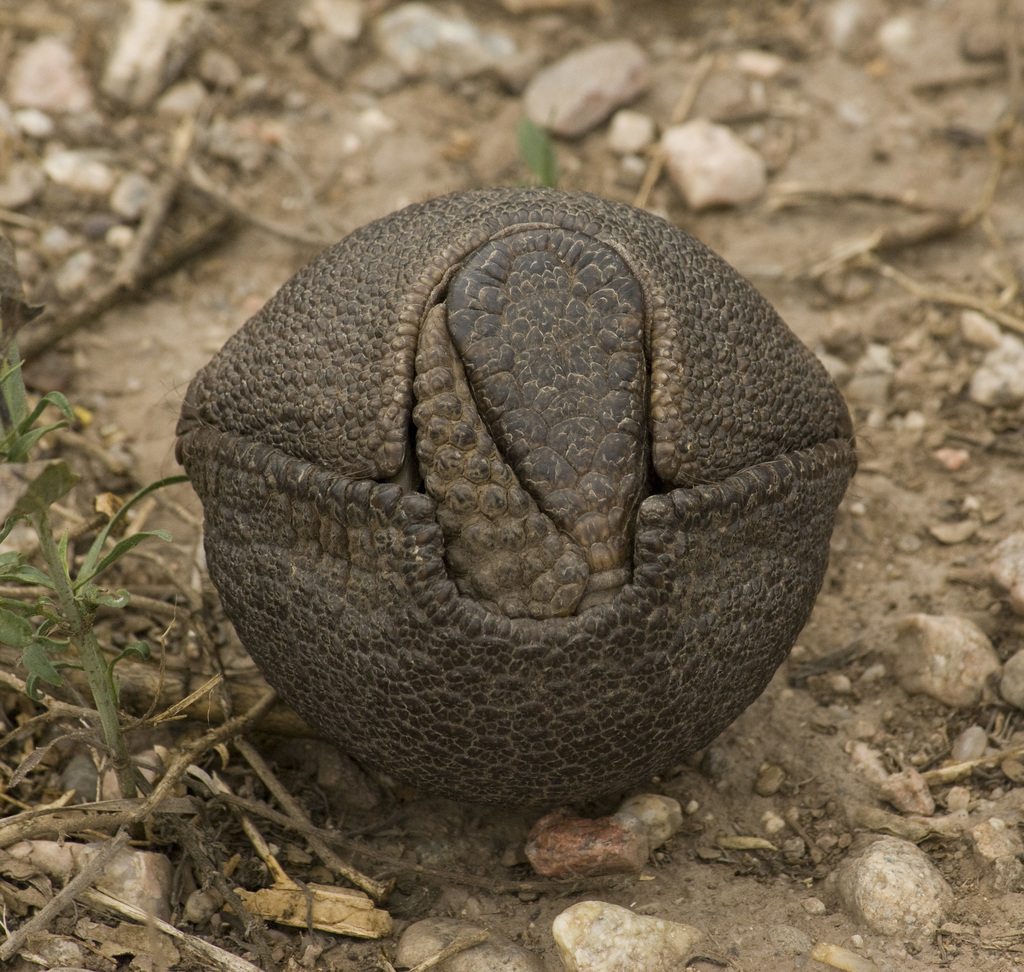
Southern Three-banded Armadillo
Photo © Nicolas Olejnik
Photo © Nicolas Olejnik — CC BY 4.0 — Source: iNaturalist #1634730Identification
The southern three-banded armadillo is among the smallest armadillo species, measuring just 22 to 27 cm (8.7 to 10.6 in) in head-and-body length and weighing between 1 and 1.6 kg (2.2 and 3.5 lb)—small enough to fit in your hand. Its most distinctive feature is the three characteristic bands that cross its back, which provide the flexibility needed for its remarkable defense mechanism: the ability to roll into a complete, impenetrable ball. This adaptation is shared only with its close relative, the Brazilian three-banded armadillo, making it unique among armadillos. The animal's body is covered in an armored shell composed of keratin—the same protein that forms human fingernails—and typically displays a yellow or brownish coloration.
Range & Habitat
This species is found across parts of South America, including northern Argentina, southwestern Brazil, Paraguay, and Bolivia, inhabiting regions from sea level to elevations of 770 m (2,530 ft). The southern three-banded armadillo occupies the Dry Chaco habitat, though this landscape is increasingly threatened by agricultural conversion. Unlike most armadillo species, the southern three-banded armadillo is not a digger and does not create its own burrows. Instead, it makes resourceful use of abandoned burrows left behind by giant anteaters, relying on these ready-made shelters for refuge and rest.
Behaviour & Diet
The southern three-banded armadillo's most famous behavior is its signature rolling defense: when threatened, it curls into a virtually impenetrable ball that protects its vulnerable underbelly, limbs, eyes, nose, and ears from predators. This remarkable adaptation is made possible by its three flexible bands. When foraging, the species employs a long, sticky, straw-like pink tongue to probe into soil and vegetation, allowing it to gather and consume numerous species of insects, with ants and termites forming the bulk of its natural diet. In captivity, these adaptable animals have been observed eating fruits and vegetables, suggesting dietary flexibility beyond their typical insectivorous preferences.
Best Time & Places to See It
Travelers hoping to observe the southern three-banded armadillo should focus on the Dry Chaco region, particularly in Bolivia, Paraguay, and northern Argentina. Though information on seasonality is limited, visitors exploring these habitats during daylight hours may encounter these small creatures, particularly in areas where suitable shelter from abandoned giant anteater burrows remains available. Local guides familiar with the Chaco ecosystem will significantly improve your chances of a sighting.
Photography Tips
The diminutive size of the southern three-banded armadillo presents both challenges and opportunities for wildlife photographers. A macro or telephoto lens will help you capture fine details of its armor plating and distinctive bands without disturbing the animal. The rolled-up posture—the species' most iconic behavior—offers a striking compositional subject, though patience and a degree of luck are required to witness and photograph this defensive display. Early morning or late afternoon light will best highlight the texture of its keratinous shell and reveal the subtle yellow and brown tones of its coloration.
No community photos yet. Log in to add the first one.
No community observations of this species yet.