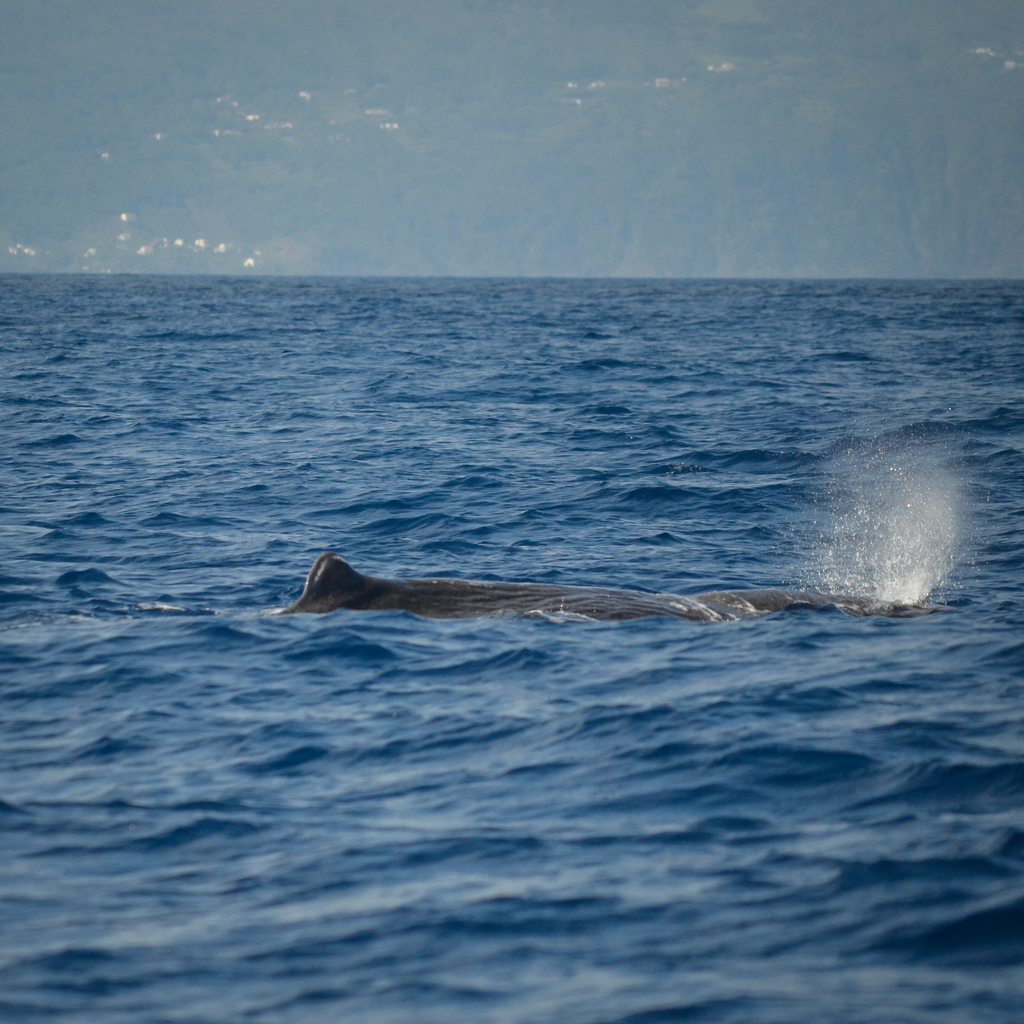
Sperm Whale
Photo © João Fortuna
Photo © João Fortuna — CC BY 4.0 — Source: iNaturalist #20370381Identification
The sperm whale is the largest of all toothed whales and the largest toothed predator on Earth. Mature males average 16 metres in length, with a distinctively enormous head that can represent up to one-third of the animal's total body length. This massive cranium is filled with spermaceti, a semi-liquid waxy substance that gives the species its name. The sperm whale has visible teeth only in its lower jaw, a feature reflected in one of its alternative scientific names, catodon, meaning 'down-tooth'. Its alternative common name, cachalot, derives from archaic words for tooth or big head across Romance and possibly Basque languages.
The sperm whale possesses the largest brain on Earth—more than five times heavier than a human brain. These remarkable marine mammals can live 70 years or more, making them long-lived inhabitants of the world's oceans.
Range & Habitat
The sperm whale is a pelagic mammal with a worldwide range. It is highly migratory, moving seasonally to exploit feeding and breeding opportunities across ocean basins. This cosmopolitan distribution makes it one of the most widespread cetaceans, found in both hemispheres wherever suitable deep-water habitat exists.
Behaviour & Diet
Sperm whales display fascinating social structures that differ markedly by sex. Females and young males live together in stable groups, while mature bulls (males) adopt a solitary lifestyle except during the mating season. Females cooperate to protect and nurse their young, giving birth every four to twenty years and caring for calves for more than a decade. A mature, healthy sperm whale has no natural predators, though calves and weakened adults may occasionally be killed by pods of orcas.
These whales are exceptional divers, plunging to depths of 2,250 metres, making them the third deepest diving mammals after the southern elephant seal and Cuvier's beaked whale. They navigate and hunt in the darkness using echolocation and vocalization at source levels as loud as 236 decibels underwater—the loudest of any animal.
Best Time & Places to See It
As a pelagic species with worldwide distribution, sperm whales can be encountered in deep ocean waters across the globe. Their seasonal migrations mean that viewing opportunities vary by location and time of year, with the best encounters typically occurring in areas where whales concentrate for feeding and breeding. Pelagic boat trips departing from coastal regions are the primary way to observe these deep-diving cetaceans.
Photography Tips
Photographing sperm whales presents unique challenges due to their deep-diving behavior and time spent underwater. Patient observation from pelagic vessels is essential, as whales must surface to breathe between dives. The massive head and distinctive body shape provide striking photographic subjects. Capture the dramatic moment of surfacing or the characteristic fluked tail as the whale begins a deep dive. Wide-angle lenses work well for environmental shots of these enormous marine mammals in their ocean habitat.
Northwest Spitsbergen National Park
Norway
+58 birds+17 mammals
Where the High Arctic converges with the Norwegian mainland, Northwest Spitsbergen National Park sprawls across one of Earth's most extreme and pristine wildernesses. Crowned by jagged…
VIEW NATIONAL PARKSchleswig-Holsteinisches Wattenmeer National Park
Germany
+378 birds+49 mammals
Where the North Sea ebbs and flows across a vast expanse of exposed mud and sand, the Schleswig-Holsteinisches Wattenmeer National Park reveals one of Europe's most…
VIEW NATIONAL PARKParque Nacional de Galápagos
Santo Tomás, Ecuador
+139 birds+23 mammals
Volcanic peaks and weathered lava fields dominate this remote archipelago in the Pacific, where the interplay of cold ocean currents and tropical latitude creates an ecological…
VIEW ISLAND & ARCHIPELAGORoyal National Park
Sydney, Australia
+296 birds+46 mammals
Where sandstone ridges plunge toward the Tasman Sea, Royal National Park unfolds across 343 square kilometres of southeastern Australian coastal wilderness. The park's defining character emerges…
VIEW NATIONAL PARKCoffin Bay National Park
Australia
+143 birds+5 mammals
Across South Australia's Eyre Peninsula, where limestone headlands rise above turquoise shallows and eucalypt woodland gives way to coastal heath, lies a 1,319-square-kilometre sanctuary shaped by…
VIEW NATIONAL PARKForlandet National Park
Vera, Norway
+38 birds+12 mammals
Windswept Arctic tundra meets jagged coastal cliffs where the Barents Sea crashes against Norway's northernmost wilderness. This sliver of protected terrain on the Nordkapp Peninsula comprises…
VIEW NATIONAL PARKCabo de Hornos National Park
Cape Horn, Chile
+88 birds+9 mammals
Where the Andes plunge into the Southern Ocean and the Drake Passage churns between two continents, Cabo de Hornos National Park sprawls across one of Earth's…
VIEW NATIONAL PARKEstrecho Natural Park
Pedro Valiente, Spain
+281 birds+20 mammals
Where Mediterranean pine forests meet wind-sculpted coastal cliffs, one of Europe's most dynamic ecological crossroads unfolds across the Strait of Gibraltar. Spanning 686 square kilometers of…
VIEW NATURAL PARKGreat Otway National Park
Australia
+255 birds+42 mammals
Temperate rainforest and wet eucalyptus woodland cloak the ridges and gullies of Victoria's Great Otway National Park, where persistent moisture and mild year-round temperatures sustain a…
VIEW NATIONAL PARKPort-Cros National Park
Hyères, France
+271 birds+29 mammals
Where Mediterranean granite islands rise from crystalline waters off the Provençal coast, Port-Cros National Park protects one of Europe's most intact marine and terrestrial ecosystems. The…
VIEW NATIONAL PARKCalanques National Park
Bouches-du-Rhône, France
+233 birds+42 mammals
Where limestone cliffs plunge dramatically into crystalline Mediterranean waters, Calanques National Park preserves one of Europe's most striking coastal landscapes. These steep-sided inlets, carved by erosion…
VIEW NATIONAL PARKAlaska Maritime National Wildlife Refuge
Alaska, United States
+391 birds+58 mammals
Where the North Pacific collides with Alaska's rugged coastline, a sprawling archipelago of islands, rocky outcrops, and coastal headlands forms one of North America's most remote…
VIEW WILDLIFE SANCTUARYNo community photos yet. Log in to add the first one.
No community observations of this species yet.