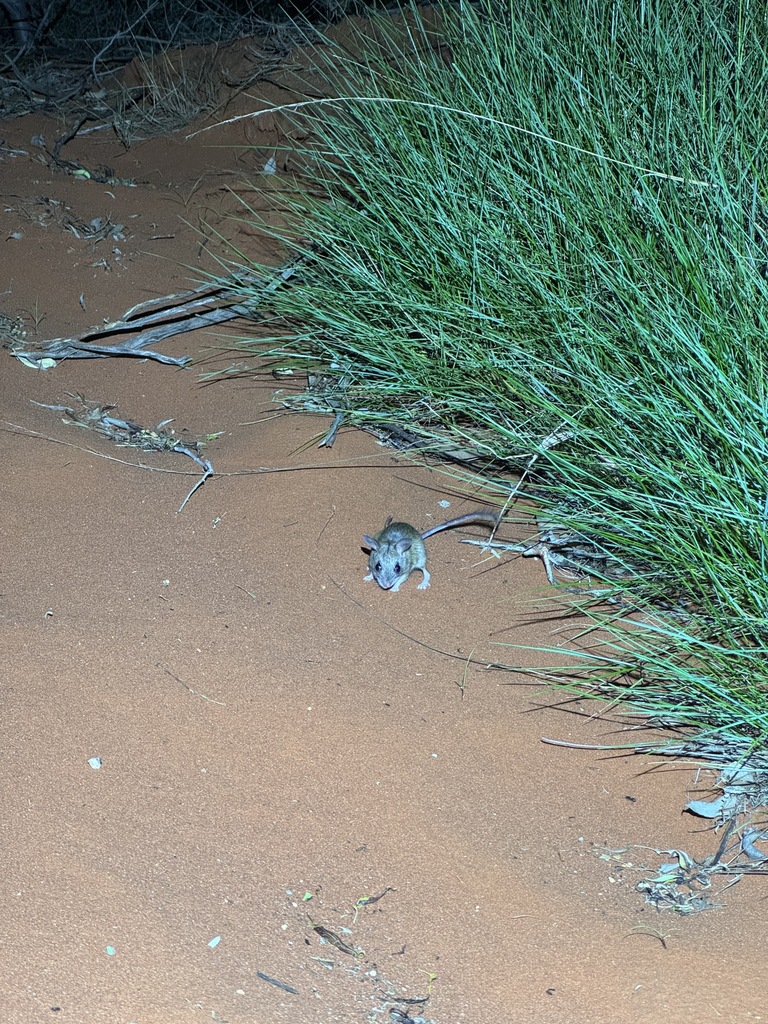
Spinifex Hopping Mouse
Photo © Lawrence Hylton
Photo © Lawrence Hylton — CC BY 4.0 — Source: iNaturalist #340687292The spinifex hopping mouse (Notomys alexis), also known as the tarkawara or tarrkawarra, occurs throughout the central and western Australian arid zones, occupying both spinifex-covered sand flats and stabilised sand dunes, and loamy mulga and melaleuca flats. The population fluctuates greatly: in normal years it is sparsely distributed and probably confined to sandy country; after rain the population explodes and spreads to other types of habitat for a time. They are mostly seen at night, bounding across open ground on their large hind feet, with tails extended and the body almost horizontal. As semi-fossorial, burrowing surface foragers, the tiny hopping mice spend a great deal of energy not just foraging for food, but also transporting it back to their burrows. In fact, it was found that the total energy spent on transporting food in relation to energy investment on burrows far outweighed any other similar type of species. == Appearance == The appearance is very similar to the northern hopping mouse: slightly larger than a common house mouse at 95 to 115 mm (3.7 to 4.5 in) head-body length and an average weight of 35 g (1.2 oz). As with all hopping mice, the hind legs are greatly elongated, the…
Uluru-Kata Tjuta National Park
Petermann, Australia
+146 birds+10 mammals
Uluru-Kata Tjuta National Park is one of Australia’s most iconic protected areas, renowned for its breathtaking desert landscapes, extraordinary geological formations, and deep cultural significance. Located…
VIEW NATIONAL PARKCape Range National Park
Australia
+159 birds+15 mammals
Where arid limestone ridges plunge toward turquoise waters, Cape Range National Park frames one of Australia's most dramatic desert-ocean interfaces. The park's spine—a stark, weathered range…
VIEW NATIONAL PARKNo community photos yet. Log in to add the first one.
No community observations of this species yet.