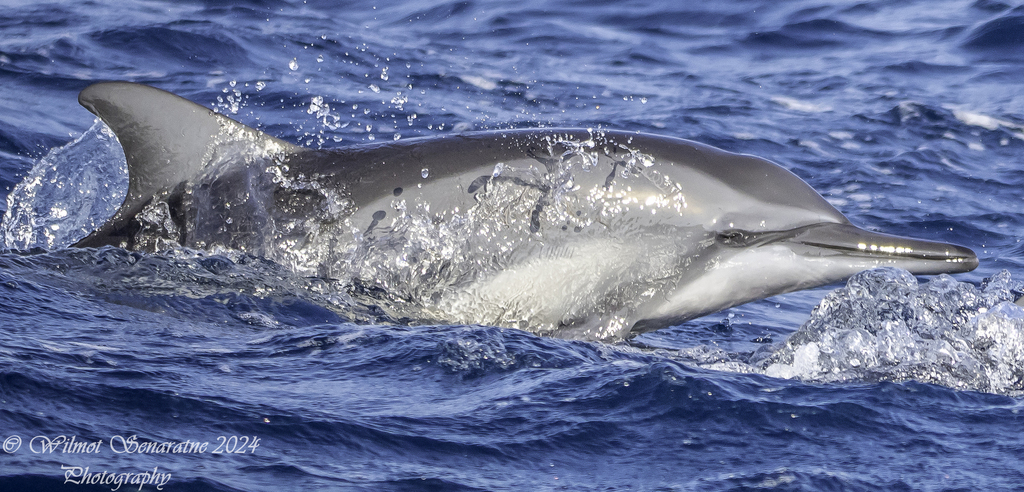
Spinner Dolphin
Photo © wilmotsenaratne
Photo © wilmotsenaratne — CC0 1.0 — Source: iNaturalist photo #676983556The spinner dolphin (Stenella longirostris) is a small dolphin found in off-shore tropical waters around the world. It is famous for its acrobatic displays in which it rotates around its longitudinal axis as it leaps through the air. It is a member of the family Delphinidae of toothed whales. == Taxonomy == The spinner dolphin is sometimes referred to as the long-snouted dolphin, particularly in older texts, to distinguish it from the similar Clymene dolphin, which is often called the short-snouted spinner dolphin. The species was described by John Gray in 1828. The four named subspecies are: Eastern spinner dolphin (S. l. orientalis), from the tropical eastern Pacific. Central American or Costa Rican spinner dolphin (S. l. centroamericana), also found in the tropical eastern Pacific. Gray's or Hawaiian spinner dolphin (S. l. longirostris), from the central Pacific Ocean around Hawaii but represents a mixture of broadly similar subtypes found worldwide. Dwarf spinner dolphin (S. l. roseiventris), first found in the Gulf of Thailand. There could however, be more subspecies currently undescribed, and more research is needed in this topic. A hybrid form between the Gray's Spinner and Eastern Spinner called the White-Bellied Spinner lives in the eastern Pacific, characterized by…
Manuel Antonio National Park
Quepos, Costa Rica
+426 birds+22 mammals
Where tropical rainforest descends steeply to a rocky Pacific coastline, Manuel Antonio National Park distills Central American biodiversity into one of Costa Rica's most compressed and…
VIEW NATIONAL PARKKomodo National Park
Komodo, Indonesia
+155 birds+14 mammals
Where volcanic peaks rise dramatically from turquoise waters, a primordial landscape unfolds across three main islands and countless smaller ones scattered throughout the Lesser Sunda archipelago.…
VIEW NATIONAL PARKNo community photos yet. Log in to add the first one.
No community observations of this species yet.