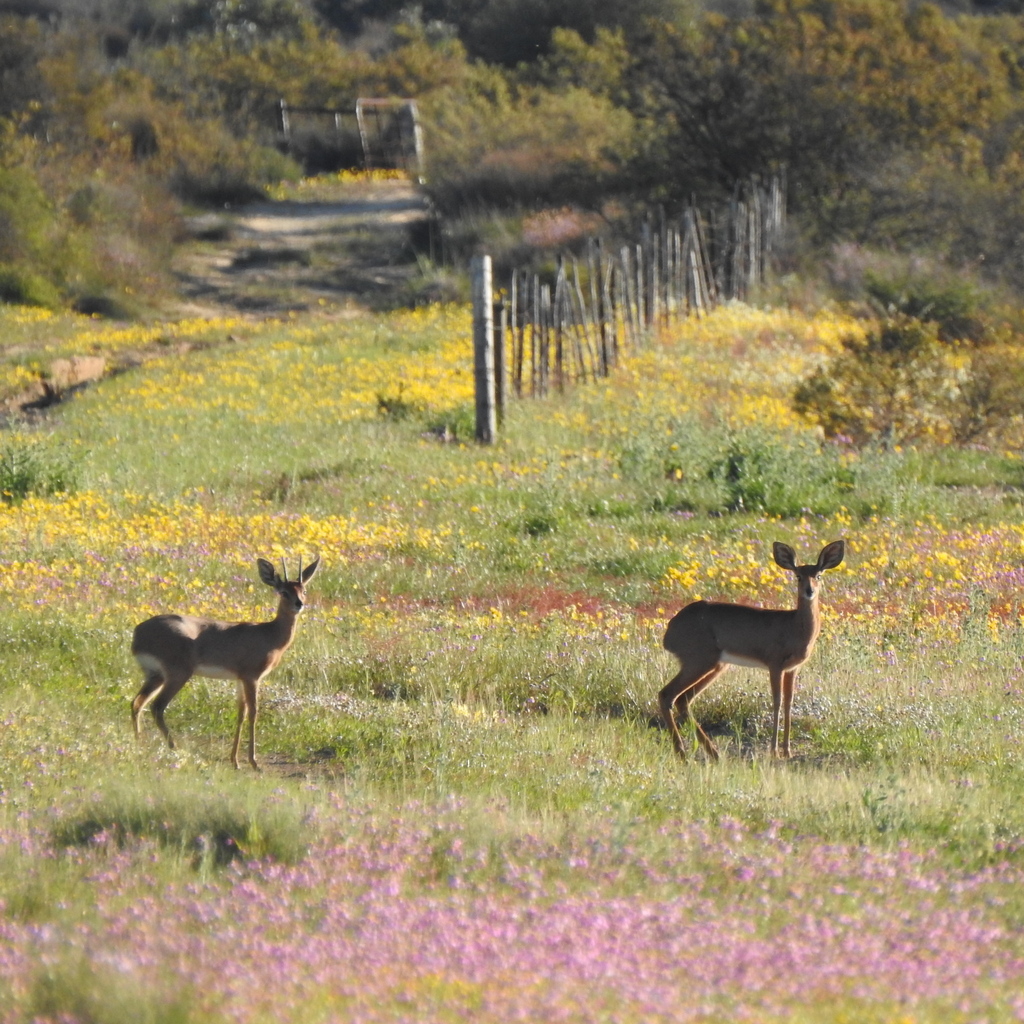
Steenbok
Photo © Noeleen du Toit
Photo © Noeleen du Toit — CC BY-SA 4.0 — Source: iNaturalist #182095333Identification
The steenbok is a diminutive antelope, standing just 45–60 cm at the shoulder and weighing 7–16 kg, making it one of Africa's smallest ungulates. Its coat ranges from fawn to rufous, typically displaying an orange tone, with a distinctive white underside, chin, and throat. A white ring encircles each eye, and the large ears bear characteristic "finger-marks" on their inner surfaces. Males carry straight, smooth, parallel horns measuring 7–19 cm in length.
Several striking facial markings distinguish the steenbok: a black crescent-shape between the ears, a long black bridge leading to a glossy black nose, and a prominent black circular scent-gland in front of each eye. The tail is barely noticeable at just 4–6 cm long, rarely visible in the field. Its small stature and refined features recall the oribi, though the steenbok is distinctly smaller.
Range & Habitat
Steenbok occur in two separate geographic clusters across Africa. In East Africa, they inhabit central and southern Kenya and northern Tanzania, though they were once widespread in Uganda and are now almost certainly extinct there. In Southern Africa, they are found throughout Angola, Namibia, South Africa, Eswatini, Botswana, Mozambique, Zambia, Zimbabwe, and probably Lesotho.
These adaptable antelopes thrive in diverse habitats ranging from semi-desert regions such as the edge of the Kalahari Desert and Etosha National Park to open woodland, thickets, plains, stony savannah, and Acacia–grassland mosaics. They show a preference for unstable or transitional habitats. In Kruger National Park, steenbok favour Acacia tortilis savannah year-round, showing no seasonal migration pattern. Population densities typically range from 0.3–1.0 individuals per square kilometre, though optimal habitats may support up to 4 per km².
Behaviour & Diet
Steenbok are active both day and night, though during hot periods they rest in shade. Feeding activity increases at night during the dry season. These small antelopes are primarily browsers, feeding on low-level vegetation up to 0.9 m high, and are skilled at scraping up roots and tubers. They show a strong preference for forbs, supplemented with woody plants when forbs are scarce, and occasionally take fruits. They rarely graze on grass and are almost entirely independent of drinking water, obtaining sufficient moisture from their food.
Typically solitary, steenbok pairs come together only to mate, though they may occupy consistent territories while living independently and maintain contact through scent markings via dung middens. When threatened, they initially lie low in vegetation; if danger persists, they leap away in zigzag patterns to evade predators, frequently stopping to look back. They are known to seek refuge in aardvark burrows. Predators include caracal, jackals, leopard, martial eagle, and Southern African rock pythons.
Best Time & Places to See It
Steenbok are most active during early morning and late afternoon hours, making these prime times for observation. They are widespread across numerous protected areas, particularly in Southern Africa. Etosha National Park in Namibia and Kruger National Park in South Africa offer reliable opportunities, with Kruger's varied habitats—especially Acacia tortilis savannah—being particularly favourable. The open woodlands and grassland mosaics across Botswana, Zimbabwe, and other range countries also provide good viewing potential.
Unlike many larger African ungulates, steenbok do not migrate seasonally in response to rainfall, so they can be encountered year-round in suitable habitats. However, their small size and preference for dense vegetation make them challenging to spot. Patient scanning of open plains and woodland edges during cooler parts of the day increases your chances of encountering these elusive antelopes.
Photography Tips
The steenbok's small stature and cryptic behaviour demand patience and a telephoto lens—at least 400–500 mm is recommended to capture satisfying frame-filling images from a distance that won't disturb them. Early morning and late afternoon light will illuminate the orange-fawn coat beautifully and highlight the distinctive facial markings: the black crescent between the ears, the nose, and the eye-patch.
Since steenbok often freeze when alarmed before fleeing, you may have brief opportunities for shots if you spot them first and remain still. Their habit of pausing to look back during escape provides another potential moment to capture movement. Photographing males displaying their small but elegant horns and the white underparts requires positioning; shooting from a low angle can enhance these features. The contrasting facial pattern—white eye-rings against the darker coat—makes for striking detail shots if you can achieve adequate magnification and focus.
Serengeti National Park
Tanzania
+558 birds+57 mammals
Across Tanzania's northern plateau, where volcanic soils meet acacia woodland and open grassland, unfolds one of Earth's most dynamic ecosystems. The Serengeti National Park sprawls across…
VIEW NATIONAL PARKMapungubwe National Park
Musina Local Municipality, South Africa
+358 birds+29 mammals
Where the Limpopo River cuts through sandstone ridges at the convergence of South Africa, Botswana, and Zimbabwe, Mapungubwe National Park preserves a landscape of profound ecological…
VIEW NATIONAL PARKChobe National Park
Botswana
+446 birds+45 mammals
Where the Chobe River cuts a sinuous path through northern Botswana, the landscape transforms into one of Africa's most dynamic wetland-savanna mosaics. This national park encompasses…
VIEW NATIONAL PARKKhaudum National Park
Botswana
+213 birds+13 mammals
Where the Okavango's northern tributaries meander through miombo woodland and riverine forest, Khaudum National Park unfolds across a landscape of profound ecological richness and isolation. This…
VIEW NATIONAL PARKTsavo East National Park
Athi ward, Kenya
+468 birds+50 mammals
Across the semi-arid lowlands of southeastern Kenya, where acacia woodland fragments into scrubland and the landscape rolls toward the Indian Ocean horizon, lies one of Africa's…
VIEW NATIONAL PARKTsavo West National Park
Mwatate, Kenya
+513 birds+49 mammals
Where volcanic ridges and weathered lava flows meet the semi-arid lowlands of south-central Kenya, Tsavo West National Park unfolds across a landscape sculpted by fire and…
VIEW NATIONAL PARKTarangire National Park
Tanzania
+527 birds+50 mammals
Acacia woodland and grassland sweep across the Manyara Region where the Tarangire River carves through low hills and volcanic soils, creating one of East Africa's most…
VIEW NATIONAL PARKNgorongoro Conservation Area
Tanzania
+626 birds+55 mammals
Volcanic calderas and open grassland dominate this high plateau in northern Tanzania, where the landscape rises above 2,000 metres and ancient geological forces have shaped both…
VIEW WILDLIFE MANAGEMENT AREAPilanesberg National Park
Moses Kotane Local Municipality, South Africa
+364 birds+49 mammals
Granite peaks and volcanic ridges rise unexpectedly from the savanna floor across this 734-square-kilometre expanse in the North West province, creating a landscape of profound ecological…
VIEW NATIONAL PARKMokala National Park
Siyancuma Local Municipality, South Africa
+246 birds+35 mammals
Across the semi-arid savanna of the Northern Cape, where red earth meets sparse acacia woodland and open grassland punctuated by rocky outcrops, lies a landscape shaped…
VIEW NATIONAL PARKKruger National Park
Ba-Phalaborwa Local Municipality, South Africa
+540 birds+91 mammals
Across the low-lying savanna of northeastern South Africa unfolds one of Africa's largest and most ecologically intact protected areas, where acacia woodlands merge into mopane scrub…
VIEW NATIONAL PARKAgulhas National Park
Cape Agulhas Local Municipality, South Africa
+224 birds+13 mammals
Where the Atlantic and Indian Oceans meet at Africa's southernmost tip, Agulhas National Park stretches across 892 square kilometres of windswept coastal landscape and rugged limestone…
VIEW NATIONAL PARKTankwa-Karoo National Park
Hantam Local Municipality, South Africa
+201 birds+20 mammals
Across the semi-arid heartland of the Northern Cape, where winter rains carve ephemeral watercourses through endless ochre plains, Tankwa-Karoo National Park sprawls across more than 3,100…
VIEW NATIONAL PARKMountain Zebra National Park
Inxuba Yethemba Local Municipality, South Africa
+265 birds+35 mammals
Across the windswept plateaus and deeply incised valleys of the Eastern Cape's interior, Mountain Zebra National Park unfolds as a landscape of geological drama and ecological…
VIEW NATIONAL PARKAugrabies Falls National Park
Kai !Garib Local Municipality, South Africa
+176 birds+20 mammals
Where the Orange River cuts a dramatic scar through the Northern Cape's arid interior, Augrabies Falls National Park sprawls across nearly 1,200 square kilometers of raw,…
VIEW NATIONAL PARKAddo Elephant National Park
Sundays River Valley Local Municipality, South Africa
+388 birds+55 mammals
Where the Eastern Cape's semi-arid scrublands meet transitional woodland, Addo sprawls across 13,478 square kilometres of one of southern Africa's most biodiverse landscapes. The terrain rises…
VIEW NATIONAL PARKMarakele National Park
Modimolle Local Municipality, South Africa
+341 birds+36 mammals
Granite ridges and sprawling grasslands dominate this 1,176-square-kilometre reserve in Limpopo's heartland, where bushveld transitions between rocky outcrops and open savanna. The park's rugged topography creates…
VIEW NATIONAL PARKCamdeboo National Park
Camdeboo Local Municipality, South Africa
+272 birds+24 mammals
Granite ridges and weathered sandstone cliffs rise across a semi-arid landscape where the Karoo transitions into the eastern escarpment of South Africa, creating Camdeboo National Park's…
VIEW NATIONAL PARKKhaudum National Park
Namibia
+221 birds+13 mammals
Where the Kavango River flows through northeastern Namibia, vast miombo woodlands and riverine forests create one of southern Africa's most remote and biodiverse wilderness corridors. Khaudum…
VIEW NATIONAL PARKSperrgebiet National Park
Barcelona, Namibia
+181 birds+18 mammals
Where the Namib's ancient gravel plains meet the Atlantic coast, one of Africa's most remote and geologically austere landscapes unfolds across more than 56,000 square kilometres.…
VIEW NATIONAL PARKDorob National Park
Henties Bay, Namibia
+230 birds+13 mammals
Where the Skeleton Coast meets the Namib Desert's inland reaches, Dorob National Park sprawls across 34,021 square kilometres of one of southern Africa's most austere and…
VIEW NATIONAL PARKNamib-Naukluft National Park
Namibia
+217 birds+33 mammals
Across nearly 94,000 square kilometers of southwestern Namibia, a landscape of extremes unfolds where towering sand dunes meet rugged mountain ranges, and ancient riverbeds carve through…
VIEW NATIONAL PARKEtosha National Park
Namibia
+356 birds+58 mammals
Across northern Namibia's stark semi-arid plateau, a vast shallow depression transforms seasonally into one of Africa's most dramatic wildlife theaters. Etosha National Park, encompassing more than…
VIEW NATIONAL PARKNamibRand Nature Reserve
Hammerstein, Namibia
+107 birds+12 mammals
Where rust-coloured dunes surrender to sculpted granite outcrops and vast plains stretch toward an endless horizon, one of southern Africa's most pristine wilderness areas unfolds. The…
VIEW NATURE RESERVEMakgadikgadi Pans National Park
Gucta, Botswana
+272 birds+27 mammals
Where salt-crusted flatlands stretch endlessly toward a shimmering horizon, one of Africa's most extraordinary ecosystems awakens with the rains. The Makgadikgadi Pans comprise vast mineral-rich basins…
VIEW NATIONAL PARKChyulu Hills National Park
Kibwezi East, Kenya
+232 birds+30 mammals
Volcanic cones rise abruptly from the Kenyan savanna floor, their flanks clothed in dense acacia woodland and grassland that transforms the Chyulu Hills into an ecological…
VIEW NATIONAL PARKNo community photos yet. Log in to add the first one.
No community observations of this species yet.