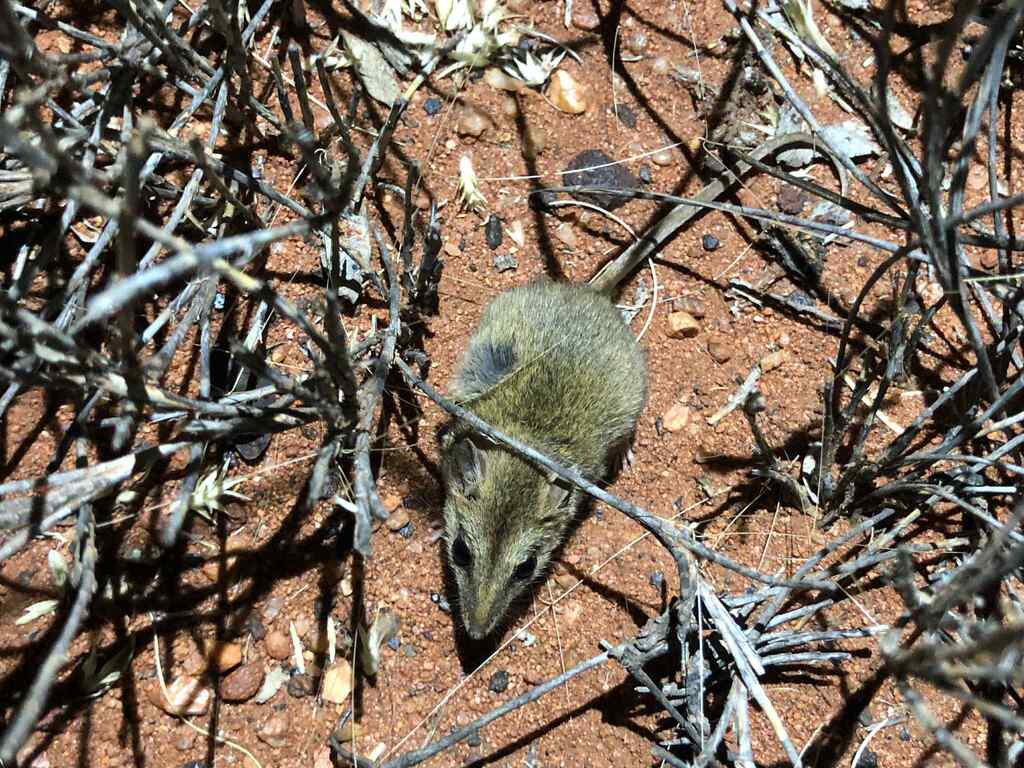
Stripe-faced Dunnart
Photo © Connor Margetts
Photo © Connor Margetts — CC0 1.0 — Source: iNaturalist #301493887The striped-faced dunnart (Sminthopsis macroura) is a small, Australian, nocturnal, "marsupial mouse," part of the family Dasyuridae. The species' distribution occurs throughout much of inland central and northern Australia, occupying a range of arid and semi-arid habitats. While the species has a broad distribution range, it has been declining across much of Australia, including the western region of New South Wales (NSW). This is due to several threatening processes, primarily habitat degradation. This has led to the NSW Office of Environment and Heritage listing the species as 'vulnerable'. The species is not listed on the Environment Protection and Biodiversity Conservation Act 1999 (EPBC Act). The International Union for Conservation of Nature (IUCN) Red List of Threatened Species list the species as of 'least concern'. Recent genetic studies have discovered that this dunnart species is in fact three distinct species that over several million years diverged from each other. However, because they are difficult to distinguish, they tend to be treated as a single species. The three subspecies are as follows: Sminthopsis macroura macroura in central, eastern, and western Australia S.m. stalkeri in central northern Australia S.m. froggatti in the Kimberley region == Description == The stripe-faced dunnart has an average…
Karijini National Park
Australia
+117 birds+5 mammals
Ochre ridges and rust-coloured gorges slice through the Pilbara's ancient landscape, where Karijini National Park sprawls across a wilderness of iron-rich plateaus and plunging ravines carved…
VIEW NATIONAL PARKCape Range National Park
Australia
+159 birds+15 mammals
Where arid limestone ridges plunge toward turquoise waters, Cape Range National Park frames one of Australia's most dramatic desert-ocean interfaces. The park's spine—a stark, weathered range…
VIEW NATIONAL PARKNo community photos yet. Log in to add the first one.
No community observations of this species yet.