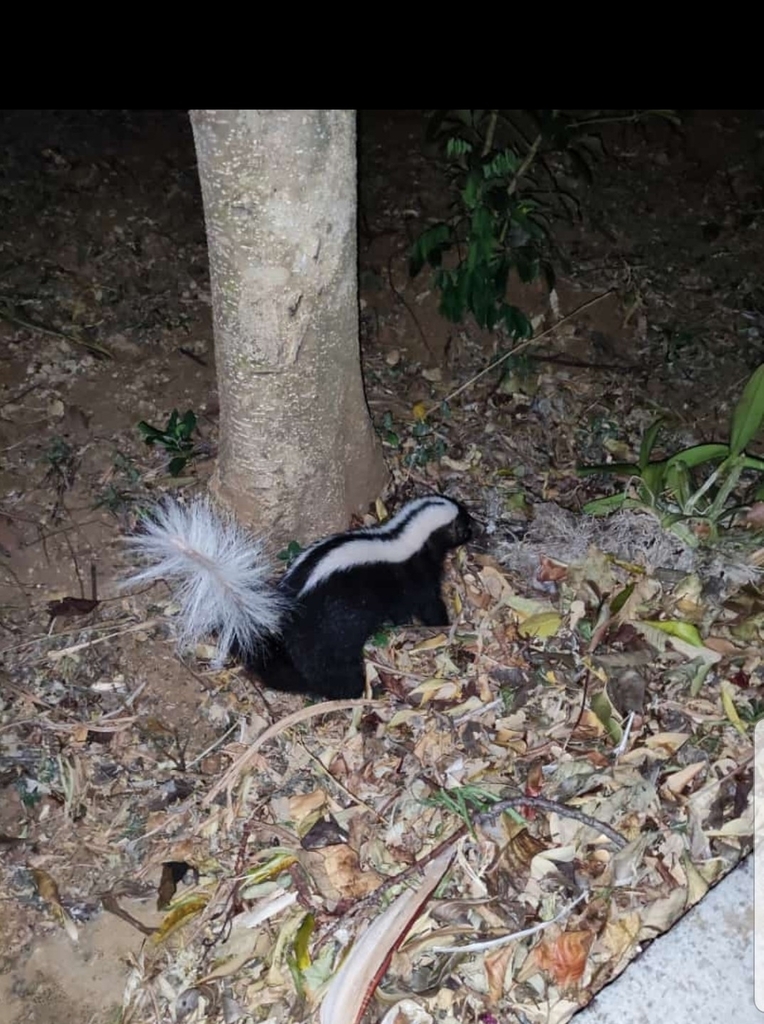
Striped Hog-nosed Skunk
Photo © geralg
Photo © geralg — CC0 1.0 — Source: iNaturalist photo #265696693The striped hog-nosed skunk (Conepatus semistriatus) is a skunk species that is found in Central and South America. It is distributed from southern Mexico to northern Peru, and in a pocket in the extreme east of Brazil. They live in a wide range of habitats such as dry forests, orchards, and occasionally in rainforests. It is classified as least concern in the IUCN Red List. == Taxonomy == The striped hog-nosed skunk (Conepatus semistriatus) belongs to the genus Conepatus. It comes under the family Mephitidae, which includes skunks and stink badgers. It was first described by Pieter Boddaert in 1785. == Distribution and habitat == The range of striped hog-nosed skunk extends from southern Mexico in Central America to northern Peru in South America, and in a pocket in the extreme east of Brazil. They live in a wide range of habitats, including arboreal caatingas, orchards, and dry forest scrubs, grasslands, and occasionally, in rainforests. In the wet season, they prefer higher grounds in deciduous forests. They usually reside in small dens made from fallen tree logs or burrows of about 1–2 m (3 ft 3 in – 6 ft 7 in) length dug below the surface. They also use…
Corcovado National Park
Puerto Jiménez, Costa Rica
+444 birds+48 mammals
Where the Osa Peninsula juts into the Pacific, rainforest descends almost to the tide line, and Corcovado National Park protects one of Central America's most intact…
VIEW NATIONAL PARKAntisana National Park
Quijos, Ecuador
+432 birds+21 mammals
Where the eastern Andean slopes descend into the Amazon basin, Antisana National Park sprawls across roughly 2,500 square kilometers of some of South America's most dramatic…
VIEW NATIONAL PARKMontes Azules
Candelaria, Mexico
+395 birds+47 mammals
Where jungle-clad limestone plateaus plunge into canyon systems carved by the Usumacinta River, Mexico's most pristine rainforest reserve unfolds across the Lacandón region of Chiapas. Montes…
VIEW BIOSPHERE RESERVECarara National Park
Tárcoles, Costa Rica
+397 birds+19 mammals
Where the Pacific coastal plain meets transitional forest, Carara National Park straddles one of Central America's most dynamic ecological boundaries. The park's landscape encompasses lowland deciduous…
VIEW NATIONAL PARKNo community photos yet. Log in to add the first one.
No community observations of this species yet.