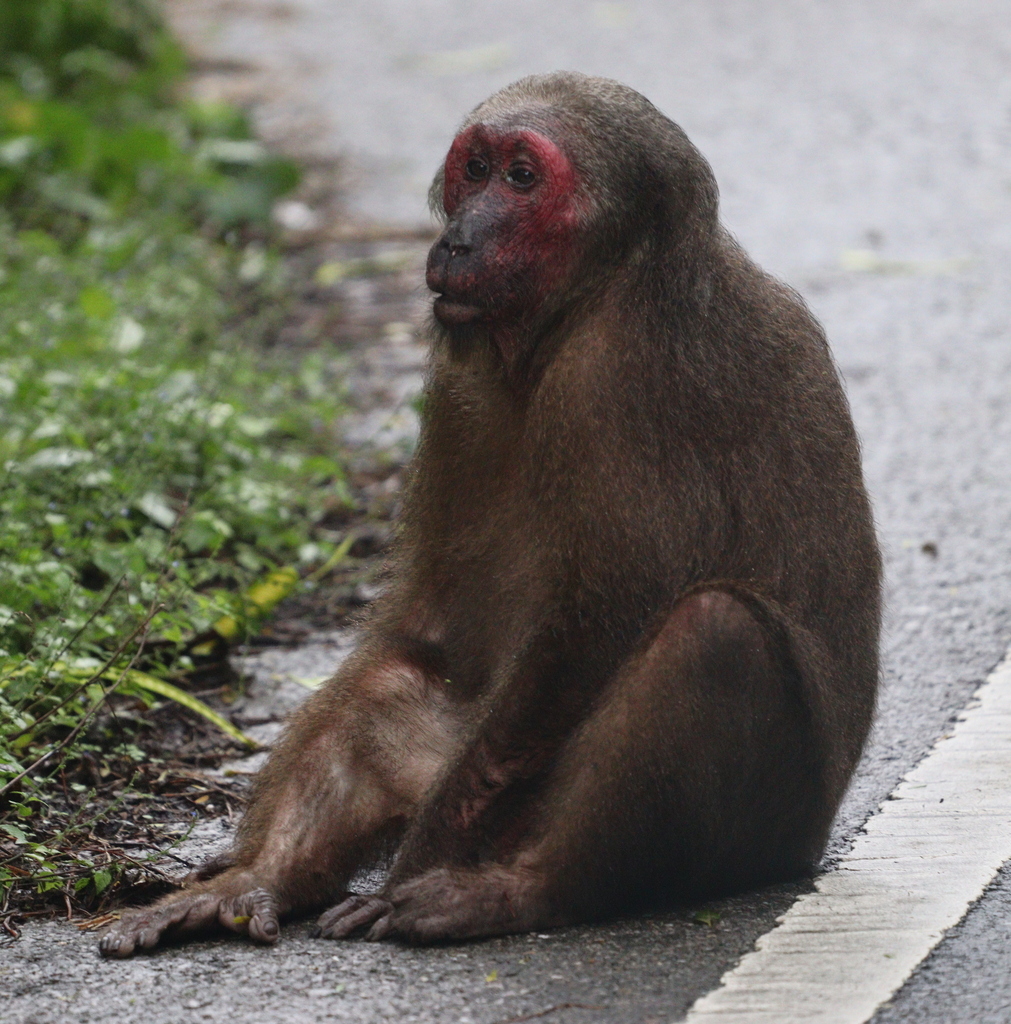
Stump-tailed Macaque
Identification
The stump-tailed macaque, also known as the bear macaque, is a robust primate with a distinctive appearance that varies considerably among individuals. Their most characteristic feature is their remarkably short tail, measuring just 32 to 69 millimetres in length. These monkeys are clothed in long, thick fur that can be gray, brown, reddish, or black, often with freckles or irregular patches across their coat. Their faces may be bright pink or red, though these colors darken to brown or nearly black with age and lose most of their hair as the animals mature.
Sexual dimorphism is pronounced in this species. Males are noticeably larger than females, measuring 51.7–65 centimetres in body length and weighing 9.7–10.2 kilograms, compared to females at 48.5–58.5 centimetres and 7.5–9.1 kilograms. Males also possess more elongated canine teeth, which serve an important role in establishing dominance within their social groups. A striking feature of infants is their white fur, which darkens considerably as they mature. All stump-tailed macaques possess cheek pouches for temporary food storage, a trait shared with other macaque species.
Range & Habitat
Stump-tailed macaques are native to South Asia and Southeast Asia, with their range extending across northeastern India, Myanmar, Thailand, Laos, Cambodia, Vietnam, southern China, and the northwest tip of Peninsular Malaysia. In India specifically, they inhabit areas south of the Brahmaputra River, ranging through Assam, Meghalaya, eastern Arunachal Pradesh, Nagaland, Manipur, Mizoram, and Tripura. They may be extinct in Bangladesh. A notable introduced population exists on Tanaxpillo, an uninhabited island in Lake Catemaco, Veracruz, Mexico, established in 1974.
These monkeys are forest specialists, inhabiting evergreen and tropical and subtropical moist broadleaf forests at elevations up to 4,000 metres. They are highly dependent on rainforests for food and shelter, venturing into secondary forests only when these border old-growth tropical forest. In Cambodia, a population of approximately 230 individuals has been documented in Keo Seima Wildlife Sanctuary.
Behaviour & Diet
Stump-tailed macaques are primarily frugivorous but maintain a diverse diet including seeds, leaves, roots, freshwater crabs, frogs, bird eggs, and insects. Their social structure mirrors that of other macaque species, with females maintaining a linear, hereditary dominance hierarchy while males experience more fluid hierarchies based on fighting ability and social maneuvering. Notably, compared to rhesus and long-tailed macaques, stump-tails are relatively tolerant of group members and employ a surprisingly rich repertoire of reconciliation tactics to defuse intense confrontations.
Female stump-tailed macaques experience two distinct mating seasons annually: one in summer (July–August) and another in fall (November), patterns reflected in their birth frequency distribution.
Best Time & Places to See It
Observing stump-tailed macaques in their natural habitat presents a considerable challenge, as few long-term wild studies have been conducted on this species. Most scientific knowledge derives from introduced populations in captive or seminatural settings, such as those on Tanaxpillo Island in Mexico. For those seeking wild populations, Keo Seima Wildlife Sanctuary in Cambodia offers confirmed sightings, though locating these forest-dependent primates requires patience and expertise. Northeastern Indian states, particularly in primary and old-growth rainforest areas, may also harbour populations, though accessibility and research infrastructure vary considerably.
Photography Tips
The stump-tailed macaque's thick fur, distinctive facial expressions, and varied coloration offer compelling photographic subjects. Their short, stubby tail—the species' defining characteristic—should feature prominently in identification shots. The dramatic colour changes from juvenile white fur to adult darker coats provide opportunities for documenting life stages. Capture the pronounced facial features, particularly the males' prominent canines during social interactions and dominance displays. Forest habitat shots showing their dependence on rainforest canopy and understory are valuable for contextual photography.
Hat Noppharat Thara-Mu Ko Phi Phi National Park
Ao Nang, Thailand
+127 birds+21 mammals
Limestone cliffs plunge into emerald waters where mangrove forests crown the shoreline and coral gardens flourish beneath transparent shallows. This […]
VIEW NATIONAL PARKKhao Laem National Park
Sangkhla Buri District, Thailand
+137 birds+25 mammals
Where limestone peaks rise dramatically above a shimmering reservoir, Thailand’s most compelling freshwater ecosystem unfolds across the Thai-Cambodian borderlands. Khao […]
VIEW NATIONAL PARKKaziranga National Park
Kohora, India
+129 birds+30 mammals
Dawn breaks over the floodplains of the Brahmaputra, where tall grasslands stretch endlessly beneath monsoon-heavy skies. This sprawling wilderness of […]
VIEW NATIONAL PARKNo community photos yet. Log in to add the first one.
No community observations of this species yet.