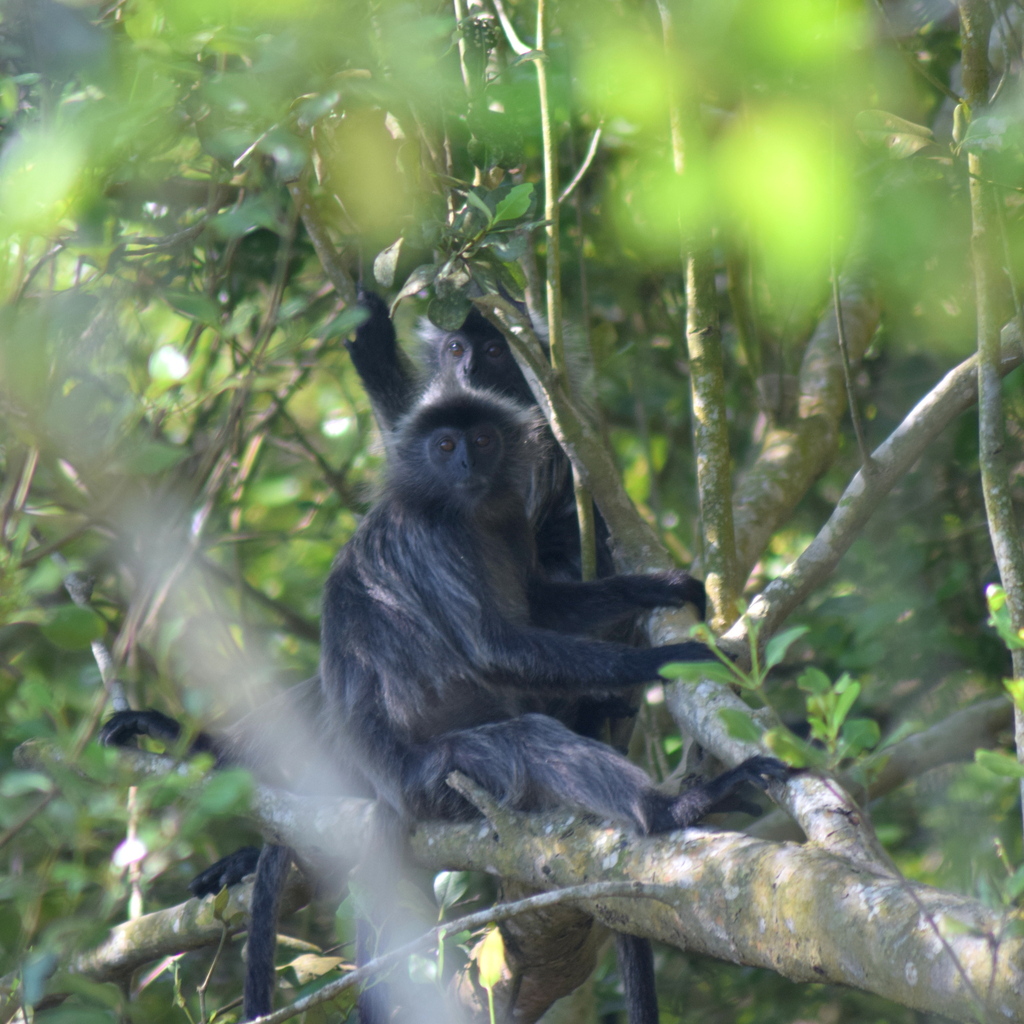
Sunda Silvery Langur
Photo © Hamas Fathani
Photo © Hamas Fathani — CC BY-SA 4.0 — Source: iNaturalist #149957299Identification
The Sunda silvery langur is a medium-sized arboreal monkey distinguished by its distinctive silvery appearance, created by grey-tipped dark brown or black fur that gives a uniform, lustrous finish across the body. Unlike some related species, it lacks paler facial or body markings, though females display a small patch of whitish hair on the groin. A prominent crest of fur runs along the top of the head, and notably long cheek hair often obscures the ears. The hands and feet are hairless with dark-coloured skin and feature opposable thumbs and toes.
Females measure 46–51 centimetres in head-body length, weighing approximately 5.7 kilograms, while males are slightly larger at 50–58 centimetres and 6.6 kilograms. Both sexes share a long, non-prehensile tail measuring 67–75 centimetres. Like other langurs, this species possesses a distinctive three-chambered stomach adapted for fermenting plant matter, alongside an unusually long intestine with pouches for further food processing, and specially modified teeth with grinding ridges for processing tough leaves.
Range & Habitat
The Sunda silvery langur is found across Borneo, Sumatra, and Java, as well as in parts of the southwestern Malay Peninsula, the Natuna Islands, and other nearby islands in Southeast Asia. This species is highly specialized for coastal and riverine environments, inhabiting mangrove swamps and nearby forest regions while generally avoiding travel far from coasts or rivers.
Behaviour & Diet
These diurnal primates are strictly herbivorous, relying on their specialized digestive system to process leaves and plant matter. They travel in groups of around 9–40 individuals, typically comprising one adult male and multiple adult females that communally care for infants. Each group occupies a home range of 20–43 hectares, though these ranges may overlap with neighbouring groups. During the day, individuals may travel up to 500 metres through the forest, with some females forming all-female subgroups that separate from the male-containing group. The entire group shelters together in a single tree at night.
Social structure is matrilineal and harem-based, with females remaining in their birth group for life while males leave after reaching adulthood and form small bachelor groups until acquiring their own harem. Despite male dominance over females and a hierarchy among females based on maternal status, aggression within groups is relatively low compared with some related species. Silvery langurs are highly arboreal and rarely descend to the ground, relying on the trees for protection from terrestrial predators.
Best Time & Places to See It
Sunda silvery langurs are diurnal and can be observed throughout the year in suitable habitat. The best opportunities for viewing occur in mangrove forests and riverine areas across their range, particularly in Borneo and Sumatra where habitat remains relatively intact. Their preference for coastal and riparian environments means looking along river courses and mangrove edges increases chances of sightings, especially in early morning when groups are most active.
Photography Tips
The silvery langur's distinctive grey-tipped fur and prominent head crest make for striking subjects, particularly when backlit to emphasize the silvery sheen. Because these monkeys are highly arboreal and rarely descend to ground level, a telephoto lens is essential for capturing detailed images from below. Early morning light filtering through mangrove or riverside forest canopy can beautifully highlight their silver colouration and the long cheek hair that partially obscures their ears. Patience is rewarded when photographing groups, as the social interactions between females and infants, and the contrast between the dominant male and females, provide compelling compositional opportunities.
Bako National Park
Kuching, Malaysia
+210 birds+17 mammals
Weathered sandstone cliffs rise dramatically from the South China Sea, their ochre faces sculpted by millennia of wind and tide into a landscape of extraordinary geological…
VIEW NATIONAL PARKKuching Wetlands National Park
Kuching, Malaysia
+103 birds+4 mammals
Where brackish waters meet mangrove stilts and freshwater swamps blend into coastal mudflats, one of Southeast Asia's most dynamic wetland ecosystems unfolds across Sarawak's northwestern coast.…
VIEW NATIONAL PARKSembilang National Park
Banyuasin, Indonesia
+56 birds+3 mammals
Where tidal mangroves grade into freshwater swamp forest and the Musi River delta spreads across more than 7,000 square kilometres, Sembilang National Park represents one of…
VIEW NATIONAL PARKWay Kambas National Park
Lampung Timur, Indonesia
+237 birds+20 mammals
Across the low swamplands of eastern Lampung, where freshwater wetlands merge into tidal mangrove forests along the Sunda Strait, sprawls one of Sumatra's most vital sanctuaries.…
VIEW NATIONAL PARKNo community photos yet. Log in to add the first one.
No community observations of this species yet.