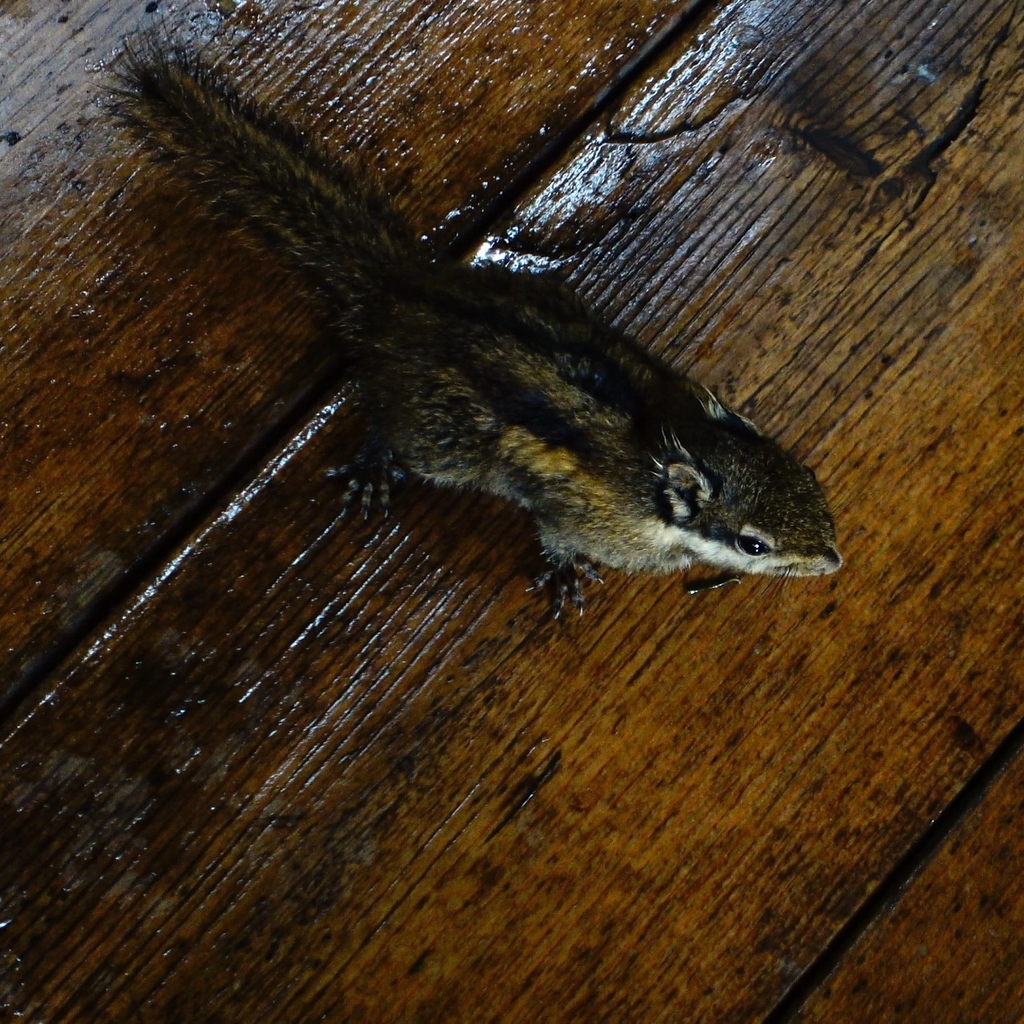
Swinhoe’s Striped Squirrel
Photo © Paul Bernstorff Ehrman
Photo © Paul Bernstorff Ehrman — CC0 1.0 — Source: iNaturalist #291167273Swinhoe's striped squirrel (Tamiops swinhoei) is a small species of rodent in the family Sciuridae. This species is found mostly in China and Southeast Asia. Their diet consists of mostly seeds, fruits, nuts and ginger nectar. Like most squirrels they live in forest areas with mountains, usually in groups. They have litters that average in size of 3.25 offspring. == Physical features == They are small bodied with stripes running from their nose to their neck and a second set that run the length of their body to their tail. The stripes range in color from yellow to brown cinnamon. Small tufts of white fur can be seen on the tips of their ears. They have dense fur to accommodate for the high elevation where they live. Females have a longer tail than males. == Reproduction == Swinhoe's striped squirrels usually breed once every six months. On average they can have 3-6 offspring in a litter. == Diet == Swinhoe's striped squirrel are herbivores. They eat mostly nuts, seeds, fruits, and ginger nectar. They collect their food and store it for later dates when food is scarce. Swinhoe's striped squirrel engages in nectar robbing on several different ginger species. It…
Giant Panda National Park
Mianyang, China
+447 birds+47 mammals
Where the eastern slopes of China's Sichuan plateau descend into cloud-wrapped valleys, one of Asia's most biodiverse landscapes unfolds across more than 350,000 square kilometres. This…
VIEW NATIONAL PARKJiuzhai Valley
Jiuzhaigou County, China
+226 birds+7 mammals
Where crystalline alpine streams cascade through limestone gorges and karst terrain rises in dramatic vertical walls, Jiuzhai Valley unfolds across nearly 1,300 square kilometers of southwestern…
VIEW NATURAL MONUMENTHuanglong Scenic and Historic Interest Area
Ngawa Tibetan and Qiang Autonomous Prefecture, China
+194 birds+7 mammals
Across the high plateau of northwestern Sichuan, a geological wonder unfolds where limestone terraces and mineral-rich springs have sculpted one of China's most distinctive natural monuments.…
VIEW NATURAL MONUMENTBaima Snow Mountain National Nature Reserve
Diqing Tibetan Autonomous Prefecture, China
+204 birds+3 mammals
High-altitude ridges and steep-sided valleys define this reserve in northwestern Yunnan, where elevations surge from around 3,000 metres to peaks above 4,100 metres. The terrain supports…
VIEW NATURE RESERVENo community photos yet. Log in to add the first one.
No community observations of this species yet.