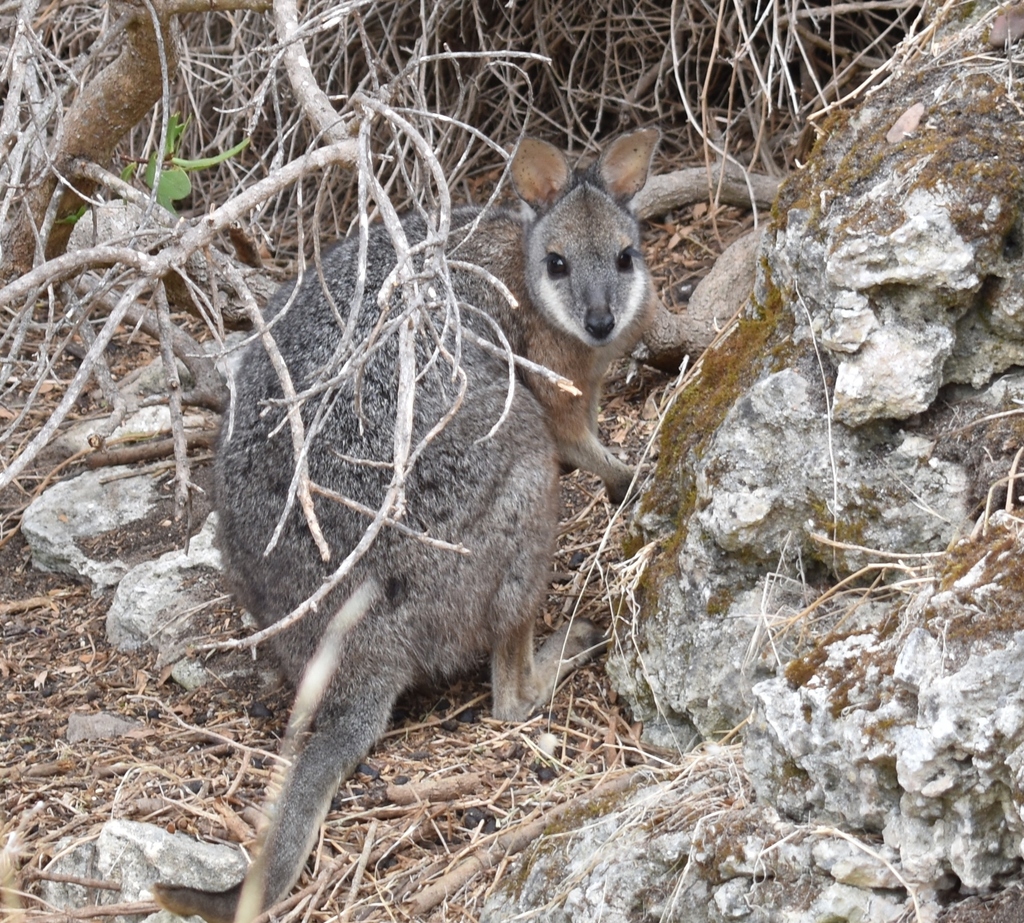
Tammar Wallaby
Photo © Gail A Baker
Photo © Gail A Baker — CC BY 4.0 — Source: iNaturalist #160911769The tammar wallaby (Notamacropus eugenii), also known as the dama wallaby or darma wallaby, is a small macropod native to South and Western Australia. Though its geographical range has been severely reduced since European colonisation, the tammar wallaby remains common within its reduced range and is listed as "Least Concern" by the International Union for Conservation of Nature (IUCN). It has been introduced to New Zealand and reintroduced to some areas of Australia where it had been previously extirpated. Skull variations differentiate between tammar wallabies from Western Australia, Kangaroo Island, and mainland South Australia, making them distinct population groups. The tammar wallaby is among the smallest of the wallabies in the genus Notamacropus. Its coat colour is largely grey. The tammar wallaby has several notable adaptations, including the ability to retain energy while hopping, colour vision, and the ability to drink seawater. A nocturnal species, it spends the nighttime in grassland habitat and the daytime in shrubland. It is also very gregarious and has a seasonal, promiscuous mating pattern. A female tammar wallaby can nurse a joey in her pouch while keeping an embryo in her uterus. The tammar wallaby is a model species for research on marsupials, and on…
Innes National Park
Barcelona, Australia
+141 birds+10 mammals
Granite ridges and weathered stone outcrops rise across South Australia's Fleurieu Peninsula, defining a landscape where ancient rock formations meet open eucalypt woodland and heathland scrub.…
VIEW NATIONAL PARKFlinders Chase National Park
Australia
+142 birds+14 mammals
Granite ridges and windswept mallee scrubland define this 1,630-square-kilometre expanse on Kangaroo Island, where ancient rock formations rise abruptly from coastal heathland and woodland mosaics. The…
VIEW NATIONAL PARKNo community photos yet. Log in to add the first one.
No community observations of this species yet.