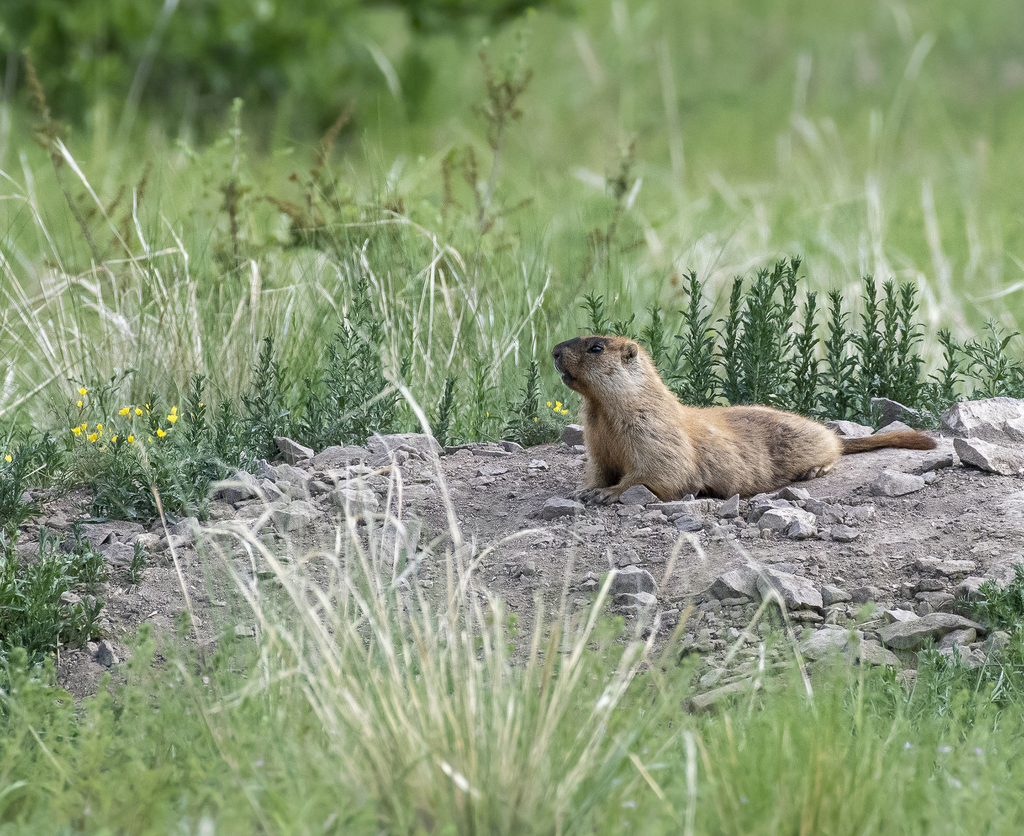
Tarbagan Marmot
Photo © Griha Hasanov
Photo © Griha Hasanov — CC BY 4.0 — Source: iNaturalist #84176097The tarbagan marmot (Marmota sibirica) is a species of rodent in the family Sciuridae. It is found in China (Inner Mongolia and Heilongjiang), northern and western Mongolia, and Russia (southwest Siberia, Tuva, Transbaikalia). In the Mongolian Altai Mountains, its range overlaps with that of the gray marmot. The species was classified as endangered by the IUCN in 2008. Two subspecies are recognized, M. s. sibirica and M. s. caliginosus. == Etymology == The word "tarbagan" comes from Russian тарбаган (tarbagan), which originates from Proto-Mongolic and denotes specific rodent species; it is related to "targa", the word for beaver in the Ulch and Nanai languages. Other names for the tarbagan marmot include Siberian marmot and Mongolian marmot. == Description and ecology == The tarbagan marmot is medium-sized compared to other marmots, with a 0.25 head-to-body ratio. During the summer, its hair is between 11–20 mm and grows up to 30 mm during winter months. Its fur has two separate slate bands, followed by a white band, and its cheeks are yellow. Its zygomatic arches are slightly expanded compared to other marmot species. Populations in western Mongolia tend to have wider skulls compared to other tarbagan marmots. Males tend to weigh more…
Khangai Nuruu National Park
Erdenetsogt, Mongolia
+136 birds+7 mammals
Where granite ridges pierce Mongolia's central steppe, alpine meadows give way to dense coniferous forests that climb toward windswept summits. Khangai Nuruu sweeps across 1.2 million…
VIEW NATIONAL PARKGorkhi-Terelj National Park
Ulaanbaatar, Mongolia
+137 birds+5 mammals
Where granite monoliths rise abruptly from rolling steppe grasslands, Gorkhi-Terelj National Park unfolds across the landscape north of Ulaanbaatar, a sanctuary where forest and alpine meadow…
VIEW NATIONAL PARKHustai National Park
Altanbulag, Mongolia
+198 birds+16 mammals
Where the steppe rolls endlessly beneath vast Mongolian skies, Hustai National Park preserves one of Central Asia's most dynamic grassland ecosystems. Rolling hills and open prairie…
VIEW NATIONAL PARKNo community photos yet. Log in to add the first one.
No community observations of this species yet.