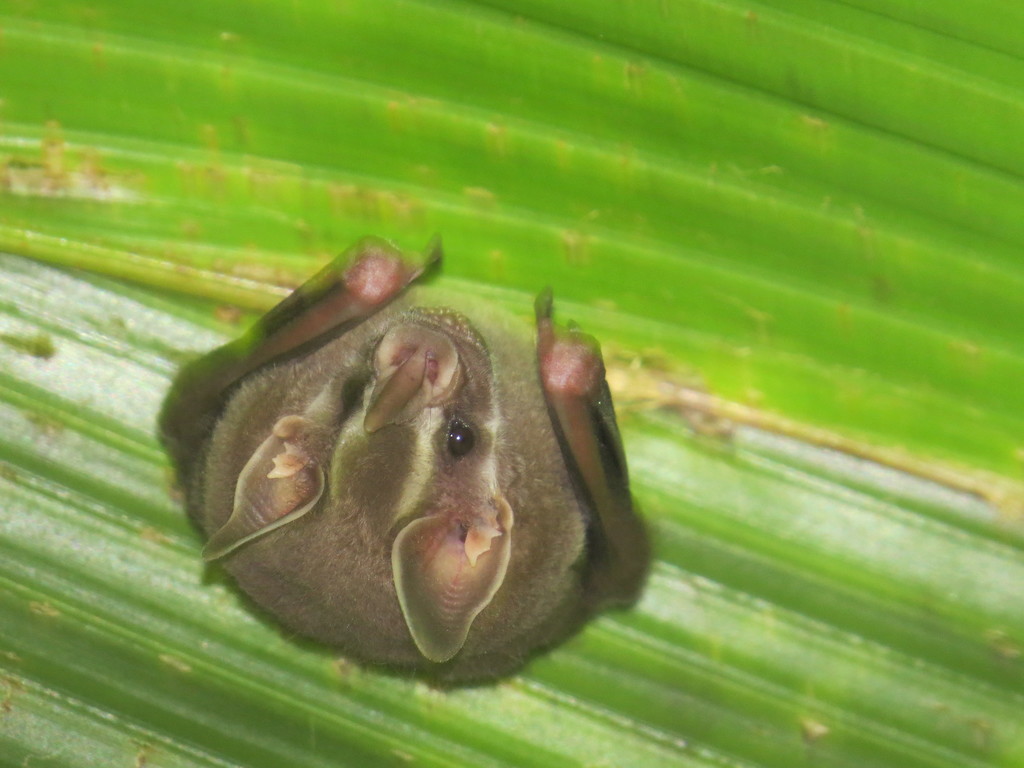
Thomas’s Fruit-eating Bat
Photo © Yves Bas
Photo © Yves Bas — CC BY 4.0 — Source: iNaturalist #41940667Thomas's fruit-eating bat (Dermanura watsoni), sometimes also popularly called Watson's fruit-eating bat, is a species of bat in the family Phyllostomidae. It is found from southern Mexico, through Central America to Colombia. Its South American range is to the west of the Andes. The species name is in honor of H. J. Watson, a plantation owner in western Panama who used to send specimens to the British Natural History Museum, where Oldfield Thomas would often describe them. == Taxonomy == This species was formerly placed in the genus Artibeus, but was reclassified, based on mitochondrial cytochrome b gene sequence data, in 2004. Dermanura, formerly a subgenus of Artibeus, was elevated to a separate genus. The two genera cannot be differentiated by morphology. === Population on Isla Escudo de Veraguas === The population on the small (3.4 km2) island Isla Escudo de Veraguas off the Caribbean coast of Panama was classified as a separate species within the genus (D. incomitata, the solitary fruit-eating bat) in 1994. It had been evaluated as critically endangered by the IUCN, being threatened by habitat loss in addition to the tiny size of its range, as well as a species in danger of imminent extinction by…
Corcovado National Park
Puerto Jiménez, Costa Rica
+444 birds+48 mammals
Where the Osa Peninsula juts into the Pacific, rainforest descends almost to the tide line, and Corcovado National Park protects one of Central America's most intact…
VIEW NATIONAL PARKMontes Azules
Candelaria, Mexico
+395 birds+47 mammals
Where jungle-clad limestone plateaus plunge into canyon systems carved by the Usumacinta River, Mexico's most pristine rainforest reserve unfolds across the Lacandón region of Chiapas. Montes…
VIEW BIOSPHERE RESERVENo community photos yet. Log in to add the first one.
No community observations of this species yet.