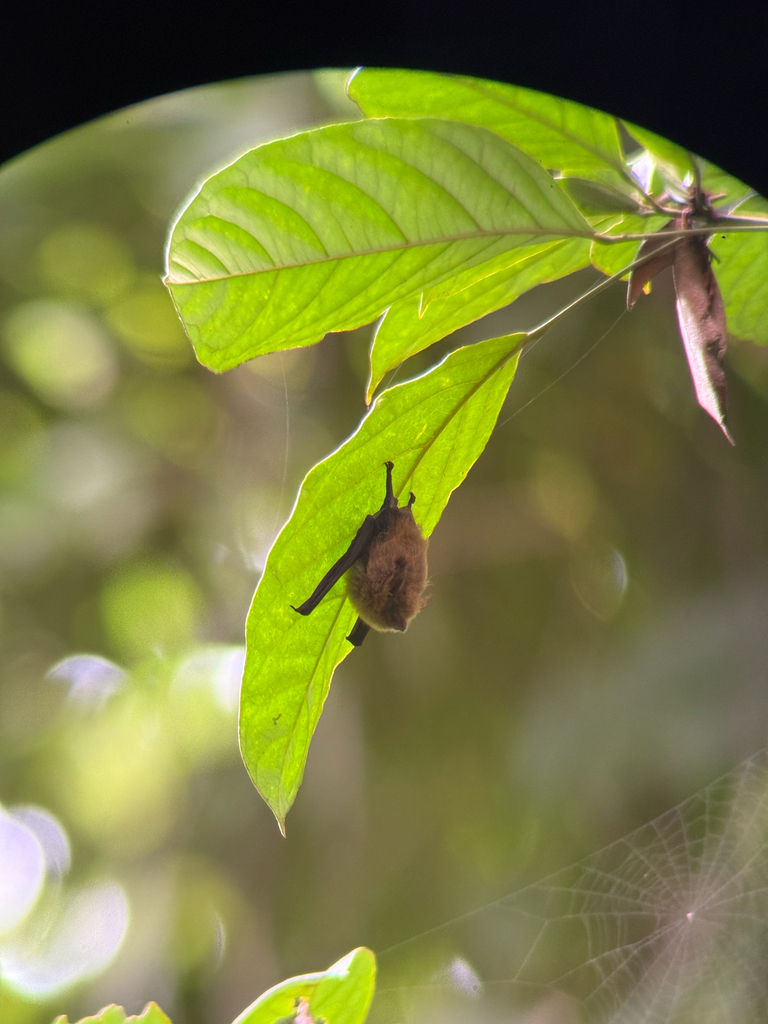
Thomas’s Shaggy Bat
Photo © Tia Tyler
Photo © Tia Tyler — CC0 1.0 — Source: iNaturalist #359797784The Thomas's shaggy bat (Centronycteris centralis) is a bat species from Central and South America. It was previously included in the shaggy bat but Simmons and Handley (1998) showed that the species were distinct. == Taxonomy == It was described as a new species in 1912 by British mammalogist Oldfield Thomas. The holotype had been collected by H. J. Watson in 1898 in Panama. Its species name "centralis" is Latin for "in the middle." == Description == The fur of its back is gray while the fur around its eyes and near its uropatagium is reddish. Its ventral fur is yellowish. Despite being in the sac-winged bat family, it lacks wing sacs. It is a small species, with individuals weighing only 4–6 g (0.14–0.21 oz). Its forearm length is approximately 45 mm (1.8 in). Its dental formula is 1.1.2.33.1.2.3 for a total of 32 teeth. == Biology and ecology == It is nocturnal, roosting in sheltered places during the day such as hollow trees. It forages for its insect prey with a "slow and maneuverable" flight. It is usually found at low elevations of 0–300 m (0–984 ft) above sea level, but has been documented at up 1,450 m (4,760…
Corcovado National Park
Puerto Jiménez, Costa Rica
+444 birds+48 mammals
Where the Osa Peninsula juts into the Pacific, rainforest descends almost to the tide line, and Corcovado National Park protects one of Central America's most intact…
VIEW NATIONAL PARKSoberanía National Park
Cristóbal, Panama
+495 birds+34 mammals
Rainforest and riverine woodland blanket the rolling terrain of this 714-square-kilometre national park in Colón Province, where the Caribbean watershed feeds a maze of streams and…
VIEW NATIONAL PARKCarara National Park
Tárcoles, Costa Rica
+397 birds+19 mammals
Where the Pacific coastal plain meets transitional forest, Carara National Park straddles one of Central America's most dynamic ecological boundaries. The park's landscape encompasses lowland deciduous…
VIEW NATIONAL PARKNo community photos yet. Log in to add the first one.
No community observations of this species yet.