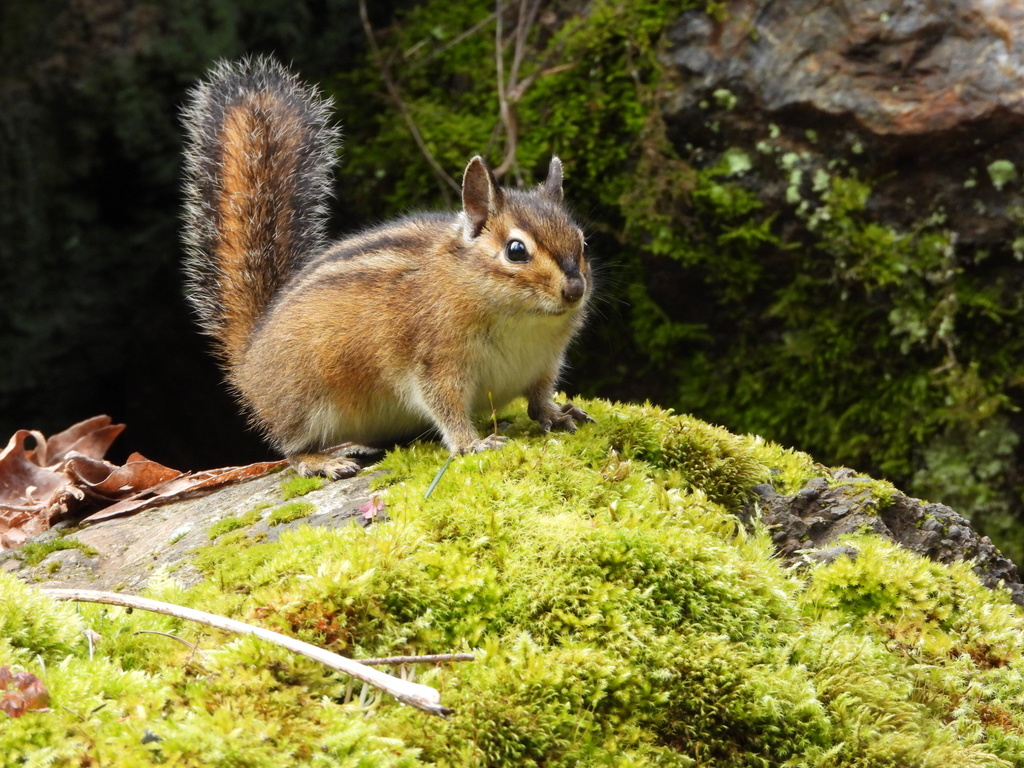
Townsend’s Chipmunk
Photo © Justin Flint
Photo © Justin Flint — CC BY 4.0 — Source: iNaturalist photo #184136879Townsend's chipmunk (Neotamias townsendii) is a species of rodent in the squirrel family, Sciuridae. It lives in the forests of the Pacific Northwest of North America, from extreme southwestern British Columbia through western Washington and western Oregon. Townsend's chipmunk is named after John Kirk Townsend, an early 19th-century ornithologist. == Description == A large chipmunk, adults can be 36 cm (14 in) from nose to the tip of its tail. In much of its range, it is the only chipmunk; it can be identified by its tail which is grayish above and reddish below, and by its brown coloration with indistinct tawny stripes. == Biology == Townsend's chipmunk hibernates in regions where the winter is harsh, but in other parts of its range that have a more mild climate it can be active year-round. It is omnivorous, eating a variety of plants and insects and even birds' eggs. Townsend's chipmunks in the Oregon Coast Range have higher population densities in areas with dense shrubbery, especially salal (Gaultheria shallon). In the summer and early fall, Townsend's chipmunks eat blackberries, salal berries, and thimbleberries. In the late fall, they eat acorns, huckleberries, maple seeds, thistle seeds, grain seeds, grass, roots, and conifer…
Mount Rainier National Park
Pierce County, United States
+187 birds+25 mammals
A volcanic colossus dominates the Cascade Range in western Washington, its 4,392-meter summit crowned year-round with glacial ice that cascades down toward temperate rainforest and subalpine…
VIEW NATIONAL PARKCrater Lake National Park
Klamath County, United States
+174 birds+13 mammals
At 1,949 metres above sea level, a volcanic caldera of impossible clarity holds one of North America's deepest and most pristine alpine lakes, ringed by pumice-and-ash…
VIEW NATIONAL PARKOlympic National Park
Jefferson County, United States
+263 birds+35 mammals
Where temperate rainforest meets alpine wilderness, Olympic National Park sprawls across nearly 11,000 square kilometers of the Pacific Northwest's most pristine landscape. The park's three distinct…
VIEW NATIONAL PARKNorth Cascades National Park
Whatcom County, United States
+120 birds+18 mammals
Jagged peaks rise abruptly from the western foothills of Washington's Cascade Range, where glaciers cling to elevations above 10,000 feet and meltwater feeds a landscape of…
VIEW NATIONAL PARKNo community photos yet. Log in to add the first one.
No community observations of this species yet.