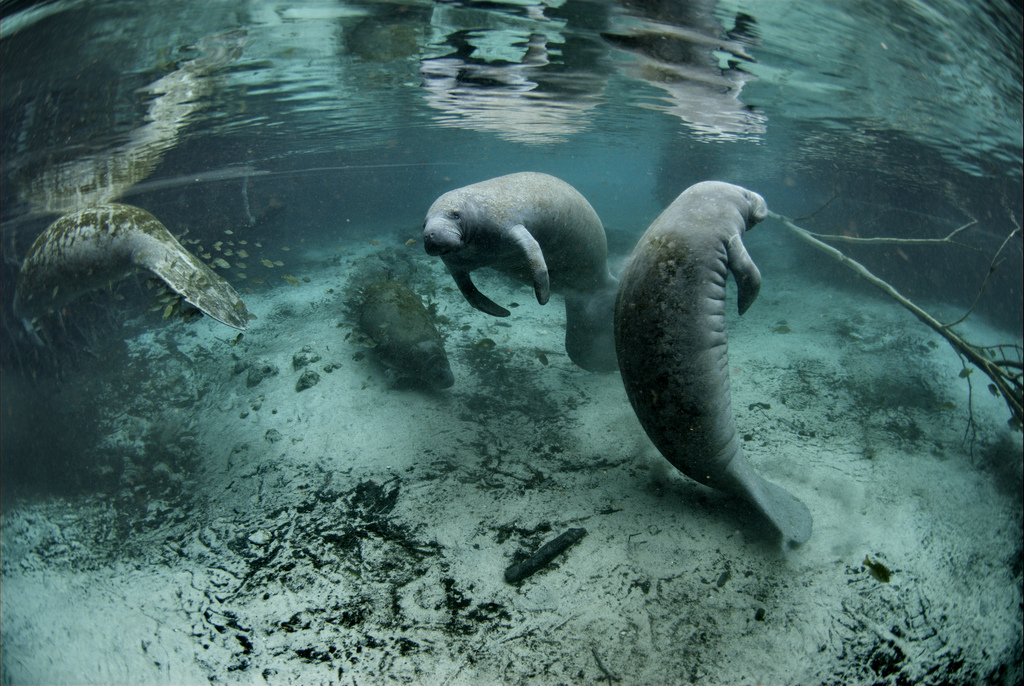
West Indian Manatee
Photo © U.S. Fish and Wildlife Service Headquarters
Photo © U.S. Fish and Wildlife Service Headquarters — CC0 1.0 — Source: Wikimedia CommonsThe West Indian manatee (Trichechus manatus), also known as the North American manatee, is a large, aquatic mammal native to warm coastal areas of the Caribbean, from the Eastern United States to northern Brazil. Living alone or in herds, it feeds on underwater plants and uses its whiskers to navigate. It is divided into two subspecies, the Florida manatee (T. m. latirostris) in the United States and the Antillean manatee (T. m. manatus) in the Caribbean, both of which are endangered and face pressure from habitat loss, pollution, and other human activity. The West Indian manatee is the largest living member of the sirenians (order Sirenia), a group of large aquatic mammals that includes the dugong, other manatees, and the extinct Steller's sea cow. Manatees are herbivores, have developed vocal communication abilities, and are covered in highly sensitive whiskers (called vibrissae) that are used for feeding and navigation. In breeding season, several males form mating herds around an individual female; on average, one calf is born to a female manatee every two to three years. In the 1970s, the West Indian manatee was listed as endangered in the United States under the Endangered Species Act, when there were only several…
Everglades National Park
Monroe County, United States
+345 birds+22 mammals
Where freshwater marsh meets subtropical sky, the Everglades sprawls across southwestern Florida as one of North America's most expansive wetland ecosystems. Spanning over 13,000 square kilometers,…
VIEW NATIONAL PARKSian Ka’an
Chunyaxché, Mexico
+350 birds+16 mammals
Where the Yucatán Peninsula dissolves into wetland and mangrove, a vast mosaic of forest, lagoon, and coastal margin creates one of Mexico's most biodiverse strongholds. Across…
VIEW BIOSPHERE RESERVEBiscayne National Park
Miami-Dade County, United States
+263 birds+7 mammals
Coral reefs and mangrove shallows dominate this marine sanctuary where the Florida Keys meet the Atlantic, creating a mosaic of shallow seagrass meadows, patch reefs, and…
VIEW NATIONAL PARKJ.N. “Ding” Darling National Wildlife Refuge
Sanibel, United States
+277 birds+6 mammals
Mangrove channels and coastal marshlands dominate this 6,400-acre sanctuary on Florida's Gulf coast, where brackish waterways weave between dense stands of red, black, and white mangrove…
VIEW WILDLIFE SANCTUARYMerritt Island National Wildlife Refuge
Brevard County, United States
+341 birds+19 mammals
Brackish marshes and palmetto scrub define this wildlife sanctuary spanning the coastal lowlands of central Florida, where the Atlantic tide meets freshwater systems in a dynamic…
VIEW WILDLIFE SANCTUARYSt. Marks National Wildlife Refuge
Saint Marks, United States
+324 birds+16 mammals
Where the Apalachee Bay begins to define the Florida coastline, salt marshes and freshwater impoundments merge into one of the southeastern United States' most productive wildlife…
VIEW WILDLIFE SANCTUARYGreat White Heron National Wildlife Refuge
Monroe County, United States
+118 birds+3 mammals
Shallow mangrove bays and salt-marsh flats sprawl across Monroe County's coastal sanctuary, where brackish water meets the Florida Keys' distinctive transition zone between temperate and subtropical…
VIEW WILDLIFE SANCTUARYCedar Keys National Wildlife Refuge
Levy County, United States
+268 birds+8 mammals
Where the Florida Gulf Coast transitions from mainland to archipelago, Cedar Keys National Wildlife Sanctuary protects a mosaic of salt marshes, shallow estuaries, and maritime hammocks…
VIEW WILDLIFE SANCTUARYChassahowitzka National Wildlife Refuge
Homosassa, United States
+299 birds+14 mammals
Where the Gulf of Mexico's coastal marshes dissolve into brackish tidal flats and mangrove thickets, the Chassahowitzka National Wildlife Sanctuary near Homosassa represents one of Florida's…
VIEW WILDLIFE SANCTUARYBarra del Colorado National Wildlife Refuge
Tortuguero, Costa Rica
+462 birds+36 mammals
Where the Caribbean's restless waters meet the Limón Province coastline, Barra del Colorado National Wildlife Sanctuary unfolds across a landscape of extraordinary ecological complexity. This equatorial…
VIEW WILDLIFE SANCTUARYNo community photos yet. Log in to add the first one.
No community observations of this species yet.