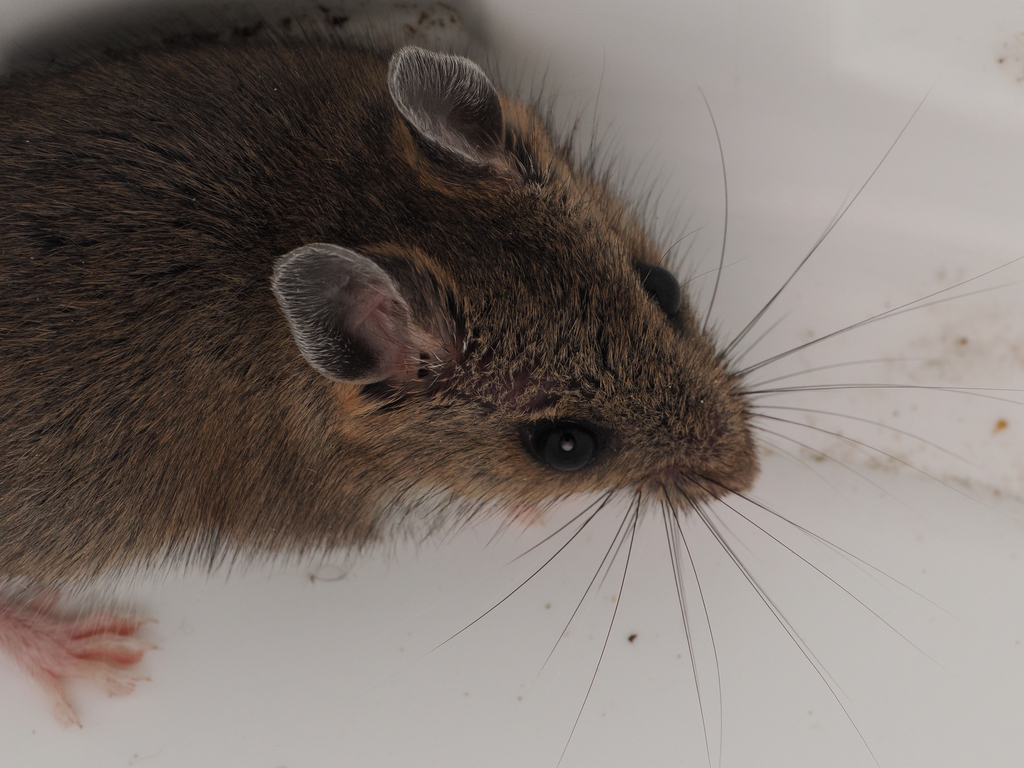
Western Deermouse
Photo © Quillipede
Photo © Quillipede — CC0 1.0 — Source: iNaturalist photo #521077938Identification
The western deermouse is a small rodent weighing 15–32 grams and measuring around 170 millimeters in length. It is characterized by its short tail, distinctive white underside, and white feet. The coat ranges from fulvous to brownish. This species can be confused with the eastern deermouse, which is indistinguishable except by geographic range, or with the white-footed mouse, which has a tail with indistinct bicoloring rather than the clear contrast of the deermouse.
Range & Habitat
Peromyscus sonoriensis is widespread and abundant throughout western North America, primarily in areas west of the Mississippi River, where its range splits from that of the eastern deermouse. It is absent from parts of the Southwestern United States, most of Mexico, most of California south of San Francisco Bay, and the coastal Pacific Northwest, where it is replaced by related species.
The western deermouse inhabits diverse plant communities across the western mountains and previously wooded areas, including grasslands, brushy areas, woodlands, and forests. Surveys in subalpine forests of Colorado and Wyoming found it had the highest frequency of occurrence among small mammals, and it was the sole rodent species in ponderosa pine savanna habitats.
Behaviour & Diet
Western deermice are polygynous, with males mating with multiple females. Breeding patterns vary regionally and depend heavily on food availability. In areas with abundant mast years (both soft and hard masts), they breed throughout much of the year, though timing varies: populations in California may breed through December in good years but cease by June in poor ones, while Oregon coast populations typically breed year-round except during the wettest and coldest periods. In southeastern Arizona, breeding occurs even in winter. Population turnover can be rapid—some populations completely replace their individuals within a single summer.
Best Time & Places to See It
The western deermouse is most readily observed in mountain and forest habitats throughout the western United States and Canada west of the Mississippi River. Look for them in subalpine forests, ponderosa pine savannas, woodlands, and brushy grassland areas. Breeding activity varies by region and season, with more activity during warmer months and periods of food abundance. Night work and live-trapping surveys are typically required for reliable observation.
Photography Tips
Photographing wild western deermice is challenging due to their small size, nocturnal habits, and rapid movements. Camera traps set near runways, brush piles, or feeding areas may capture images. Use fast shutter speeds and high ISO if attempting handheld photography. The distinctive white feet and underside contrast with the brown coat provide good subject contrast. Early evening or night photography with appropriate lighting will yield the best results for documenting this elusive species.
Gulf Islands National Park Reserve
Southern Gulf Islands Electoral Area, Canada
+268 birds+26 mammals
Scattered across the Salish Sea in British Columbia's southwestern corner, this national park reserve stitches together a fragmented archipelago of forested islands and rocky outcrops where…
VIEW NATIONAL PARKBanff National Park
Improvement District No. 9, Canada
+264 birds+33 mammals
Where the Canadian Rockies thrust skyward in a cathedral of limestone and ice, Banff National Park preserves a wilderness of astounding vertical drama. Glacier-carved valleys cradle…
VIEW NATIONAL PARKJasper National Park
Improvement District No. 12, Canada
+235 birds+34 mammals
Where the Canadian Rockies rise in dramatic succession across western Alberta, Jasper National Park spans over 11,000 square kilometres of subalpine and alpine terrain, glaciated valleys,…
VIEW NATIONAL PARKLassen Volcanic National Park
Shasta County, United States
+239 birds+18 mammals
Volcanic peaks and geothermal upheaval have sculpted 545 square kilometers of Northern California into a landscape where fire and water engage in perpetual dialogue. Lassen Peak…
VIEW NATIONAL PARKGrand Teton National Park
Teton County, United States
+247 birds+38 mammals
Where the Teton Range tears skyward in a dramatic escarpment above the Snake River valley, nearly 2,550 square kilometers of montane wilderness unfolds across Teton County,…
VIEW NATIONAL PARKYellowstone National Park
Park County, United States
+253 birds+43 mammals
Across nearly 11,400 square kilometres of the Rocky Mountain plateau, geothermal fury and pristine wilderness converge in one of Earth's most dynamic landscapes. Hot springs, geysers…
VIEW NATIONAL PARKMount Rainier National Park
Pierce County, United States
+187 birds+25 mammals
A volcanic colossus dominates the Cascade Range in western Washington, its 4,392-meter summit crowned year-round with glacial ice that cascades down toward temperate rainforest and subalpine…
VIEW NATIONAL PARKRocky Mountain National Park
Larimer County, United States
+259 birds+33 mammals
Where granite peaks rise above 12,000 feet and alpine tundra gives way to subalpine forest, Rocky Mountain National Park spans the Continental Divide across nearly 1,600…
VIEW NATIONAL PARKRedwood National Park
Humboldt County, United States
+343 birds+43 mammals
Where the Pacific fog rolls deep into northern California's coastal valleys, some of the tallest trees on Earth rise from a landscape shaped by tectonic forces…
VIEW NATIONAL PARKOlympic National Park
Jefferson County, United States
+263 birds+35 mammals
Where temperate rainforest meets alpine wilderness, Olympic National Park sprawls across nearly 11,000 square kilometers of the Pacific Northwest's most pristine landscape. The park's three distinct…
VIEW NATIONAL PARKWaterton Lakes National Park
Improvement District No. 04, Canada
+252 birds+31 mammals
Where the Continental Divide plunges toward the prairies of Alberta, glacier-carved valleys and emerald lakes pierce a landscape where montane forest meets alpine tundra. Waterton Lakes…
VIEW NATIONAL PARKGlacier National Park
United States
+246 birds+39 mammals
Where jagged peaks pierce a subarctic sky and glacial valleys carve through ancient rock, Glacier National Park spans the spine of the Northern Rockies along Montana's…
VIEW NATIONAL PARKGrand Canyon National Park
United States
+277 birds+35 mammals
A mile-deep chasm of rust-red rock and purple shadow cuts through the high desert plateau of northern Arizona, revealing nearly two billion years of geological history…
VIEW NATIONAL PARKNorth Cascades National Park
Whatcom County, United States
+120 birds+18 mammals
Jagged peaks rise abruptly from the western foothills of Washington's Cascade Range, where glaciers cling to elevations above 10,000 feet and meltwater feeds a landscape of…
VIEW NATIONAL PARKPetrified Forest National Park
Apache County, United States
+206 birds+23 mammals
Across the high desert plateau of northeastern Arizona, where the climate swings between scorching summer days and frost-laden winters, badlands of raw earth and timber-turned-to-stone dominate…
VIEW NATIONAL PARKMalheur National Wildlife Refuge
Harney County, United States
+309 birds+24 mammals
Across the high desert plateau of southeastern Oregon, where sagebrush scrubland stretches toward distant ridgelines under an enormous sky, lies a sanctuary shaped by water in…
VIEW WILDLIFE SANCTUARYNational Elk Refuge
Jackson, United States
+230 birds+27 mammals
Where the sagebrush flats of northwestern Wyoming rise toward the Gros Ventre Mountains, winter transforms the landscape into a realm of survival and spectacle. The National…
VIEW WILDLIFE SANCTUARYNo community photos yet. Log in to add the first one.
No community observations of this species yet.