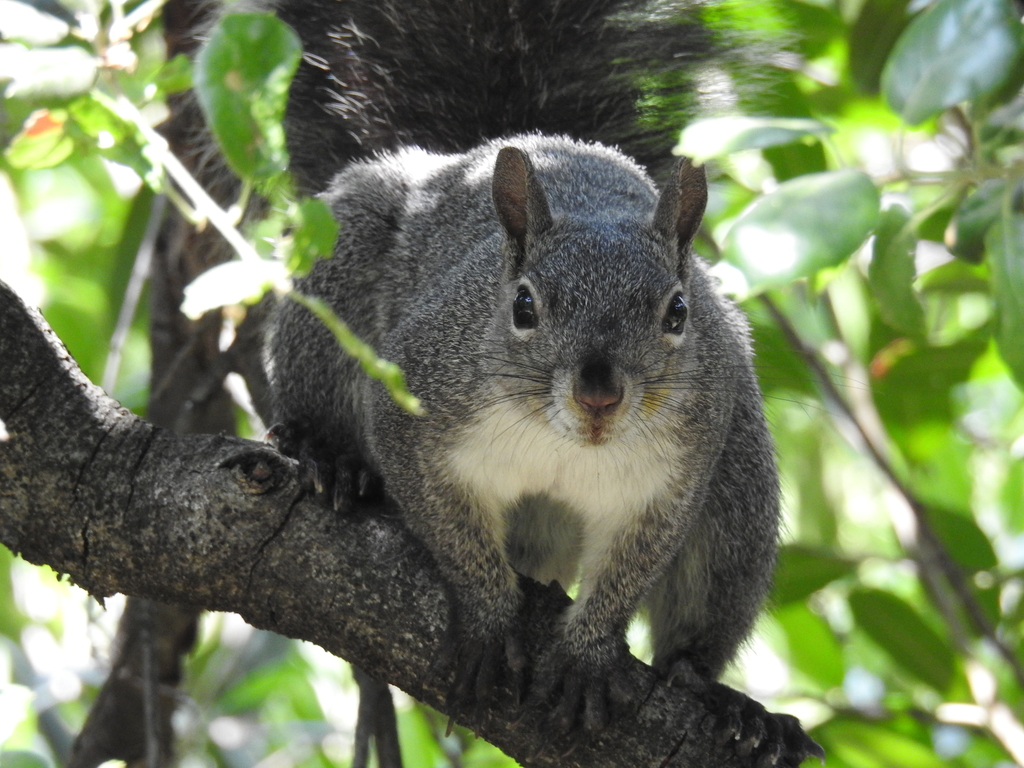
Western Gray Squirrel
Photo © James M. Maley
Photo © James M. Maley — CC BY 4.0 — Source: iNaturalist photo #36483843Identification
The western gray squirrel is the largest tree squirrel in the Sierra Nevada and Central California range. Adults weigh between 0.35 and 1 kilogram (0.77 to 2.20 lb) and measure 43 to 61 centimetres (17 to 24 in) in length, including their distinctive tail. They are characterized by solid gray fur across most of their body, with the color most prevalent on the back and sides. Like other tree squirrels, they have four toes on their front feet and five on their hind feet, equipped with plantigrade, pentadactyl feet.
Compared with introduced eastern gray squirrels and fox squirrels, western gray squirrels are notably shy and elusive. When disturbed, they will rapidly climb a tree and give a hoarse chirping call. They undergo a complete head-to-tail molt in spring and a rump-to-head molt in fall, with tail hair replaced only in spring.
Range & Habitat
The western gray squirrel is found along the western coast of the United States and Mexico, with three geographical subspecies. S. g. griseus ranges from central Washington to the western Sierra Nevada in central California; S. g. nigripes occurs from south of San Francisco Bay to San Luis Obispo County; and S. g. anthonyi ranges from San Luis Obispo to northern Baja California. Historically known by several regional names including the silver-gray squirrel, California gray squirrel, Oregon gray squirrel, Columbian gray squirrel, and banner-tail, this species is now less common in some areas due to habitat loss and competition with other squirrel species.
Western gray squirrels forage mainly on the ground but remain closely tied to tree cover for escape routes, avoiding open spaces. They inhabit oak woodlands and areas with close canopy cover, where they can move rapidly despite being less agile in trees than other tree squirrel species. They rarely make large leaps between branches.
Behaviour & Diet
Western gray squirrels are primarily diurnal, alternating between periods of activity and rest, becoming less active in the late afternoon. During windy or stormy conditions they remain close to their nests. When alarmed, they rapidly climb trees, face the perceived threat while flagging their tails, and make repeated "chuck" calls that typically rise in pitch as the alarm is sustained.
These squirrels eat berries, nuts, various seeds, and the eggs of small birds. They play a crucial ecological role as important dispersers of fungi, particularly hypogeous (subterranean) fungi such as truffles. By consuming large quantities of these fungi and dispersing spores through their droppings, they support the ectomycorrhizal symbiotes that provide nitrogen to oak trees and other vegetation. They also disperse oak seeds by gathering and burying acorns, many of which are not recovered and subsequently germinate. Competition with other native species is minimized through habitat preferences, though some overlap occurs with Douglas squirrels and American red squirrels in coniferous forests, and with nocturnal northern flying squirrels that forage at different times.
Best Time & Places to See It
Western gray squirrels are most active during daylight hours, particularly in the morning and early afternoon. They are most active during the mating season, which extends from December through June, when males become highly visible and aggressive in pursuit of females. Look for them in oak woodlands and mature forest with close canopy cover throughout their range in California, Oregon, Washington, and Baja California.
The best locations are areas with abundant oak trees, particularly Oregon white oak and red oak, which are central to their diet and ecological role. Early morning visits to oak woodlands will provide the best opportunities for observation, as the squirrels are less active later in the day and remain sheltered during stormy weather.
Photography Tips
Western gray squirrels are shy and will flee up the nearest tree when disturbed, so patience and careful approach are essential. Position yourself near oak trees and remain still during early morning hours when activity peaks. The squirrel's solid gray coloring photographs well in dappled forest light, and their distinctive tail creates a striking compositional element.
Watch for their characteristic behavior of flagging their tails and "chucking" when alarmed—these dramatic defensive displays make compelling images. Photographing them on the ground during foraging provides dynamic compositions, while shots of them high in trees using their bushy tails for balance capture their arboreal nature. Avoid sudden movements or loud noises that will send them climbing and triggering their alarm calls.
Lassen Volcanic National Park
Shasta County, United States
+239 birds+18 mammals
Volcanic peaks and geothermal upheaval have sculpted 545 square kilometers of Northern California into a landscape where fire and water engage in perpetual dialogue. Lassen Peak…
VIEW NATIONAL PARKYosemite National Park
Mariposa County, United States
+224 birds+28 mammals
Granite cliffs soar nearly a kilometer above the valley floor in this expanse of high Sierra wilderness, where glacial U-shaped valleys sculpt a landscape of dramatic…
VIEW NATIONAL PARKRedwood National Park
Humboldt County, United States
+343 birds+43 mammals
Where the Pacific fog rolls deep into northern California's coastal valleys, some of the tallest trees on Earth rise from a landscape shaped by tectonic forces…
VIEW NATIONAL PARKSequoia National Park
Tulare County, United States
+187 birds+27 mammals
Granite peaks rising above 3,600 meters dominate the southern Sierra Nevada, where Sequoia National Park sprawls across one of North America's most vertically compressed wilderness zones.…
VIEW NATIONAL PARKKings Canyon National Park
Fresno County, United States
+186 birds+20 mammals
Where granite peaks fracture the Sierra Nevada skyline and the Kings River has carved one of North America's most dramatic canyons, a landscape of extreme relief…
VIEW NATIONAL PARKNo community photos yet. Log in to add the first one.
No community observations of this species yet.