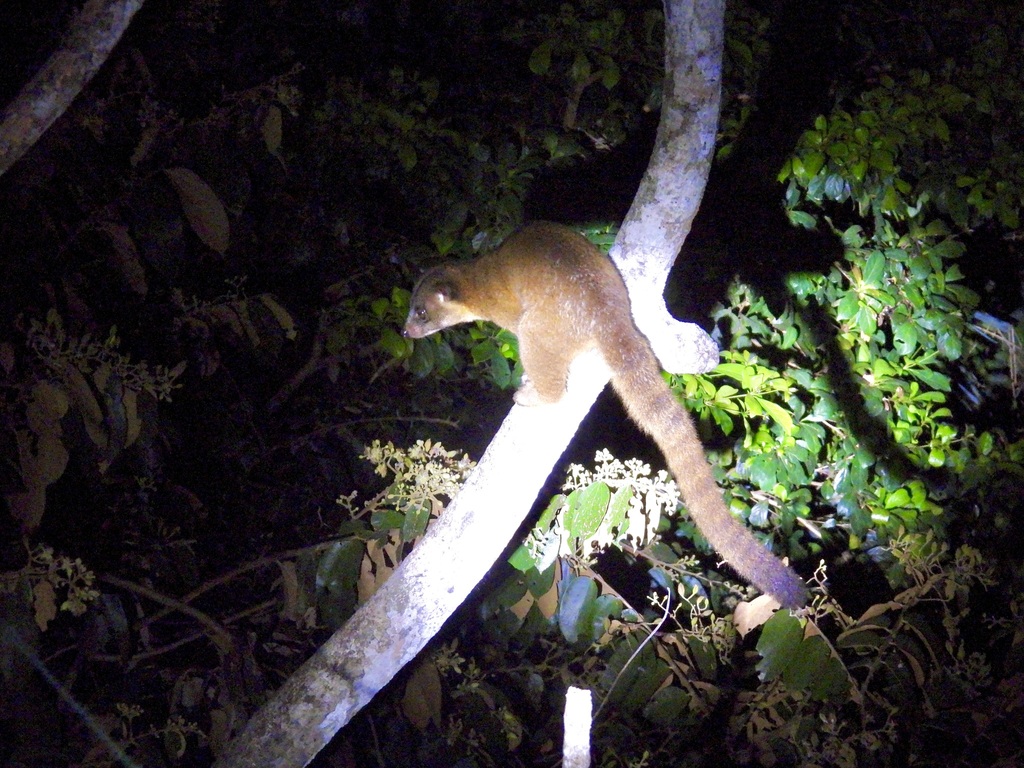
Western Lowland Olingo
Photo © henrya
Photo © henrya — CC0 1.0 — Source: iNaturalist #261936434The western lowland olingo (Bassaricyon medius) is a species of olingo from Central and South America, where it is known from Panama and from Colombia and Ecuador west of the Andes. == Description == The western lowland olingo is smaller than the northern olingo, but larger than the most montane member of the genus, the recently described olinguito ("little olingo"). While the Panamanian subspecies B. m. orinomus is about the same size as the eastern lowland olingo, the subspecies from west of the Andes, B. m. medius is smaller. The pelage is slightly lighter than that of the eastern species. It has a head-body length of 31 to 41 centimetres (12 to 16 in), with a tail length of 35 to 52 centimetres (14 to 20 in). It weighs .9 to 1.2 kilograms (2.0 to 2.6 lb). == Taxonomy == There are two subspecies of the western lowland olingo: the nominate B. m. medius (Colombia and Ecuador) and B. m. orinomus (Panama and possibly Colombia). The closest relative of the western lowland olingo is the other lowland olingo species, B. alleni, found east of the Andes, from which it diverged about 1.3 million years ago.
Natural Farallones de Cali National Park
Buenaventura, Colombia
+733 birds+27 mammals
Where the Pacific coastal plain meets the western slopes of the Andes, Farallones de Cali National Park sprawls across nearly 3,500 square kilometers of dramatic topography…
VIEW NATIONAL PARKSoberanía National Park
Cristóbal, Panama
+495 birds+34 mammals
Rainforest and riverine woodland blanket the rolling terrain of this 714-square-kilometre national park in Colón Province, where the Caribbean watershed feeds a maze of streams and…
VIEW NATIONAL PARKChagres National Park
Caimitillo, Panama
+486 birds+19 mammals
Where the Chagres River carves through the humid tropics of central Panama, a vast montane and lowland forest sprawls across more than 2,300 square kilometers, anchoring…
VIEW NATIONAL PARKNo community photos yet. Log in to add the first one.
No community observations of this species yet.