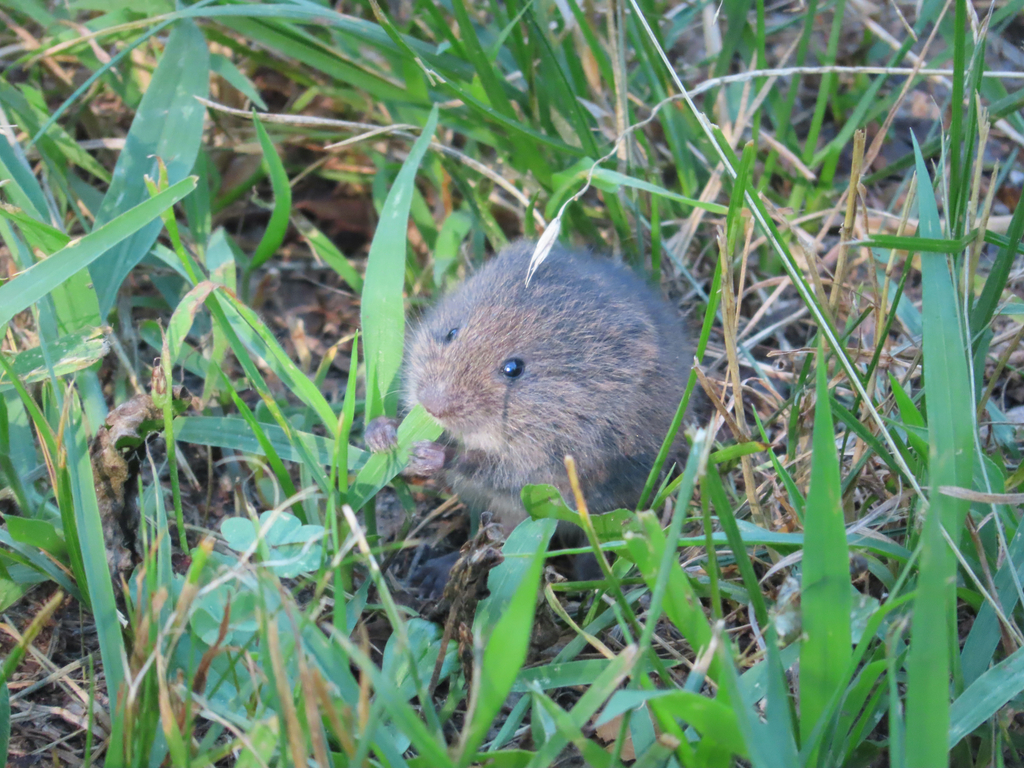
Western Meadow Vole
Photo © Eric Vehe
Photo © Eric Vehe — CC0 1.0 — Source: iNaturalist photo #236447095The western meadow vole (Microtus drummondii) is a species of North American vole found in western North America, the midwestern United States, western Ontario, Canada, and formerly in Mexico. It was previously considered conspecific with the eastern meadow vole (M. pennsylvanicus), but genetic studies indicate that it is a distinct species. It is sometimes called the field mouse or meadow mouse, although these common names can also refer to other species. == Distribution == It ranges from Ontario west to Alaska, and south to Missouri, north-central Nebraska, the northern half of Wyoming, and central Washington south through Idaho into north-central Utah. A disjunct subset of its range occurs from central Colorado to northwestern New Mexico. An isolated population was formerly found in Chihuahua, Mexico, but has since been extirpated. The United States portion of the Souris River is alternately known as the Mouse River because of the large numbers of field mice that lived along its banks. == Plant communities == In eastern Washington and northern Idaho, meadow voles are found in relative abundance in sedge (Carex sp.) fens, but not in adjacent cedar (Thuja sp.)-hemlock (Tsuga sp.), Douglas-fir (Pseudotsuga menziesii), or ponderosa pine (Pinus ponderosa) forests. Meadow voles are…
No community photos yet. Log in to add the first one.
No community observations of this species yet.