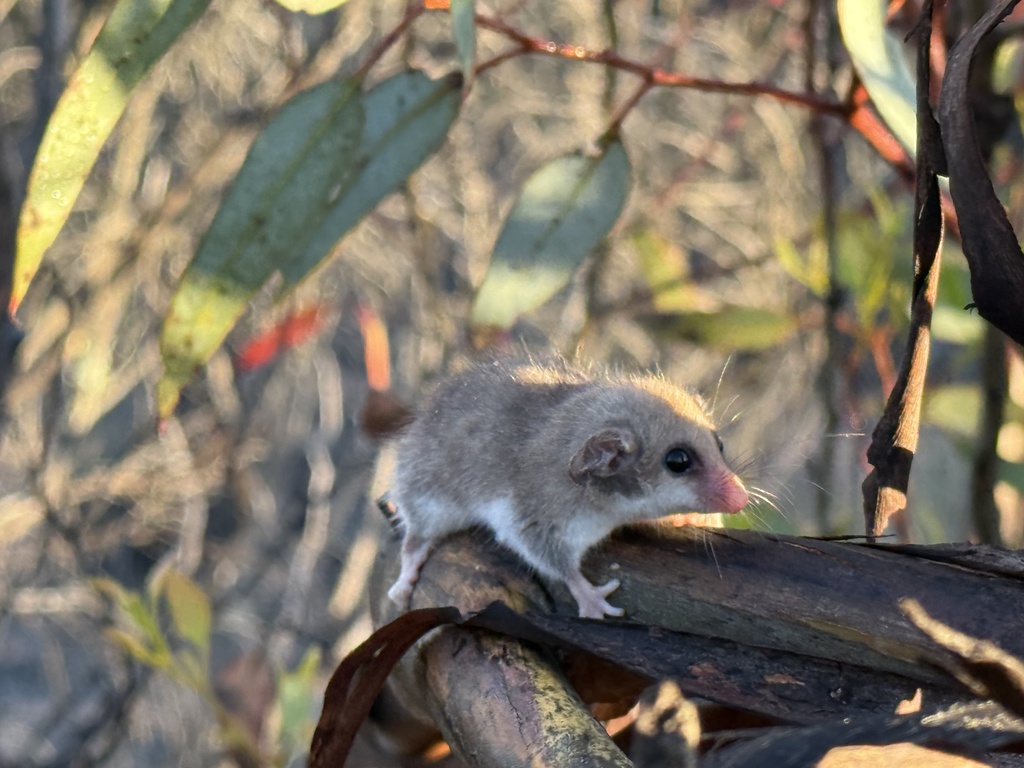
Western Pygmy Possum
Photo © Nicole Kearney
Photo © Nicole Kearney — CC BY 4.0 — Source: iNaturalist photo #462428712The western pygmy possum (Cercartetus concinnus), also known as the southwestern pygmy possum or the mundarda, is a small nocturnal marsupial found in Australia. It is observed to be both arboreal and terrestrial, foraging on the ground or in trees and shrubs in search of different flowering plants, and predominantly feeding on the pollen and nectar of plants native to its habitat, such as Eucalyptus and Melaleuca. Its nightly movements are typically short, averaging around 50 m (160 ft), but individuals are capable of traveling much greater distances in search of food. Genetic studies indicate its closest relative is likely the eastern pygmy possum, from which its ancestors diverged around eight million years ago. == Taxonomy == John Gould provided the first formal description of Cercartetus concinnus, which was presented to the Zoological Society of London and published in 1845. He initially placed the species in the genus Dromicia, noting its similarity to a previously described species found in Tasmania. In the same year, G.R. Waterhouse independently described the animal as Phalangista (Dromicia) neillii, a name that is now considered a synonym of Cercartetus concinnus. == Morphology and phylogeny == The molecular divergence of the Diprotodontia order indicates an early…
Coffin Bay National Park
Coorong National Park
Fitzgerald River National Park
Flinders Chase National Park
Innes National Park
Little Desert National Park
Nothing matches these filters.
No community photos yet. Log in to add the first one.
No community observations of this species yet.