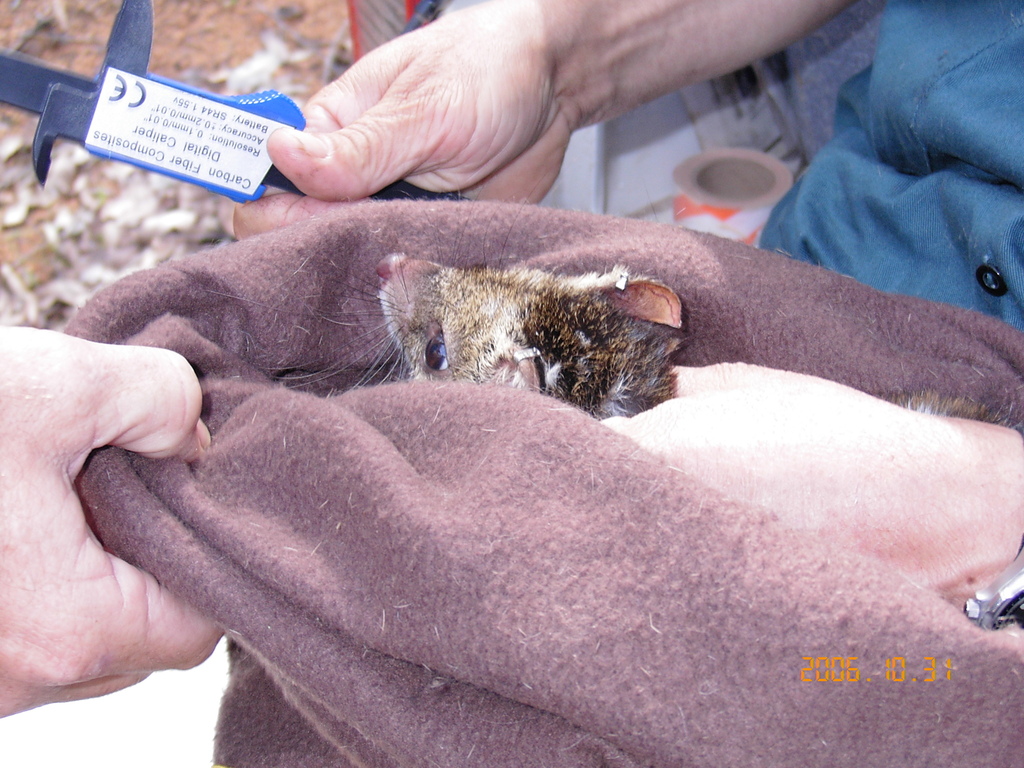
Western Quoll
Photo © Belinda Forbes
Photo © Belinda Forbes — CC BY 4.0 — Source: iNaturalist #151184717Identification
The western quoll is about the size of a domestic cat, making it Western Australia's largest endemic mammalian carnivore. It has a distinctive rufous-brown coat adorned with 40–70 white spots across its back and a creamy white underside. These spots serve a practical purpose, helping to diminish the animal's outline under moonlight during nocturnal hunts. The head and body measure 36 to 46 cm in length, with a tail of 22 to 30 cm featuring a characteristic black brush from halfway down to the tip.
Built for nocturnal hunting, the western quoll has large eyes and pointed ears perfectly suited to low-light activity. Males typically weigh around 1.3 kg while females are smaller at 0.9 kg. A key distinguishing feature from the similar eastern quoll is the presence of a first toe on the hind foot and a darker tail. The granular pads on its five-toed hind feet provide excellent grip for climbing and ground movement.
Range & Habitat
Once distributed across 70% of the Australian continent, the western quoll's range has dramatically contracted to the south-western corner of Western Australia. This collapse began after European settlement in the late 1780s and accelerated through subsequent decades; by the 1930s the species had disappeared completely from the Swan Coastal Plain. Today, it inhabits wet and dry sclerophyll forests, including Jarrah Forest and mallee ecosystems consisting of open forest, low open forest, woodland, and open shrub habitats. Occasional sightings occur in the WA Wheatbelt and Goldfields regions.
The western quoll's carnivorous lifestyle requires extensive territories. Males range over approximately 15 square kilometres, often overlapping with several female ranges of 3–4 square kilometres each. Females maintain exclusive territories with no overlap between individuals. Typical female home ranges contain around 70 hollow log dens and 110 burrows, providing essential shelter and hunting bases.
Behaviour & Diet
A solitary, mostly terrestrial nocturnal predator, the western quoll is most active around dusk when it hunts with swift, efficient movement on the ground and in trees. By day, it rests in hollow logs or burrows, conserving energy by lowering its body temperature during sleep. As the apex carnivore in its ecosystem, it depends entirely on resource abundance and ecosystem health.
The western quoll feeds on large invertebrates and small animals including lizards, birds, frogs, spiders, insects, and small mammals—prey as large as bandicoots or parrots. It hunts primarily on the ground but will climb trees for bird eggs. The species kills larger prey with a characteristic bite to the back of the head and can extract most of its water from food, a valuable adaptation during droughts. Reintroduced populations in South Australia have been observed hunting rabbits and burrowing bettongs. Seasonal breeding occurs from late April to July with a June peak, and litters typically range from two to six young after a 16–23 day gestation period.
Best Time & Places to See It
The western quoll is strictly nocturnal and crepuscular, most active around dusk when it emerges to hunt. Your best opportunities for observation are during the twilight hours in south-western Western Australia, particularly in the sclerophyll forests and Jarrah Forest regions. The species is difficult to encounter due to its solitary, elusive nature and preference for darkness, making night-time wildlife surveys or guided nocturnal tours the most reliable methods for observation.
Photography Tips
Photographing the western quoll presents significant challenges due to its nocturnal habits and elusive behaviour. A high-quality spotlight or red-filtered headlamp is essential for locating the animal without disturbing it excessively. Use a camera with excellent high-ISO performance and fast lenses (f/2.8 or faster) to capture usable images in low light conditions. A remote camera trap with infrared triggers set in areas with den entrances or along known foraging routes may yield the most consistent results. Approach slowly and carefully, as the quoll is sensitive to disturbance and will flee quickly if threatened.
Ikara-Flinders Ranges National Park
Australia
+149 birds+10 mammals
Where ancient quartzite ridges rise across the semi-arid heart of South Australia, Ikara-Flinders Ranges National Park unfolds across nearly two thousand square kilometres of one of…
VIEW NATIONAL PARKVulkathunha-Gammon Ranges National Park
Australia
+97 birds+8 mammals
Granite ridges and quartzite peaks rise abruptly from the red earth of South Australia's mid-north, their steep slopes carved into gorges where seasonal waterfalls cascade through…
VIEW NATIONAL PARKNo community photos yet. Log in to add the first one.
No community observations of this species yet.