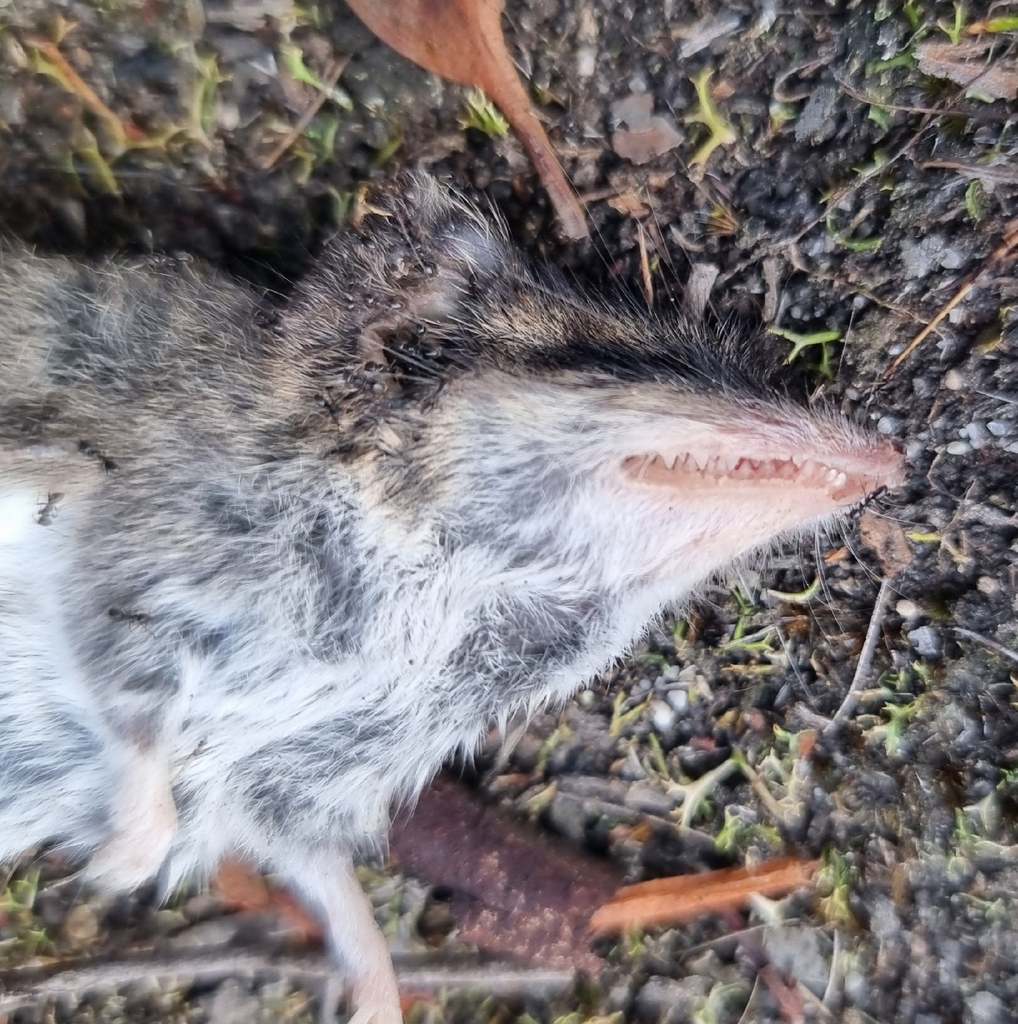
White-footed Dunnart
Photo © Peter Crowcroft
Photo © Peter Crowcroft — CC BY 4.0 — Source: iNaturalist #351581277The white-footed dunnart (Sminthopsis leucopus) is a marsupial that occurs on Tasmania and mainland Australia. It occurs along the coast and in inner Gippsland and Alpine areas up to 400 metres near Narbethong. In southern New South Wales, the white-footed dunnart is known to occur at elevations at least as high as 1000 metres. The length from snout to tail tip is 14–20 cm (5.5–7.9 in) of which head and body are 7–11 cm (2.8–4.3 in) and the tail 7–9 cm (2.8–3.5 in) long. They weigh 19–27 g (0.67–0.95 oz). == Habitat == The average rainfall of its habitat is between 60–100 cm (24–39 in) per year. Unlike the fat-tailed dunnart, this species requires forest and woodland cover of more than 50% of any square metre of heath understory or mid-story plant species. Other habitats include coastal tussock grasslands, sedgeland and wet heath. This dunnart has an individual range of about 120 square metres for both sexes, although this varies greatly among males, with some males acquiring territories of up to 1200 square metres. Male territories often overlap those of females. == Breeding and social organisation == The white-footed dunnarts mate in summer. The female white-footed dunnart will give birth…
Morton National Park
Australia
+253 birds+57 mammals
Across nearly 4,800 square kilometers of New South Wales's Southern Tablelands, rugged sandstone plateaus rise above sheltered valleys where cool-climate eucalypt woodland meets grassy heath and…
VIEW NATIONAL PARKBen Boyd National Park
Eden, Australia
+255 birds+47 mammals
Where the temperate forests of the far south coast meet towering sea cliffs, Ben Boyd National Park unveils one of New South Wales' most dramatic coastal…
VIEW NATIONAL PARKGreat Otway National Park
Australia
+255 birds+42 mammals
Temperate rainforest and wet eucalyptus woodland cloak the ridges and gullies of Victoria's Great Otway National Park, where persistent moisture and mild year-round temperatures sustain a…
VIEW NATIONAL PARKNo community photos yet. Log in to add the first one.
No community observations of this species yet.