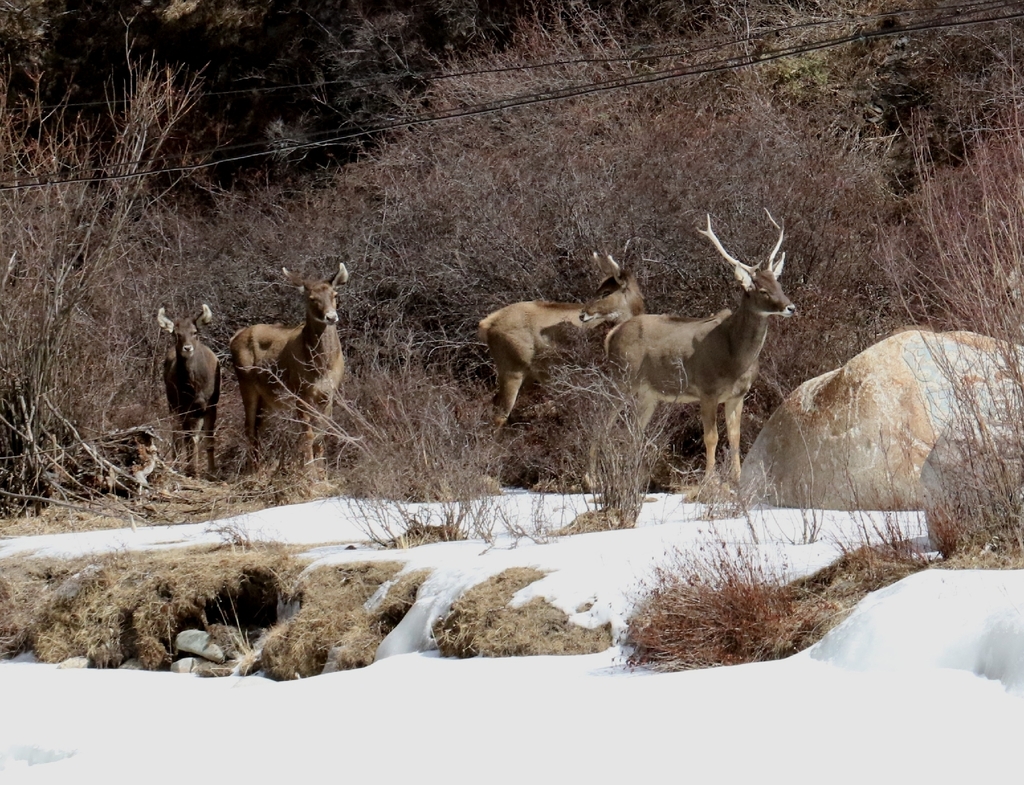
White-lipped Deer
Photo © Agnes Trekker
Photo © Agnes Trekker — CC0 1.0 — Source: iNaturalist #339551476Thorold's deer (Cervus albirostris) is a threatened species of deer found in the grassland, shrubland, and forest habitats, at high altitudes, of the eastern Tibetan Plateau, as well as some fragmented areas further north in central Western China. It is also known as the white-lipped deer (or baichunlu, 白唇鹿, in Simplified Chinese, ཤྭ་བ་མཆུ་དཀར།་ in Standard Tibetan) for the white fur around its snout. Thorold's deer is one of the larger ungulate mammals within its range, and fills an ecological niche similar to the Tibetan red deer (or shou, the subspecies Cervus elaphus wallichi of the red deer species group). It was first scientifically described by Nikolay Przhevalsky in 1883. As of early 2011, more than 100 of the deer are kept globally in Species360-registered zoos, and, in 1998, it was estimated that about 7,000 remained in the wild. == Taxonomy and nomenclature == In the late 1870s, Polish-Russian explorer Nikolay Przhevalsky encountered Thorold's deer in his expedition to Tibet. A Cossack named Kalmynin hunted two maral-like animals which Przhevalsky determined to belong to a separate species, Cervus albirostris. Of these specimens, only one managed to be analysed, as the other carcass was devoured by wolves. The specific epithet albirostris combines…
No community photos yet. Log in to add the first one.
No community observations of this species yet.