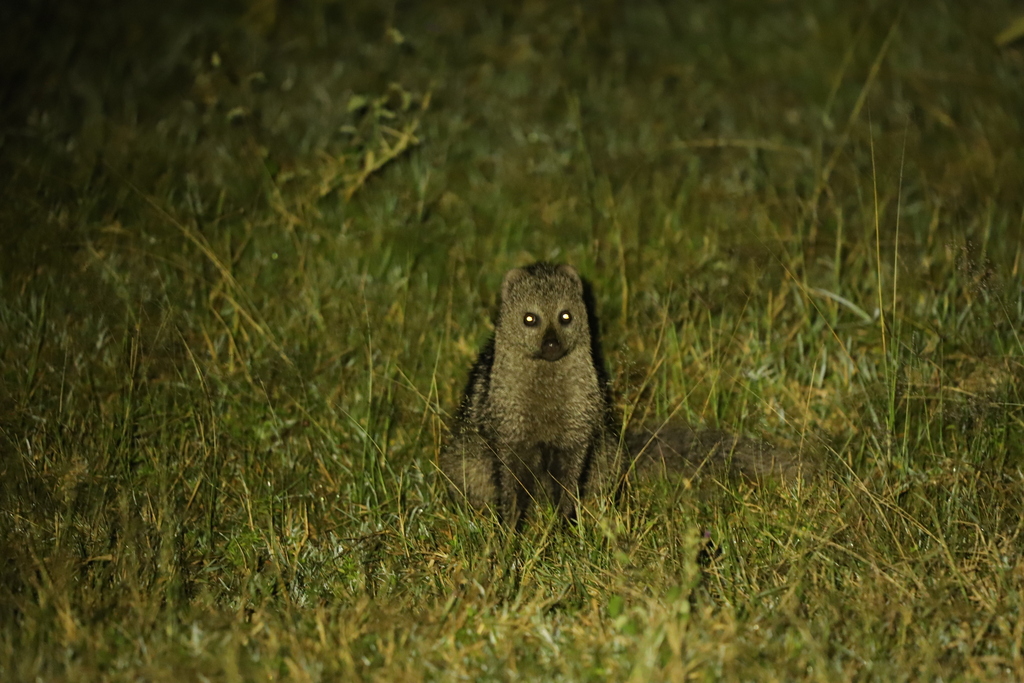
White-tailed Mongoose
Photo © Adrien Jailloux
Photo © Adrien Jailloux — CC BY 4.0 — Source: iNaturalist photo #607532520The white-tailed mongoose (Ichneumia albicauda) is a species in the mongoose family Herpestidae. It is the only member of the genus Ichneumia. == Taxonomy == Herpestes albicaudus was the scientific name proposed by Georges Cuvier in 1829 for a mongoose specimen with a white tail from Senegal. The genus name Ichneumia was coined by Isidore Geoffroy Saint-Hilaire in 1837. == Characteristics == The white-tailed mongoose attains a weight range of 1.8 to 5.2 kg (4.0 to 11.5 lb), with an average of approximately 3.38 kg (7.5 lb), has a head-and-body length of 53 to 71 cm (21 to 28 in) and a tail length of 40 to 47 cm (16 to 19 in). On average it appears to be the longest and heaviest extant species of mongoose, although its linear and body mass parameters broadly overlap with other larger mongoose species, in particular, the marsh mongoose seems to most closely rival (and possibly match) in range of body masses reported if not average weight. Its legs are relatively long for a mongoose. The head is long and narrow. Its large, rounded ears are set low on the sides of the head. It has a yellow to tan coloration on its…
Murchison Falls National Park
Uganda
+608 birds+33 mammals
Where the Victoria Nile compresses through a narrow gorge and explodes across a 45-meter precipice, the landscape speaks in thunder. Murchison Falls National Park sprawls across…
VIEW NATIONAL PARKTsavo West National Park
Mwatate, Kenya
+513 birds+49 mammals
Where volcanic ridges and weathered lava flows meet the semi-arid lowlands of south-central Kenya, Tsavo West National Park unfolds across a landscape sculpted by fire and…
VIEW NATIONAL PARKAmboseli National Park
Etonet/Lenkism ward, Kenya
+501 birds+43 mammals
Where the Amboseli basin opens toward the Tanzanian frontier, a shallow alkaline lake mirrors vast skies across one of East Africa's most iconic savanna landscapes. The…
VIEW NATIONAL PARKKruger National Park
Ba-Phalaborwa Local Municipality, South Africa
+540 birds+91 mammals
Across the low-lying savanna of northeastern South Africa unfolds one of Africa's largest and most ecologically intact protected areas, where acacia woodlands merge into mopane scrub…
VIEW NATIONAL PARKLake Nakuru National Park
Nakuru West, Kenya
+494 birds+32 mammals
Alkaline waters ringed by acacia woodland and grassland create one of East Africa's most distinctive wetland ecosystems, where the interplay of geology and climate sustains a…
VIEW NATIONAL PARKAberdare National Park
Mweiga ward, Kenya
+394 birds+30 mammals
Where the central highlands of Kenya rise to their elemental grandeur, the Aberdare range unfolds across Nyeri County as a montane stronghold of cool, misty forest…
VIEW NATIONAL PARKSamburu National Reserve
Samburu, Kenya
+430 birds+42 mammals
Across the arid plains of northern Kenya, where scattered acacia woodland gives way to rocky outcrops and dry riverbeds, Samburu National Park unfolds as one of…
VIEW NATURE RESERVEArabuko Sokoke Forest Reserve
Kilifi, Kenya
+383 birds+29 mammals
Coastal forest rises from the Indian Ocean plains of Kilifi County, where sandy soils and seasonal rainfall have sculpted a woodland ecosystem unlike anywhere else on…
VIEW NATURE RESERVENo community photos yet. Log in to add the first one.
No community observations of this species yet.