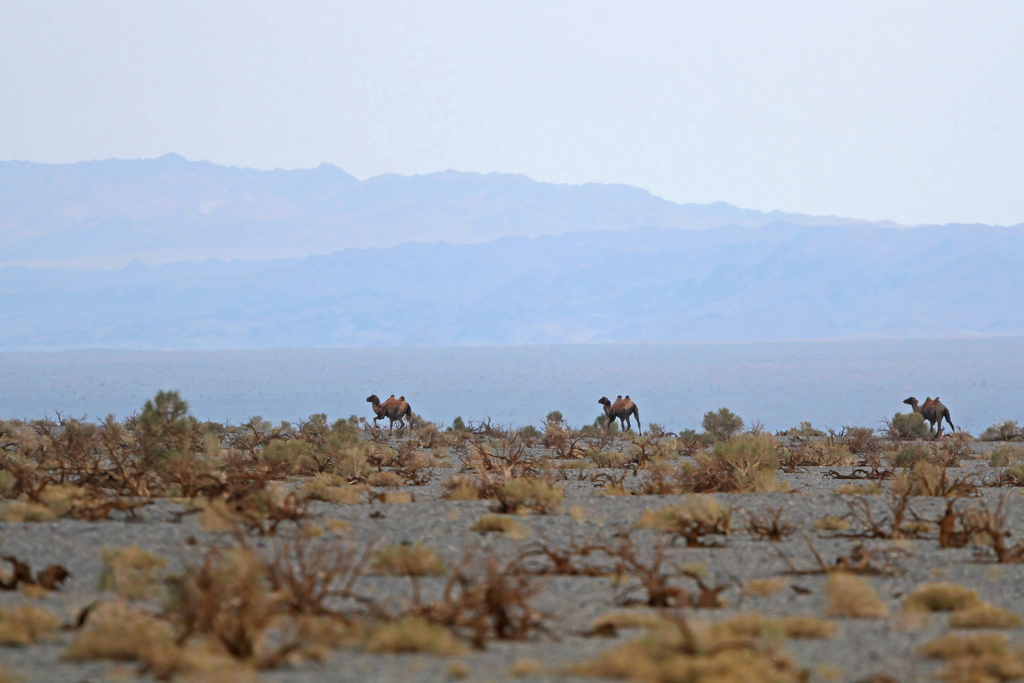
Wild Bactrian Camel
Photo © James Eaton
Photo © James Eaton — CC0 1.0 — Source: iNaturalist #198783744Identification
The wild Bactrian camel is a distinct species, closely related to but genetically separate from the domesticated Bactrian camel. It is slightly smaller and more slender than its domestic counterpart, with notably smaller, lower, and more conical humps—often only about half the size of those on domestic animals. The body appears laterally compressed with narrow feet and a characteristically flatter skull. Their sandy-colored coat is shorter and sparser than domestic Bactrians, transitioning seasonally from a thick, shaggy light brown in winter to a thinner, darker brown in summer. Distinctive adaptations for desert life include long, narrow slit-like nostrils, a double row of thick eyelashes, and ear hairs that protect against sandstorms. Their tough, undivided soles with two widely-spreading toes enable them to traverse rough, hot, stony, and sandy terrain.
Wild Bactrian camels possess a remarkable physiological adaptation: they can survive on water saltier than seawater, a tolerance found in virtually no other large mammal. Like their domestic relatives, they can eat snow for hydration in winter, though they are primarily adapted to conserve water rather than store it in their humps—a common misconception.
Range & Habitat
Wild Bactrian camels are endemic to Northwest China and southwestern Mongolia, with approximately 950 individuals remaining today. The largest populations inhabit the Lop Nur Wild Camel National Nature Reserve in China. Smaller populations survive in the Great Gobi A Strictly Protected Area in Mongolia and several Chinese reserves including the Altun Shan Wild Camel Nature Reserve, Aksai Annanba Nature Reserve, Dunhuang Xihu Wild Camel Nature Reserve, and Mazongshan reserves. Historically, they ranged from the Yellow River's great bend westward through Inner Mongolian deserts into Northwest China and central Kazakhstan.
They inhabit arid plains and hills with scarce water sources and minimal vegetation, where shrubs provide their primary food. These extreme environments experience dramatic temperature swings: summer temperatures reach 40–50°C (104–122°F), while winters plunge to −30°C (−22°F). Camels seek water near mountain springs and travel to snow-covered hill slopes for winter moisture.
Behaviour & Diet
Wild Bactrian camels are fully migratory, moving in groups typically of 6–20 individuals, though groups can reach up to 30, with the largest temporary assemblies at water points potentially numbering around 100. Their extremely low population density averages just 5 per 100 km². They travel considerable distances with a single adult male leading, and their lifespan extends to approximately 40 years. Solitary camels observed are typically young individuals recently dispersed after reaching sexual maturity.
They breed during winter, extending into the rainy season. Females first reproduce at age 5 and thereafter produce offspring on a two-year cycle. Their diet consists primarily of shrubs and available vegetation in their harsh habitat. The reduced herd sizes compared to historical records reflect both the arid environment and the impact of heavy poaching pressure.
Best Time & Places to See It
The most reliable locations for viewing wild Bactrian camels are the protected reserves in Northwest China. The Lop Nur Wild Camel National Nature Reserve hosts the majority of the remaining population. The Altun Shan, Dunhuang Xihu, and Mazongshan reserves in China also support significant populations, while the Great Gobi A Strictly Protected Area in southwestern Mongolia offers another opportunity, though populations there are smaller. Recent surveys recorded 39 individuals in one count and 600–650 across combined Altun Shan-Lop Nur reserves, with approximately 100 at both Dunhuang and Mazongshan reserves.
Visiting these remote reserves requires preparation for extreme desert conditions and collaboration with local conservation authorities. The winter breeding season may offer better viewing opportunities as camels congregate near water sources and breeding grounds.
Photography Tips
Photographing wild Bactrian camels demands patience and respect for their critically endangered status. Their sandy coloration blends remarkably well with desert landscapes, so scan carefully using binoculars before attempting approach. The dramatic seasonal coat changes—from thick winter plumage to sleek summer fur—offer distinct photographic opportunities throughout the year. Capture their distinctive flatter skull profile and smaller humps as key identifying features that differentiate them from domestic Bactrians.
The extreme desert lighting presents both challenges and opportunities. Early morning and late afternoon light will render their sandy coats beautifully while minimizing harsh shadows. Their movement across vast arid plains and near water sources provides dynamic compositional possibilities. Wide-angle shots emphasizing their adaptation to the desolate landscape complement close-up portraits of their unique facial features—the narrow nostrils, thick eyelashes, and ear hairs. Always prioritize the animals' wellbeing and maintain safe, non-disruptive distances.
No community photos yet. Log in to add the first one.
No community observations of this species yet.