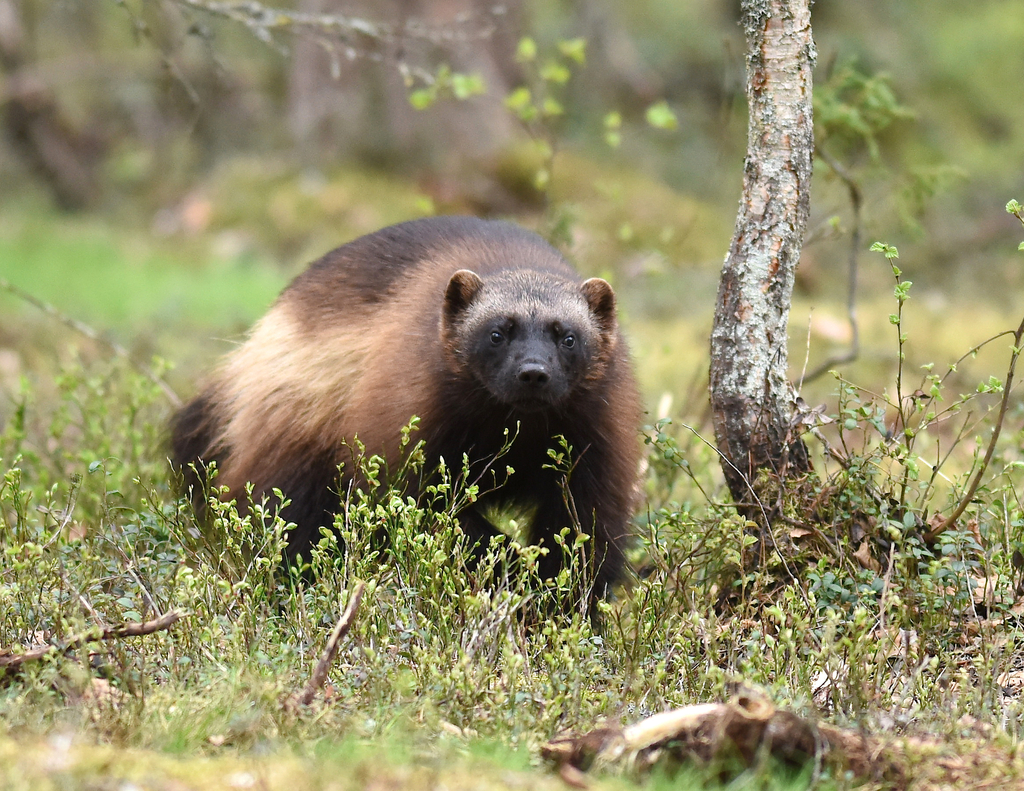
Wolverine
Photo © Dennis Vollmar
Photo © Dennis Vollmar — CC BY 4.0 — Source: iNaturalist photo #429001711Identification
The wolverine is the largest land-dwelling member of the mustelid (weasel) family. Anatomically an elongated animal low to the ground, it most closely resembles a large fisher, with a broad and rounded head, small eyes, and short rounded ears. Adults are about the size of a medium dog, with males weighing 11–18 kg (24–40 lb) and females 8–12 kg (18–26 lb), though exceptionally large males may reach up to 32 kg (71 lb). Males are typically 10–15% larger in linear measurements than females and 30–40% heavier.
The wolverine's most distinctive feature is its thick, dark, oily fur, which is highly hydrophobic and resistant to frost. Many individuals display a light-silvery facial mask, and a pale buff stripe runs laterally from the shoulders along the side and across the rump. A bushy tail of 25–35 cm (10–14 in) and sometimes prominent white hair patches on the throat or chest aid identification. Its short but powerful limbs have large, five-toed paws with crampon-like claws that enable remarkable climbing ability on steep terrain and snow-covered peaks.
Range & Habitat
The wolverine is found primarily in remote reaches of the northern boreal forests and subarctic and alpine tundra of the Northern Hemisphere. The greatest numbers are found in Northern Canada, Alaska, the mainland Nordic countries of Europe, and throughout western Russia and Siberia. Two subspecies are recognized: the Old World form (Gulo gulo gulo) and the New World form (G. g. luscus).
The wolverine's population has steadily declined since the 19th century owing to trapping, range reduction, and habitat fragmentation. It has become essentially absent from the southern end of its range in both Europe and North America, making sightings increasingly rare outside of its northernmost strongholds.
Behaviour & Diet
The wolverine is a solitary carnivore with a formidable reputation for ferocity and strength out of proportion to its size. It has the documented ability to kill prey many times larger than itself, making it one of nature's most formidable predators despite its relatively modest stature.
Like many mustelids, wolverines possess potent anal scent glands used for marking territory and sexual signaling. The pungent odor produced by these glands has earned the animal nicknames such as "skunk bear" and "nasty cat." The scent secretion is remarkably complex, with analysis revealing over 120 compounds, though the composition varies considerably between individuals.
Best Time & Places to See It
Finding wolverines in the wild is extremely challenging due to their remote habitat preferences and solitary nature. The best opportunities exist in the far north, particularly in Northern Canada, Alaska, and Siberia, where populations remain most robust. The Nordic countries of Europe also offer possible viewing opportunities, though sightings remain rare and unpredictable even in these regions.
Wolverines are most active in the remote boreal forests and alpine tundra during winter months, when their dark fur contrasts with snow-covered landscapes. However, their solitary behavior and preference for vast, inhospitable terrain means that dedicated wildlife travelers should prepare for lengthy expeditions with minimal guarantee of sightings.
Photography Tips
The wolverine's thick, dark fur and distinctive facial markings can photograph dramatically, particularly in snow or against tundra backgrounds. The animal's low-slung, muscular build and crampon-like claws are worth capturing in detail. Its potent anal glands, though not visually striking, represent a fascinating behavioral subject for behavior-focused photography.
Given the extreme remoteness of wolverine habitat and the animal's solitary, unpredictable movements, successful photography requires patience, proper Arctic equipment, and often reliance on local guides familiar with individual animals' territories. Winter conditions provide better visual contrast but demand specialized cold-weather photography gear. Long focal lengths are essential, as approaching these powerful carnivores closely is neither safe nor advisable.
Abisko National Park
Norrbottens län, Sweden
+164 birds+13 mammals
Where the Arctic tundra meets boreal forest in Swedish Lapland, Abisko National Park guards one of Europe's most dramatically fragile ecosystems. The park's terrain alternates between…
VIEW NATIONAL PARKVadvetjåkka National Park
Norrbottens län, Sweden
+41 birds+5 mammals
Subarctic plateaus and deep river valleys define this remote corner of Swedish Lapland, where boreal forest gives way to open moorland and montane tundra across a…
VIEW NATIONAL PARKRago National Park
Nordland, Sweden
+36 birds+2 mammals
Where granite gorges slice through boreal forest in Nordland's remote interior, Rago National Park preserves one of Scandinavia's most dramatic mountain landscapes. The park's deeply incised…
VIEW NATIONAL PARKJunkerdal National Park
Nordland, Sweden
+81 birds+8 mammals
Where deep river gorges slice through the high plateaus of northern Scandinavia, Junkerdal National Park reveals the raw architecture of boreal wilderness. The park's defining feature…
VIEW NATIONAL PARKDovrefjell-Sunndalsfjella National Park
Trøndelag, Norway
+127 birds+17 mammals
Granite peaks and deep valleys carved by ancient glaciers define this vast mountain wilderness straddling the spine of central Norway. Dovrefjell-Sunndalsfjella National Park rises where subalpine…
VIEW NATIONAL PARKØvre Dividal National Park
Troms, Norway
+78 birds+3 mammals
Where granite plateaus rise above the Arctic tundra in northernmost Troms, Øvre Dividal National Park unfolds across a landscape shaped by ice-age geology and subarctic climate.…
VIEW NATIONAL PARKKootenay National Park
Area G (Forster Creek/Mount Assiniboine), Canada
+181 birds+23 mammals
Where the spine of the Canadian Rockies rises above 3,000 metres, the high alpine realm around Forster Creek and Mount Assiniboine reveals one of the continent's…
VIEW NATIONAL PARKBanff National Park
Improvement District No. 9, Canada
+264 birds+33 mammals
Where the Canadian Rockies thrust skyward in a cathedral of limestone and ice, Banff National Park preserves a wilderness of astounding vertical drama. Glacier-carved valleys cradle…
VIEW NATIONAL PARKKenai Fjords National Park
Kenai Peninsula Borough, United States
+164 birds+19 mammals
Granite peaks and tidewater glaciers dominate Alaska's Kenai Peninsula, where nearly 7,900 square kilometers of pristine coastal wilderness descend from the Harding Icefield toward the Gulf…
VIEW NATIONAL PARKGates of the Arctic National Park
Unorganized Borough, United States
+112 birds+12 mammals
Where granite gorges pierce the Brooks Range and alpine tundra stretches endlessly beneath the Alaskan sky, Gates of the Arctic National Park unfolds across nearly 50,000…
VIEW NATIONAL PARKDenali National Park
Denali Borough, United States
+144 birds+18 mammals
Across nearly 31,000 square kilometres of interior Alaska, subarctic boreal forest gives way to alpine tundra, where the raw architecture of mountains—including the continent's tallest peak—shapes…
VIEW NATIONAL PARKMount Rainier National Park
Pierce County, United States
+187 birds+25 mammals
A volcanic colossus dominates the Cascade Range in western Washington, its 4,392-meter summit crowned year-round with glacial ice that cascades down toward temperate rainforest and subalpine…
VIEW NATIONAL PARKWrangell-Saint Elias National Park
Unorganized Borough, United States
+155 birds+13 mammals
Where granite peaks thrust above 5,400 metres and vast fields of glacial ice dominate the landscape, Wrangell-Saint Elias encompasses one of North America's most extreme wilderness…
VIEW NATIONAL PARKPyhä-Luosto National Park
Pelkosenniemi, Finland
+113 birds+6 mammals
Where boreal forest meets fell landscape in Finnish Lapland, Pyhä-Luosto National Park sprawls across 616 square kilometres of terrain that embodies the raw essence of the…
VIEW NATIONAL PARKStora Sjöfallet
Norrbotten County, Sweden
+150 birds+10 mammals
Where granite plateaus rise above boreal forest and ice-carved valleys plunge toward rushing rivers, Stora Sjöfallet unfolds across nearly 3,300 square kilometres of pristine subarctic wilderness…
VIEW NATIONAL PARKWaterton Lakes National Park
Improvement District No. 04, Canada
+252 birds+31 mammals
Where the Continental Divide plunges toward the prairies of Alberta, glacier-carved valleys and emerald lakes pierce a landscape where montane forest meets alpine tundra. Waterton Lakes…
VIEW NATIONAL PARKWood Buffalo National Park
Improvement District No. 24, Canada
+187 birds+10 mammals
Across nearly 75,000 square kilometres of boreal forest, wetland and grassland in northern Alberta, the landscape unfolds in a mosaic of spruce and pine woodland interspersed…
VIEW NATIONAL PARKTombstone Territorial Park
Dawson City, Canada
+150 birds+17 mammals
Where granite peaks pierce the Yukon sky and tundra stretches endlessly toward the Arctic horizon, the Tombstone Range commands attention with uncompromising beauty. This subarctic wilderness…
VIEW NATURE RESERVEKhoridol Saridag National Park
Khatgal, Mongolia
+164 birds+6 mammals
Where granite peaks thrust skyward across Mongolia's remote southeastern reaches, a landscape of raw geological drama unfolds. Deep river gorges carved through ancient stone create a…
VIEW NATIONAL PARKGlacier National Park
United States
+246 birds+39 mammals
Where jagged peaks pierce a subarctic sky and glacial valleys carve through ancient rock, Glacier National Park spans the spine of the Northern Rockies along Montana's…
VIEW NATIONAL PARKArctic National Wildlife Refuge
Arctic Village, United States
+132 birds+15 mammals
Across the northernmost reaches of Alaska's Unorganized Borough, where the Brooks Range rises from the coastal plain and tundra spreads endlessly toward the Arctic Ocean, lies…
VIEW WILDLIFE SANCTUARYNo community photos yet. Log in to add the first one.
No community observations of this species yet.