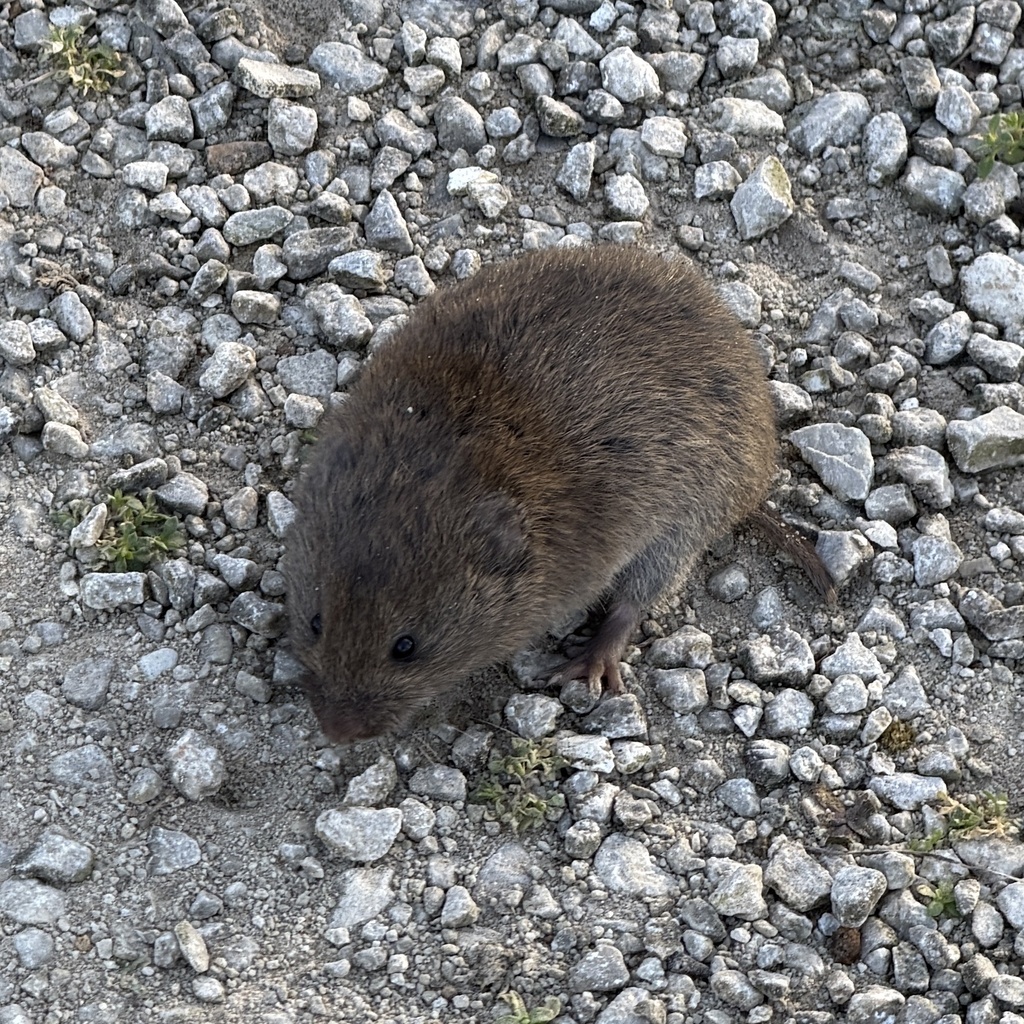
Woodland Vole
Photo © Conway Hawn
Photo © Conway Hawn — CC BY 4.0 — Source: iNaturalist #331463446The woodland vole (Microtus pinetorum) is a small vole found in eastern North America. It is also known as the pine vole. == Characteristics == The woodland vole has a head and body length ranging between 3.25–4.75 in (83–121 mm) with a 0.5–1.5 in (13–38 mm) short tail. Its weight ranges between 0.5–1.3 oz (14–37 g). It has a brown (light or dark) dorsal region with a whitish or silvery underside. The eyes, external ears and tail are reduced to adapt to their partially subterranean lifestyle. == Ecology == The woodland vole lives throughout the eastern United States, ranging as far as Nebraska, Kansas, Oklahoma, and Texas. They inhabit deciduous forests, dry fields, and apple orchards. Voles prefer wooded areas with high vertical vegetative stratification but also evergreen shrubs, ground cover, and old fallen logs. Deciduous forests with moist, friable soils are suitable for burrowing and voles are most abundant in these habitats. However, they can also be found in other habitats from dry fields to the edges of coastal bays. In addition, apple orchards are a favorite habitat. The root systems of trees are an important food source for vole and thus tree spacing affects the density of vole…
Great Smoky Mountains National Park
Sevier County, United States
+244 birds+40 mammals
Where the southern Appalachian ridgeline reaches its most densely forested expression, over 4,200 square kilometres of temperate woodland rise and fall across Tennessee and North Carolina,…
VIEW NATIONAL PARKCuyahoga Valley National Park
Brecksville, United States
+255 birds+27 mammals
Where the Cuyahoga River carves through a glaciated landscape of Ohio, the valley reveals a temperate deciduous forest ecosystem shaped by four distinct seasons and reliable…
VIEW NATIONAL PARKShenandoah National Park
Page County, United States
+243 birds+31 mammals
Ridges of ancient quartzite rise above the Shenandoah Valley floor, their slopes dressed in a mosaic of oak and hickory forest that yields to cove hardwoods…
VIEW NATIONAL PARKNo community photos yet. Log in to add the first one.
No community observations of this species yet.