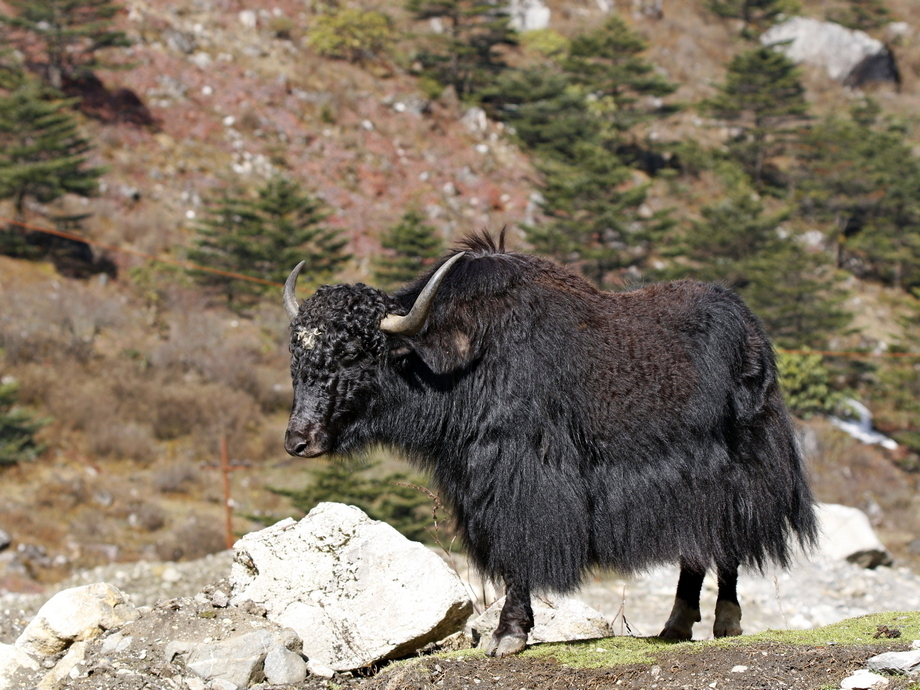
Yak
Photo © Subhadra Devi
Photo © Subhadra Devi — CC BY 4.0 — Source: iNaturalist photo #47604060Identification
The yak is a heavily built bovine with distinctive long, shaggy hair that hangs lower than its belly, giving it a uniquely robust appearance. Wild yaks are generally dark, blackish to brown, while domestic yaks display considerable colour variation, often with rusty brown and cream patches. Both sexes have small ears, broad foreheads, and smooth, dark horns that curve backwards in males (ranging from 48 to 99 cm in length) and stand more upright in females (27 to 64 cm). Males are substantially larger, weighing 350 to 585 kg compared to females at 225 to 255 kg, and both sexes feature a pronounced shoulder hump that is more visible in males. The dense woolly undercoat covers the chest, flanks, and thighs, sometimes forming a long "skirt" that reaches the ground. Perhaps most notably, yaks do not produce the characteristic mooing sound of cattle; instead, they grunt and squeak—a trait reflected in their scientific name, Bos grunniens (grunting ox).
Range & Habitat
Yaks are found throughout the Himalayan region, the Tibetan Plateau, Tajikistan, the Pamir Mountains, and as far north as Mongolia and Siberia. These animals are superbly adapted to high-altitude environments, with larger lungs and hearts than lowland cattle, along with enhanced oxygen-carrying capacity in their blood. Their physiology is finely tuned to cold climates; they possess a thick layer of subcutaneous fat and almost completely lack functional sweat glands. Conversely, yaks struggle at lower altitudes and are prone to heat exhaustion above approximately 15°C, making them creatures of the highland world.
Behaviour & Diet
Yaks are grazing herbivores that consume only about 1% of their body weight daily—far less than domestic cattle, which require 3%—thanks to an unusually large rumen that allows them to extract maximum nutrition from low-quality forage. Their wild ancestors fed primarily on grass and sedges, supplemented with herbs and dwarf shrubs. During most of the year, bulls wander in small bachelor groups separate from the main herds. The mating season, or rut, occurs in summer between July and September, when bulls become highly aggressive and compete fiercely for dominance. Males engage in dramatic displays of dominance, including bellowing, scraping the ground with their horns, charging with lowered heads, and sparring. Like bison, bulls also wallow in dry soil during the rut while scent-marking with urine or dung. Females come into oestrus up to four times annually, though they remain receptive for only a few hours per cycle. Gestation lasts 257 to 270 days, with calves born singly between May and June.
Best Time & Places to See It
The summer months from July to September offer the best opportunity to observe yaks in their natural behaviour, particularly during the rut when bulls are most active and visible. The Tibetan Plateau and Himalayan highlands are prime destinations for encountering these animals in their native habitat, along with the Pamir Mountains and regions of Mongolia and Siberia. Visitors to high-altitude regions in these areas are likely to encounter domestic yaks, while wild yaks remain more elusive inhabitants of remote highland terrain.
Photography Tips
The yak's long, flowing coat and distinctive silhouette make it a compelling photographic subject. Capture the dramatic shoulder hump and shaggy "skirt" of fur by positioning yourself to show the animal's profile against highland landscapes. During the rut season, photograph the intense interactions between bulls—their charging, sparring, and wallowing behaviour—which provide dynamic action shots. The contrast between dark wild yaks and the variable coat colours of domestic animals offers diverse compositional opportunities. Use the broad forehead and curved horns as compositional elements, and consider how the dense fur catches light differently depending on weather conditions. Early morning or late afternoon light will accentuate the texture of their long coats and enhance the dramatic alpine scenery that frames these remarkable animals.
Langtang National Park
Helambu, Nepal
+364 birds+14 mammals
Where the southern slopes of the Himalayan highlands descend toward the subtropical valleys of central Nepal, Langtang National Park sprawls across one of the subcontinent's most…
VIEW NATIONAL PARKSagarmatha National Park
Khumjung, Nepal
+219 birds+7 mammals
Soaring peaks and deep glacial valleys define this alpine wilderness in northeastern Nepal, where the terrain rises from forested foothills into a realm of high-altitude tundra…
VIEW NATIONAL PARKKhangchendzonga National Park
Sakkyong, India
+290 birds+1 mammals
Where the eastern Himalayas surge toward their crowning peaks, Khangchendzonga National Park embraces a landscape of almost overwhelming vertical drama. Rising from subtropical river valleys into…
VIEW NATIONAL PARKBaikal National Park
Ольхонский район, Russia
+184 birds+11 mammals
Where the world's deepest freshwater lake meets ancient Siberian taiga, Baikal National Park sprawls across 66,203 square kilometers of one of Earth's most singular ecosystems. The…
VIEW NATIONAL PARKGiant Panda National Park
Mianyang, China
+447 birds+47 mammals
Where the eastern slopes of China's Sichuan plateau descend into cloud-wrapped valleys, one of Asia's most biodiverse landscapes unfolds across more than 350,000 square kilometres. This…
VIEW NATIONAL PARKJiuzhai Valley
Jiuzhaigou County, China
+226 birds+7 mammals
Where crystalline alpine streams cascade through limestone gorges and karst terrain rises in dramatic vertical walls, Jiuzhai Valley unfolds across nearly 1,300 square kilometers of southwestern…
VIEW NATURAL MONUMENTHuanglong Scenic and Historic Interest Area
Ngawa Tibetan and Qiang Autonomous Prefecture, China
+194 birds+7 mammals
Across the high plateau of northwestern Sichuan, a geological wonder unfolds where limestone terraces and mineral-rich springs have sculpted one of China's most distinctive natural monuments.…
VIEW NATURAL MONUMENTHemis National Park
Raigahar Dhar, India
+131 birds+13 mammals
Where granite gorges cleave through the Himalayas at dizzying altitudes, a vast wilderness of alpine desert unfolds across the rain shadow of Ladakh. Hemis sprawls across…
VIEW NATIONAL PARKKhangai Nuruu National Park
Erdenetsogt, Mongolia
+136 birds+7 mammals
Where granite ridges pierce Mongolia's central steppe, alpine meadows give way to dense coniferous forests that climb toward windswept summits. Khangai Nuruu sweeps across 1.2 million…
VIEW NATIONAL PARKAltai Tavan Bogd National Park
Tsengel, Mongolia
+146 birds+3 mammals
Where the Altai Mountains rise in jagged defiance along Mongolia's western frontier, the terrain transforms into a realm of alpine tundra, rocky plateaus, and glacier-carved valleys…
VIEW NATIONAL PARKKhoridol Saridag National Park
Khatgal, Mongolia
+164 birds+6 mammals
Where granite peaks thrust skyward across Mongolia's remote southeastern reaches, a landscape of raw geological drama unfolds. Deep river gorges carved through ancient stone create a…
VIEW NATIONAL PARKSanjiangyuan National Park
Nagqu, China
+187 birds+25 mammals
Where the headwaters of three great Asian rivers emerge from a high alpine plateau, the landscape unfolds in tundra and dwarf shrubland—a world of austere beauty…
VIEW NATIONAL PARKWolong National Nature Reserve
Wenchuan County, China
+333 birds+17 mammals
Where the Qingyi River cuts through the eastern flanks of the Minshan Range, a temperate montane forest cloaks steep valleys in dense canopy that thins dramatically…
VIEW NATURE RESERVEQinghai Lake National Nature Reserve
Hainan Tibetan Autonomous Prefecture, China
+243 birds+11 mammals
At 3,200 metres above sea level on the Tibetan plateau, where winter temperatures plunge far below freezing and snow blankets the landscape for half the year,…
VIEW NATURE RESERVEBaima Snow Mountain National Nature Reserve
Diqing Tibetan Autonomous Prefecture, China
+204 birds+3 mammals
High-altitude ridges and steep-sided valleys define this reserve in northwestern Yunnan, where elevations surge from around 3,000 metres to peaks above 4,100 metres. The terrain supports…
VIEW NATURE RESERVENo community photos yet. Log in to add the first one.
No community observations of this species yet.