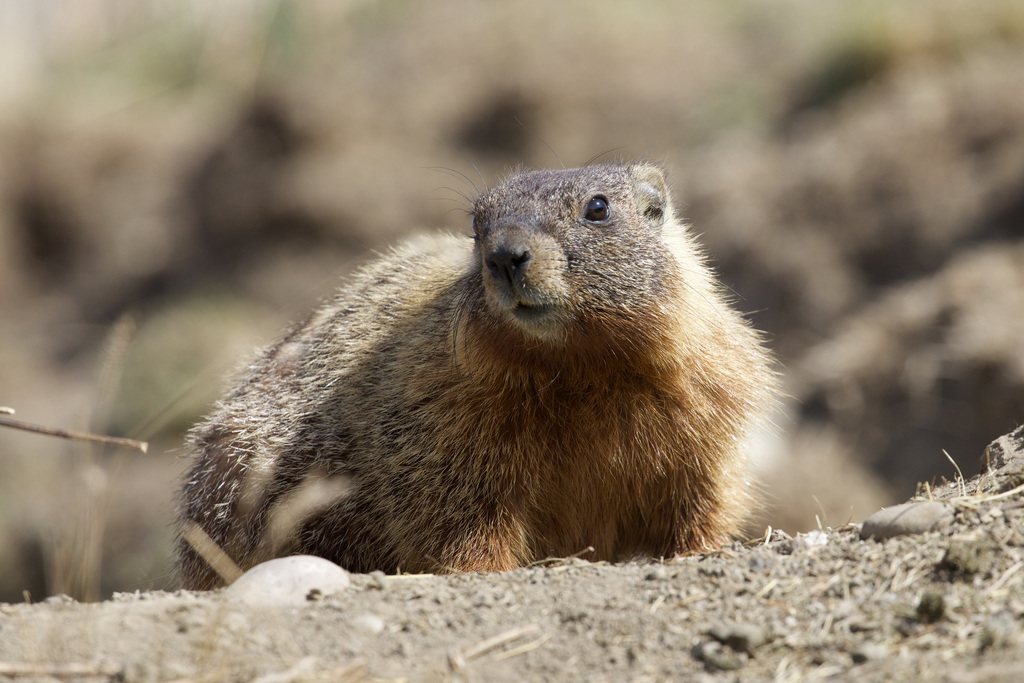
Yellow-bellied Marmot
Photo © John Krampl
Photo © John Krampl — CC BY 4.0 — Source: iNaturalist photo #194126064Identification
The yellow-bellied marmot is a large, stout-bodied ground squirrel weighing up to 5.2 kg (11 lb 7 oz), with males typically heavier than females. Adults measure 47–68 cm (18½–27 in) in length with a short tail of 13–21 cm (5–8½ in). The species is easily recognized by its distinctive appearance: a brown coat with a dark head and reddish-brown back grizzled with black and light-grey tan, combined with its namesake bright yellow fur on the belly, sides of the neck, and throat. They have a characteristic white furry patch on the snout between their eyes, small round ears, and a frosty appearance created by pale-tipped guard hairs with dark bands.
Range & Habitat
Yellow-bellied marmots inhabit the mountainous and semi-arid regions of southwestern Canada and the western United States, from southern British Columbia south to northern New Mexico, with their range including the Rocky Mountains, Sierra Nevada, Great Basin, and montane regions of Wyoming, Montana, Colorado, and southern Alberta. They occupy open habitats such as steppes, meadows, talus fields, and foothills, often at elevations above 2,000 metres (6,500 feet), though they can be found from as low as 1,600 m (5,400 ft) to over 4,300 m (14,000 ft). These marmots prefer open areas free of vegetation and typically dig burrows under rocks rather than trees, establishing territories of approximately 2.5 hectares (6 acres) with multiple burrow systems.
Behaviour & Diet
Yellow-bellied marmots are diurnal, highly social creatures living in colonies of up to twenty individuals with a harem-polygynous mating system. They spend approximately 80% of their lives in burrows, including 60% in hibernation lasting from September through May (approximately eight months). They feed on plant material, insects, and bird eggs. These marmots do not store food for winter; instead, they accumulate fat reserves during their active season to survive their long hibernation period. Upon detecting predators such as foxes, coyotes, wolves, eagles, or dogs, they emit distinctive whistles to warn colony members before retreating to nearby rock piles. They have a relatively high average lifespan of 15 years, which scientists attribute to hibernation slowing epigenetic ageing.
Best Time & Places to See It
Yellow-bellied marmots are active during their above-ground season from approximately June through August, following their emergence from hibernation. They are most commonly observed in open meadows, valleys, and foothills throughout the Rocky Mountains and Sierra Nevada at higher elevations. Early morning and mid-day are ideal times to spot them, as they are diurnal and often rest in burrows during night hours. Look for them in talus fields and rocky terrain where burrows are concentrated, particularly in areas with scattered vegetation.
Photography Tips
Photograph yellow-bellied marmots from a distance to avoid startling them into their burrows; use a telephoto lens (200–400 mm) to capture detailed shots while maintaining a safe distance. The bright yellow underside is the marmot's most distinctive feature—position yourself to capture this coloration against the rocky habitat. Early morning light produces the best contrast and reveals the subtle grizzled texturing of their coat. Scout burrow locations in advance and set up before the marmots fully emerge. Remember that these animals are vigilant; patient, stationary observation from concealment yields the best results and avoids triggering their warning whistles.
Lassen Volcanic National Park
Shasta County, United States
+239 birds+18 mammals
Volcanic peaks and geothermal upheaval have sculpted 545 square kilometers of Northern California into a landscape where fire and water engage in perpetual dialogue. Lassen Peak…
VIEW NATIONAL PARKGreat Basin National Park
White Pine County, United States
+170 birds+19 mammals
Where the Great Basin's high desert plateaus rise above 10,000 feet, ancient bristlecone pines endure on moonscape ridges of limestone and quartzite, creating one of North…
VIEW NATIONAL PARKZion National Park
Washington County, United States
+244 birds+30 mammals
Towering sandstone cliffs in shades of crimson, rust, and cream rise abruptly from the Virgin River's winding canyon floor, their sculpted faces bearing witness to millions…
VIEW NATIONAL PARKCapitol Reef National Park
Garfield County, United States
+196 birds+22 mammals
Wrinkled ridges of crimson and gold sandstone rise from the floor of south-central Utah, their weathered faces carved by the Fremont River into one of the…
VIEW NATIONAL PARKYosemite National Park
Mariposa County, United States
+224 birds+28 mammals
Granite cliffs soar nearly a kilometer above the valley floor in this expanse of high Sierra wilderness, where glacial U-shaped valleys sculpt a landscape of dramatic…
VIEW NATIONAL PARKGrand Teton National Park
Teton County, United States
+247 birds+38 mammals
Where the Teton Range tears skyward in a dramatic escarpment above the Snake River valley, nearly 2,550 square kilometers of montane wilderness unfolds across Teton County,…
VIEW NATIONAL PARKYellowstone National Park
Park County, United States
+253 birds+43 mammals
Across nearly 11,400 square kilometres of the Rocky Mountain plateau, geothermal fury and pristine wilderness converge in one of Earth's most dynamic landscapes. Hot springs, geysers…
VIEW NATIONAL PARKRocky Mountain National Park
Larimer County, United States
+259 birds+33 mammals
Where granite peaks rise above 12,000 feet and alpine tundra gives way to subalpine forest, Rocky Mountain National Park spans the Continental Divide across nearly 1,600…
VIEW NATIONAL PARKSequoia National Park
Tulare County, United States
+187 birds+27 mammals
Granite peaks rising above 3,600 meters dominate the southern Sierra Nevada, where Sequoia National Park sprawls across one of North America's most vertically compressed wilderness zones.…
VIEW NATIONAL PARKKings Canyon National Park
Fresno County, United States
+186 birds+20 mammals
Where granite peaks fracture the Sierra Nevada skyline and the Kings River has carved one of North America's most dramatic canyons, a landscape of extreme relief…
VIEW NATIONAL PARKBryce Canyon National Park
Tropic, United States
+202 birds+20 mammals
Hoodoos rise like a forest of stone pillars from an amphitheater carved into Utah's high plateau, where the Paunsaugunt elevates the landscape to over 9,000 feet…
VIEW NATIONAL PARKGlacier National Park
United States
+246 birds+39 mammals
Where jagged peaks pierce a subarctic sky and glacial valleys carve through ancient rock, Glacier National Park spans the spine of the Northern Rockies along Montana's…
VIEW NATIONAL PARKMalheur National Wildlife Refuge
Harney County, United States
+309 birds+24 mammals
Across the high desert plateau of southeastern Oregon, where sagebrush scrubland stretches toward distant ridgelines under an enormous sky, lies a sanctuary shaped by water in…
VIEW WILDLIFE SANCTUARYTule Lake National Wildlife Refuge
Siskiyou County, United States
+255 birds+9 mammals
Across the high volcanic plateau of northeastern California, where summer heat scorches the alkali flats and winter winds sweep unobstructed through open water and marsh, Tule…
VIEW WILDLIFE SANCTUARYBear River Migratory Bird Refuge
Box Elder County, United States
+254 birds+9 mammals
Where the Bear River winds through the semi-arid basin country of northwestern Utah, a sprawling wildlife sanctuary transforms the high desert into a haven for migratory…
VIEW WILDLIFE SANCTUARYNational Elk Refuge
Jackson, United States
+230 birds+27 mammals
Where the sagebrush flats of northwestern Wyoming rise toward the Gros Ventre Mountains, winter transforms the landscape into a realm of survival and spectacle. The National…
VIEW WILDLIFE SANCTUARYNo community photos yet. Log in to add the first one.
No community observations of this species yet.