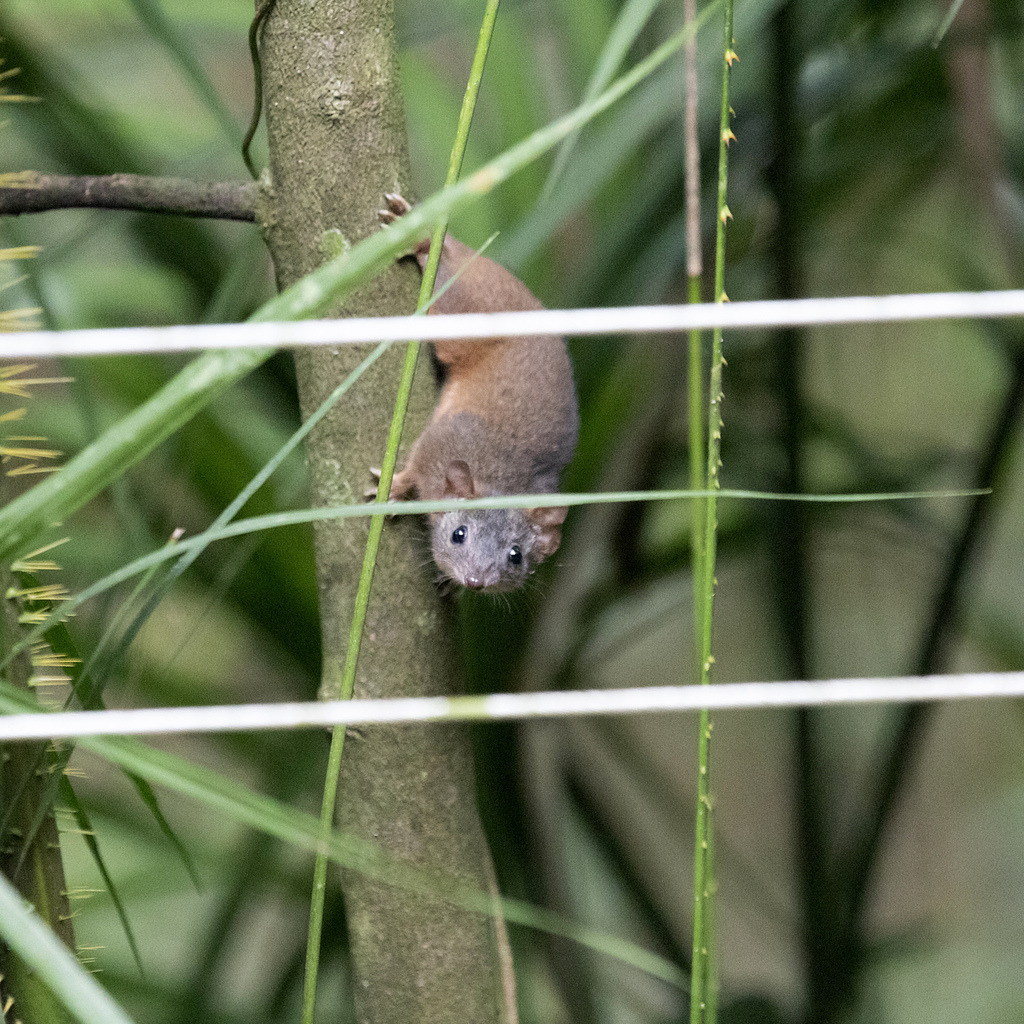
Yellow-footed Antechinus
Photo © Kym Nicolson
Photo © Kym Nicolson — CC BY 4.0 — Source: iNaturalist #70175664Identification
The yellow-footed antechinus is a small, shrew-like marsupial with distinctive features that make it recognizable in the field. Its fur is generally greyish with a characteristic slate-grey head and shoulders that gradually grades to russet or yellowish tones toward the rear. The underparts are paler at the chin and throat, with darker coloring on the rump, flanks, belly, and legs. A white eye-ring and black-tipped tail are notable field marks. True to its name, the short, broad feet are buff to yellow-brown in color. The body is compact and typical of its genus, measuring 90 to 160 millimetres in head-and-body length and weighing between 20 and 75 grams, with a moderately long tail and pointed muzzle.
Subspecific variation is geographically evident: the northeastern Queensland population (rubeculus) displays deeper red coloration compared to the southwestern Australian form (leucogaster). This variation, combined with the species' relatively diurnal habits compared to its relatives, can aid in field identification.
Range & Habitat
The yellow-footed antechinus is the most widespread member of its genus and is found discontinuously across eastern and southwestern Australia. The primary range extends from the Mount Lofty Ranges in South Australia northward to around Eungella in Queensland, with notable gaps along most of the coastal regions of New South Wales and Victoria. Isolated populations persist in northeastern Queensland and southwestern Western Australia. Some populations are locally common, though others remain uncertain in status.
This adaptable species occupies diverse habitats including dry arid scrubland and sclerophyll forest. In northern regions, it also inhabits coastal heaths, swamps, and open woodland, while in far northern tropical areas it ventures into vine forest. This habitat flexibility contributes to its widespread distribution across the continent.
Behaviour & Diet
The yellow-footed antechinus exhibits notably diurnal habits compared to other members of its genus, making it more accessible to daytime observers. The species is both polyandrous and semelparous—males engage in extraordinarily intense mating behavior during the breeding season, which profoundly affects their physiology. The frenzied mating activity so severely compromises the males' immune system that stress-related death inevitably follows before they reach one year of age. Most females also perish after weaning their young, though some survive to produce another brood the following year.
The diet consists primarily of invertebrates, supplemented with eggs, nectar, and occasionally small vertebrates. Females exhibit remarkable physiological adaptations, employing variable torpor patterns throughout gestation (approximately 28 days) and lactation to optimize offspring development under varying environmental conditions.
Best Time & Places to See It
Timing your search with the breeding season offers the best chances of observation, though males' intense mating activity during this period makes sightings particularly rewarding. The breeding season varies geographically: August for southern populations, October for southern Queensland, and June–July for north Queensland animals. Outside the breeding season, the species' comparatively diurnal nature means daytime searches are productive.
Sclerophyll forests and woodland habitats in the core range—particularly between the Mount Lofty Ranges and Eungella—offer the most reliable opportunities. In tropical northern regions, vine forests should be explored. Populations listed as locally common in specific areas provide better odds for patient observers.
Photography Tips
The yellow-footed antechinus's small size (20–75 grams) and active, diurnal habits require patient stalking and close-focus techniques. Position yourself in suitable habitat during daylight hours, particularly in early morning or late afternoon when activity peaks. A macro or telephoto lens will be essential for capturing detail of the distinctive white eye-ring and buff-colored feet that characterize this species.
During breeding season, males are more active and visible, though their frenzied behavior may make photography challenging. Capture the slate-grey head, grizzled appearance, and the striking contrast of the black tail-tip and pale throat against the darker body. Backlighting can beautifully highlight the fine texture of the fur and emphasize the species' diminutive, delicate form.
Bunya Mountains National Park
Australia
+149 birds+11 mammals
Where subtropical rainforest meets open eucalyptus woodland on the elevated plateau of southeastern Queensland, Bunya Mountains National Park unfolds across 483 square kilometres of some of…
VIEW NATIONAL PARKDaintree National Park
Dedin, Australia
+362 birds+37 mammals
Daintree National Park is one of the world’s oldest and most biologically diverse tropical rainforests, protecting an extraordinary landscape where ancient forests meet the Great Barrier…
VIEW NATIONAL PARKGreater Bendigo National Park
Whipstick, Australia
+202 birds+8 mammals
Across the red volcanic plains of inland Victoria, Greater Bendigo National Park sprawls across more than 1,000 square kilometres of eucalyptus woodland, open grassland, and scattered…
VIEW NATIONAL PARKChiltern-Mt Pilot National Park
Australia
+229 birds+12 mammals
Granite ridges and eucalyptus woodlands define this 869-square-kilometre park straddling the border between Victoria and New South Wales, where rugged terrain rises sharply from gentler foothill…
VIEW NATIONAL PARKLamington National Park
Australia
+227 birds+24 mammals
Where subtropical rainforest rises steeply from the Queensland coast, Lamington National Park spreads across 541 square kilometres of one of Australia's most biodiverse mountain landscapes. The…
VIEW NATIONAL PARKRoyal National Park
Sydney, Australia
+296 birds+46 mammals
Where sandstone ridges plunge toward the Tasman Sea, Royal National Park unfolds across 343 square kilometres of southeastern Australian coastal wilderness. The park's defining character emerges…
VIEW NATIONAL PARKBelair National Park
Adelaide, Australia
+126 birds+18 mammals
Eucalyptus woodland and native shrubland cloak the low hills of this Adelaide park, where ancient quartzite ridges rise above the plains of South Australia's densest metropolitan…
VIEW NATIONAL PARKCleland National Park
Australia
+127 birds+14 mammals
Eucalypt woodlands rise and fall across Adelaide's nearby hills, where Cleland National Park sprawls across some twenty square kilometres of native South Australian bushland. The terrain…
VIEW NATIONAL PARKBald Rock National Park
Australia
+122 birds+15 mammals
Granite peaks and weathered stone dominate the landscape of this 202-square-kilometre national park in inland New South Wales, where rugged tors and rocky outcrops rise dramatically…
VIEW NATIONAL PARKGirraween National Park
Australia
+193 birds+21 mammals
Granite boulders rise like the bones of the earth across these 278 square kilometres of southeastern Queensland, where the Great Dividing Range descends towards the coastal…
VIEW NATIONAL PARKGlass House Mountains National Park
Australia
+151 birds+8 mammals
Conical peaks of volcanic origin rise dramatically from the coastal lowlands of southeastern Queensland, their weathered slopes cloaked in eucalyptus woodland and open sclerophyll forest that…
VIEW NATIONAL PARKGreat Sandy National Park
Australia
+306 birds+40 mammals
Where coastal dunes rise inland from the Queensland coastline, Great Sandy National Park encompasses a landscape of remarkable ecological diversity shaped by subtropical humid conditions year-round.…
VIEW NATIONAL PARKBarrington Tops National Park
Australia
+175 birds+47 mammals
Where the New England Plateau rises above the Hunter Valley, temperate rainforest cloaks the highest reaches of Barrington Tops, its dense canopy fed by year-round precipitation…
VIEW NATIONAL PARKWarrumbungle National Park
Coonabarabran, Australia
+183 birds+22 mammals
Volcanic peaks and weathered ridges rise abruptly from the inland tablelands of central New South Wales, their exposed rock faces glowing ochre and rust in the…
VIEW NATIONAL PARKOxley Wild Rivers National Park
Australia
+202 birds+45 mammals
Where the New England Tablelands descend toward the coast, river gorges carve through temperate forests in a landscape of dramatic geological contrast. Oxley Wild Rivers National…
VIEW NATIONAL PARKGrampians National Park
Australia
+214 birds+18 mammals
Where sandstone ridges rise above the Western District of Victoria, Grampians National Park unfolds across rolling terrain sculpted by ancient geology and sustained by a temperate…
VIEW NATIONAL PARKStirling Range National Park
Australia
+149 birds+7 mammals
Where ancient quartzite ranges rise abruptly from the southwestern Australian plateau, Stirling Range National Park unfolds as a realm of dramatic escarpments, deep valleys, and surprising…
VIEW NATIONAL PARKNo community photos yet. Log in to add the first one.
No community observations of this species yet.