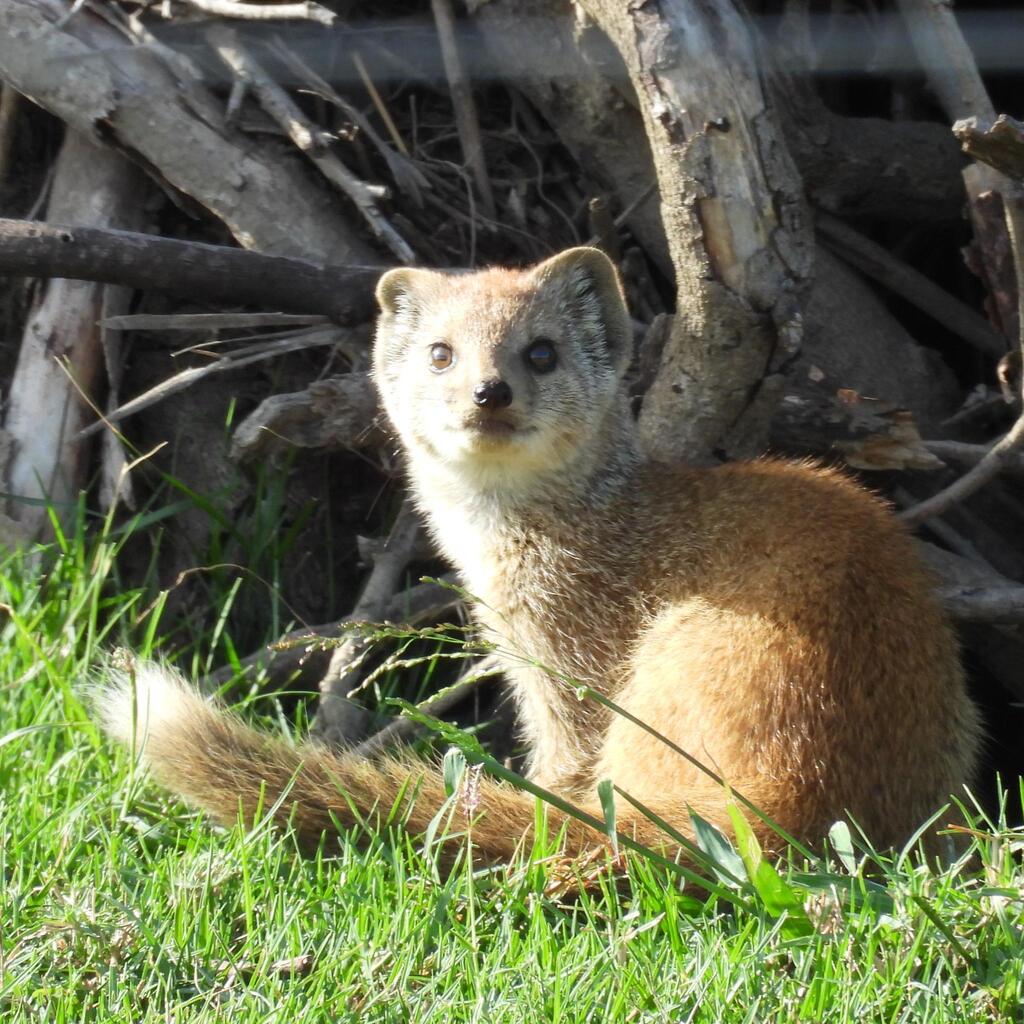
Yellow Mongoose
Photo © Henry de Lange
Photo © Henry de Lange — CC BY 4.0 — Source: iNaturalist #342568507Identification
The yellow mongoose is a small member of the mongoose family, weighing around 0.45 kg and measuring about 510 mm in length. It is sometimes called the red meerkat, though it is a distinct species. The animal displays no sexual dimorphism, meaning males and females look identical. All yellow mongooses share lighter highlights on their underbelly and chin, along with a characteristic bushy tail.
Subspecific variation is notable across the species' range. Southern yellow mongooses are larger with yellow or reddish fur, longer hair, and a distinctive white-tipped tail. Northern subspecies tend to be smaller with grey colouration, a darker grey tail tip, and shorter fur better suited to hotter climates.
Range & Habitat
The yellow mongoose is found across southern Africa, occurring in Angola, Botswana, South Africa, Namibia, and Zimbabwe. It is the only member of the genus Cynictis and inhabits open country, semi-desert scrubland, and grasslands. The species is notably adaptable and has also established populations in urban environments, particularly in South African cities.
Behaviour & Diet
Yellow mongooses are primarily diurnal hunters, though they may be active at night. They are carnivorous, feeding mainly on beetles, termites, grasshoppers, crickets, caterpillars, and ants. They also hunt rodents, small birds, reptiles, and amphibians, and will scavenge carrion and eggs. In urban areas, they forage in human refuse. They live in colonies of up to 20 individuals within permanent burrow complexes, often sharing warren systems with Cape ground squirrels or suricates, collectively maintaining and expanding the tunnel network.
Social structure is strictly hierarchical, centred on a breeding pair and their recent offspring, with subadults and elderly individuals also present. The alpha male marks colony members and territorial boundaries with anal gland and facial secretions, urine, and hair rubbed on raised objects. Generally silent, yellow mongooses communicate through tail movements and vocalizations that include growls, screams, barks, and purrs. When threatened, they growl and discharge from anal glands. Predators include birds of prey, snakes, and jackals.
Best Time & Places to See It
The yellow mongoose is diurnal and active during daylight hours, making daytime visits to open grasslands, semi-desert scrubland, and open country your best opportunity for sightings. Look for their burrow complexes, identifiable by multiple entrances and nearby latrine areas. The species occurs across southern Africa, with populations in Angola, Botswana, South Africa, Namibia, and Zimbabwe offering prime viewing locations.
Photography Tips
Photograph yellow mongooses during daylight hours when they are most active. Look for them foraging near their burrow entrances in open habitats where you can maintain a respectful distance without obstruction. The species' small size and quick movements require patience and a fast shutter speed. Their lighter underbelly, bushy tail, and distinctive white-tipped tail (in southern subspecies) make excellent focal points. Early morning or late afternoon light will best showcase their fur coloration and the characteristic features that distinguish different subspecies.
Chobe National Park
Botswana
+446 birds+45 mammals
Where the Chobe River cuts a sinuous path through northern Botswana, the landscape transforms into one of Africa's most dynamic wetland-savanna mosaics. This national park encompasses…
VIEW NATIONAL PARKMokala National Park
Siyancuma Local Municipality, South Africa
+246 birds+35 mammals
Across the semi-arid savanna of the Northern Cape, where red earth meets sparse acacia woodland and open grassland punctuated by rocky outcrops, lies a landscape shaped…
VIEW NATIONAL PARKMountain Zebra National Park
Inxuba Yethemba Local Municipality, South Africa
+265 birds+35 mammals
Across the windswept plateaus and deeply incised valleys of the Eastern Cape's interior, Mountain Zebra National Park unfolds as a landscape of geological drama and ecological…
VIEW NATIONAL PARKAugrabies Falls National Park
Kai !Garib Local Municipality, South Africa
+176 birds+20 mammals
Where the Orange River cuts a dramatic scar through the Northern Cape's arid interior, Augrabies Falls National Park sprawls across nearly 1,200 square kilometers of raw,…
VIEW NATIONAL PARKAddo Elephant National Park
Sundays River Valley Local Municipality, South Africa
+388 birds+55 mammals
Where the Eastern Cape's semi-arid scrublands meet transitional woodland, Addo sprawls across 13,478 square kilometres of one of southern Africa's most biodiverse landscapes. The terrain rises…
VIEW NATIONAL PARKCamdeboo National Park
Camdeboo Local Municipality, South Africa
+272 birds+24 mammals
Granite ridges and weathered sandstone cliffs rise across a semi-arid landscape where the Karoo transitions into the eastern escarpment of South Africa, creating Camdeboo National Park's…
VIEW NATIONAL PARKNamib-Naukluft National Park
Namibia
+217 birds+33 mammals
Across nearly 94,000 square kilometers of southwestern Namibia, a landscape of extremes unfolds where towering sand dunes meet rugged mountain ranges, and ancient riverbeds carve through…
VIEW NATIONAL PARKEtosha National Park
Namibia
+356 birds+58 mammals
Across northern Namibia's stark semi-arid plateau, a vast shallow depression transforms seasonally into one of Africa's most dramatic wildlife theaters. Etosha National Park, encompassing more than…
VIEW NATIONAL PARKMakgadikgadi Pans National Park
Gucta, Botswana
+272 birds+27 mammals
Where salt-crusted flatlands stretch endlessly toward a shimmering horizon, one of Africa's most extraordinary ecosystems awakens with the rains. The Makgadikgadi Pans comprise vast mineral-rich basins…
VIEW NATIONAL PARKNo community photos yet. Log in to add the first one.
No community observations of this species yet.