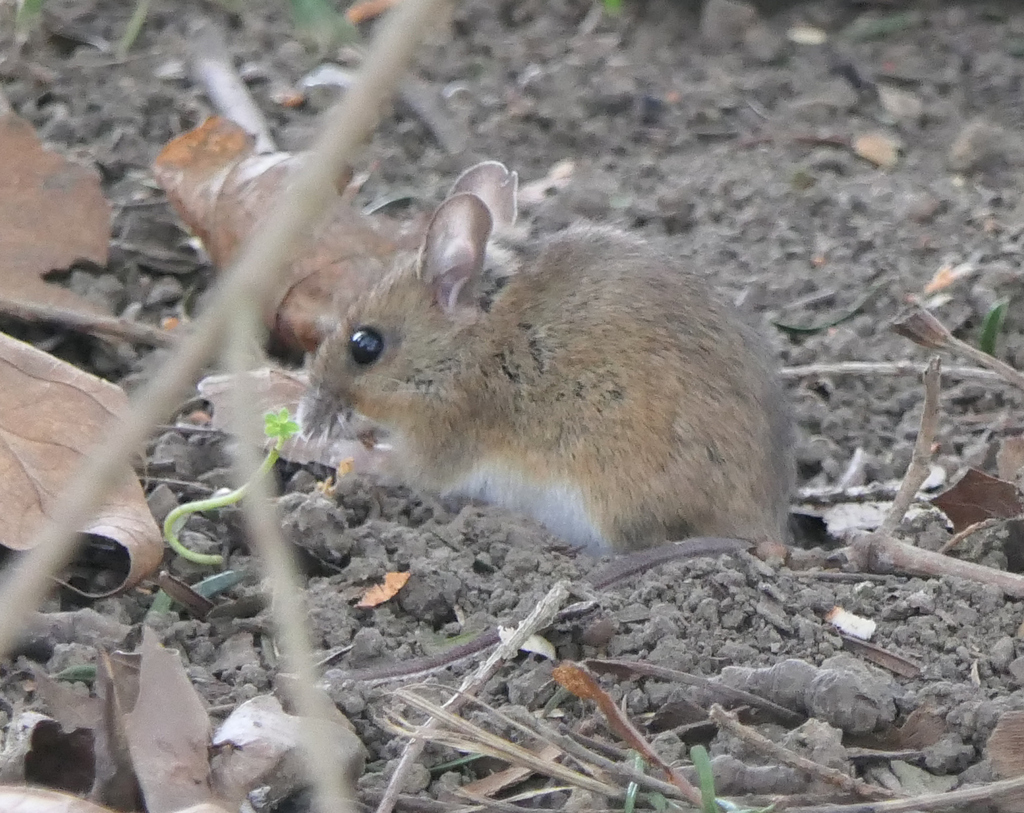
Yellow-necked Field Mouse
Photo © Roland Gromes
Photo © Roland Gromes — CC BY 4.0 — Source: iNaturalist #333204681Identification
The yellow-necked field mouse is easily confused with its close relative, the wood mouse, but several distinctive features set it apart. Most notably, it bears a complete band of yellow or ochre-coloured fur across the neck area between its forelegs—though this marking can sometimes be inconspicuous. The yellow-necked mouse also has slightly larger ears and is generally slightly larger overall than the wood mouse. Its upperparts are brownish-grey with a distinctly more brown tone than the wood mouse, while the underparts are pure white with a sharp demarcation line between the two colours. Adults measure 89–133 mm in head and body length, with a tail approximately as long again, and weigh between 28–43 grams.
Range & Habitat
This species is native to Europe and western Asia, with a range extending from the mountainous regions of Western Europe eastward to the Ural Mountains. It occurs in Great Britain but not Ireland, and is absent from northern Scandinavia, southern Spain, western France, and numerous Mediterranean islands. Its range also encompasses Turkey, Armenia, Iran, Syria, Lebanon, and Israel. The yellow-necked mouse is primarily a woodland species, favouring mature deciduous forests near forest verges, particularly in mountainous regions where it inhabits all forest types. It also thrives in scrubby areas, hedgerows, orchards, plantations, parks, and gardens, showing a strong preference for areas with large nut-bearing trees such as oak and hazel.
Behaviour & Diet
Active year-round without hibernating, the yellow-necked mouse is a superb climber that scrambles through trees and bushes with equal agility. Nocturnal by nature, it maintains a home range smaller than half a hectare. The species creates extensive burrow systems with multiple entrances and complex layouts, often constructing elaborate food storage chambers and nesting areas lined with dry plant material. It also establishes food caches in tree holes away from its burrow. Besides acorns and beechmast, it feeds on buds, shoots, fruit, seedling plants, and occasionally small invertebrates. During winter, several mice may huddle together to preserve heat.
Breeding occurs between February and October, with females producing successive litters at short intervals. After a gestation period of about twenty-six days, females give birth to typically five young (ranging from two to eleven) in a prepared nesting chamber. Young are born naked, blind, and helpless, opening their eyes after approximately two weeks. Weaning occurs around eighteen days of age, and early-born young may breed in their birth year, while late-born individuals mature sexually the following spring.
Best Time & Places to See It
The yellow-necked mouse is common throughout its range in suitable habitats, with densities reaching up to one hundred individuals per hectare in Eastern Europe. To observe this species, focus on mature deciduous woodlands, particularly those dominated by oak and hazel, especially near forest edges and in mountainous terrain. It may also be encountered in parks, orchards, and gardens with mature trees. Since the species is nocturnal and active in both ground and canopy levels, nighttime observation with appropriate lighting offers the best opportunities for sighting. The species is active year-round, so visits during any season may prove rewarding.
Photography Tips
Photographing the yellow-necked mouse requires patience and preparation for nocturnal work. Position camera traps near burrow entrances, which are often marked by earth mounds, or within suitable woodland habitat. The species' climbing ability means setting up cameras at various heights to capture both ground-level and arboreal behaviour. The distinctive yellow neck band is the key identification feature to capture—ensure adequate lighting to render this ochre-coloured marking clearly visible against the brownish-grey upperparts. The sharp contrast between brown upperparts and white underparts provides excellent compositional potential. Wide shots showing the mouse in its woodland habitat among nut-bearing trees, and close-ups highlighting facial features and ear size, will best convey the species' character and distinctiveness from the similar wood mouse.
Stenshuvuds National Park
Skåne län, Sweden
+224 birds+19 mammals
Where limestone cliffs rise sharply above the Øresund Strait, Stenshuvuds National Park commands the southeastern tip of Skåne, a landscape carved by glaciation into rolling beech…
VIEW NATIONAL PARKSöderåsens National Park
Skåne län, Sweden
+136 birds+18 mammals
Steep beech-clad ravines and limestone escarpments carve through the landscape of southern Sweden's Skåne region, creating Söderåsens—a textbook example of temperate woodland gorge habitat. The park's…
VIEW NATIONAL PARKHarz National Park
Harz (LK Goslar), Germany
+141 birds+38 mammals
Where granite peaks rise above beech and spruce forests, the Harz unfolds as one of Germany's most biodiverse upland landscapes. Straddling the border between Lower Saxony…
VIEW NATIONAL PARKSchleswig-Holsteinisches Wattenmeer National Park
Germany
+378 birds+49 mammals
Where the North Sea ebbs and flows across a vast expanse of exposed mud and sand, the Schleswig-Holsteinisches Wattenmeer National Park reveals one of Europe's most…
VIEW NATIONAL PARKBavarian Forest National Park
Germany
+127 birds+18 mammals
Where ancient spruce and fir forests rise across the Bohemian plateau, the Bavarian Forest National Park unfolds as one of central Europe's most intact temperate woodland…
VIEW NATIONAL PARKBannau Brycheiniog National Park
Powys, United Kingdom
+178 birds+36 mammals
Where sandstone ridges rise above the rolling moorlands of mid-Wales, Bannau Brycheiniog National Park protects one of Britain's most compelling upland landscapes. The park's dramatic peaks,…
VIEW NATIONAL PARKSouth Downs National Park
Chichester, United Kingdom
+298 birds+45 mammals
Chalk downland ridges rise and fall across the South Downs, their open grasslands and beech hangers creating a mosaic of habitats that has shaped human settlement…
VIEW NATIONAL PARKDanube Delta Biosphere Reserve
Tulcea, Romania
+277 birds+27 mammals
Where the Danube surrenders to the Black Sea, a vast labyrinth of channels, reed beds, and freshwater lakes sprawls across nearly 13,400 square kilometers of eastern…
VIEW NATIONAL PARKNuuksio National Park
Espoo, Finland
+135 birds+12 mammals
Across the forested plateaus and rocky shorelines of southern Finland, where granite bedrock pierces through boreal woodland just twenty kilometers northwest of Helsinki, lies a landscape…
VIEW NATIONAL PARKCévennes National Park
Vebron, France
+187 birds+63 mammals
Where granite gorges slice through the limestone plateaux of southern France, the Cévennes Cœur National Park unfolds across nearly 3,500 square kilometres of one of Europe's…
VIEW NATIONAL PARKForêts National Park
Lucey, France
+140 birds+50 mammals
Across the rolling plateaux of central Burgundy, where limestone uplands give way to deep valleys carved by time and water, lies a landscape of profound ecological…
VIEW NATIONAL PARKŐrség National Park
Kondorfa, Hungary
+88 birds+12 mammals
Where low, forested ridges roll across the border landscape between Hungary and Slovenia, Őrség National Park encompasses a patchwork of beech and oak woodlands, wetland corridors,…
VIEW NATIONAL PARKMontseny Natural Park
Viladrau, Spain
+156 birds+30 mammals
The Montseny Natural Park is one of Catalonia’s most remarkable protected areas, offering an extraordinary blend of biodiversity, scenic landscapes, and cultural heritage within easy reach…
VIEW NATURAL PARKRegional Park of the Catalan Pyrenees
Olette, France
+244 birds+63 mammals
Where granite peaks thrust skyward above cloud-laden valleys, a wild tapestry of Mediterranean and alpine ecosystems interweaves across the Franco-Spanish frontier. These Pyrenean slopes harbour extraordinary…
VIEW NATURE RESERVELahemaa National Park
Lääne-Viru County, Estonia
+237 birds+25 mammals
Where the Baltic coast meets temperate forest in northwestern Estonia, Lahemaa National Park sprawls across more than 1,300 square kilometers of deeply character-filled terrain. Coastal wetlands…
VIEW NATIONAL PARKParcial de la Fageda d’en Jordà Nature Reserve
Santa Pau, Spain
+117 birds+5 mammals
Where volcanic slopes rise above the Catalan heartland, the Parcial de la Fagada d'en Jordà unfolds across five square kilometres of one of Europe's most botanically…
VIEW NATURE RESERVELosiny Ostrov National Park
Balashikhinsky District, Russia
+173 birds+20 mammals
Across the forested plateaus of Moscow Oblast, where the Losinka River winds through mixed woodland and marshy clearings, lies a national park that captures the ecological…
VIEW NATIONAL PARKWolin National Park
Kamień County, Poland
+232 birds+21 mammals
Where the Baltic shoreline meets vast wetland complexes and Pleistocene woodlands, Wolin National Park unfolds across nearly 440 square kilometres of northwestern Poland's most biodiverse terrain.…
VIEW NATIONAL PARKŚwiętokrzyski National Park
Dębno, Poland
+70 birds+2 mammals
Granite ridges and beech forests define this protected landscape in central Poland, where ancient hills rise above rolling farmland and small streams carve through limestone valleys.…
VIEW NATIONAL PARKBiałowieża National Park
Bialowieza, Poland
+177 birds+23 mammals
Straddling the border between Poland and Belarus, this primordial forest landscape encompasses one of Europe's last remaining expanses of old-growth woodland, where ancient trees rise through…
VIEW NATIONAL PARKSeven Sisters National Nature Reserve
Eastbourne, United Kingdom
+190 birds+15 mammals
Where the South Downs meet the English Channel, the chalk cliffs of Seven Sisters rise in a dramatic sequence of white promontories that have shaped both…
VIEW NATURE RESERVENo community photos yet. Log in to add the first one.
No community observations of this species yet.