Yellow-throated Marten
Photo © scott_young
Photo © scott_young — CC0 1.0 — Source: iNaturalist #257546553Identification
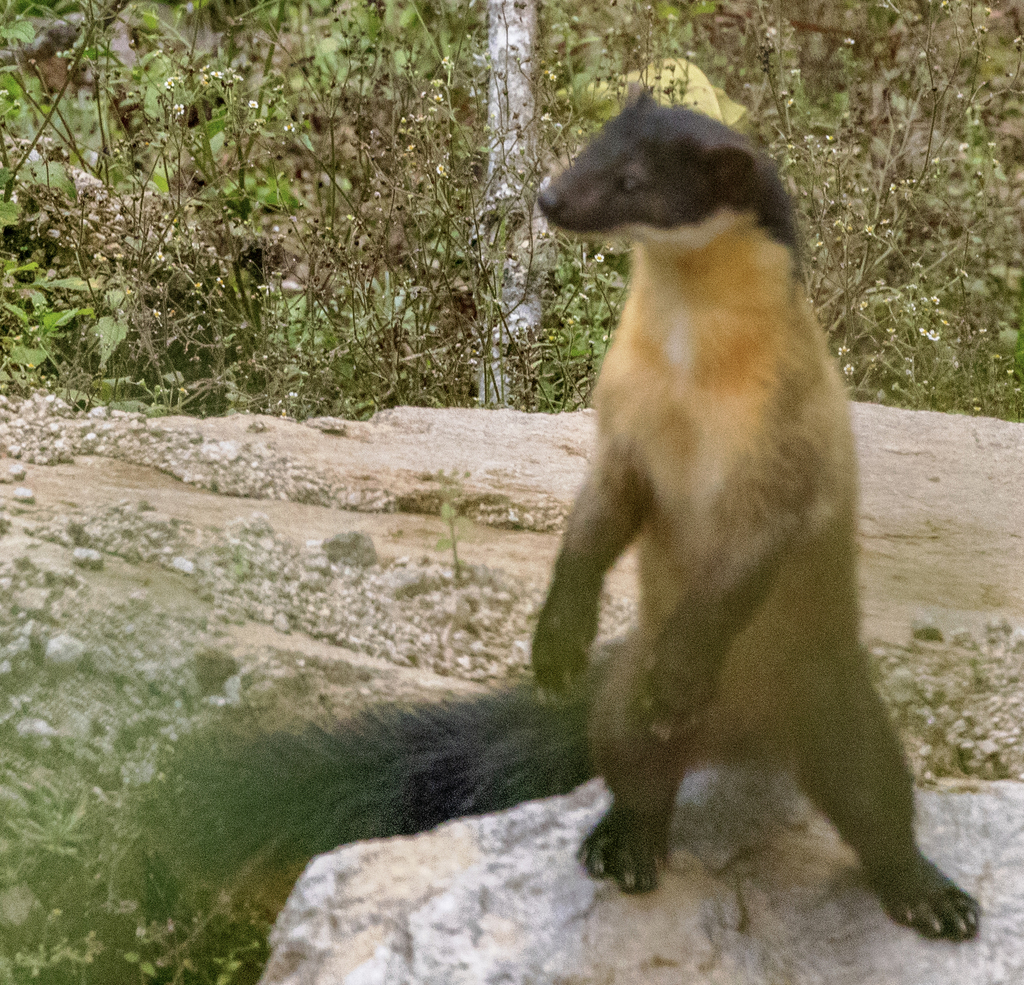
The yellow-throated marten is a striking and colourful mustelid with a distinctive coat of bright yellow-golden fur contrasted by a much darker head and back, blending black, white, golden-yellow and brown. Its most characteristic features include an orange-golden chest and throat, reddish cheeks, blackish-brown pointed head, and bright yellowish flanks and belly. The tail is notably black above with a greyish-brown base and lighter tip, accounting for roughly two-thirds of the animal's body length.
This is the second-largest marten in the Old World, with males measuring 50–72 cm in body length and weighing 2.5–5.7 kg, while females are slightly smaller at 50–62 cm and 1.6–3.8 kg. The species has a robust, muscular build with an elongated thorax, long neck, and relatively short but strong limbs with broad paws. Large, rounded ears and the distinctive soles covered with coarse, flexible hairs are also notable field marks.
Range & Habitat
The yellow-throated marten is widely distributed across the Himalayas and throughout much of Asia. Its range spans from Afghanistan and Pakistan through the Himalayan regions of India, Nepal and Bhutan, extending across continental southern China and Taiwan, the Korean Peninsula and eastern Russia. To the south, the species is found in Bangladesh, Myanmar, Thailand, the Malay Peninsula, Laos, Cambodia and Vietnam, with populations also occurring in Indonesian islands including Borneo, Sumatra and Java.
This adaptable species occupies diverse elevations and habitats; it has been recorded at elevations up to 4,510 m in alpine meadows of Nepal, while also thriving in lower-altitude forested regions. It occurs in several protected areas across its range, including Musk Deer National Park in Pakistan.
Behaviour & Diet
The yellow-throated marten is diurnal and highly active, typically hunting in pairs but sometimes in larger packs of three or more. It holds extensive home ranges that it actively patrols, capable of covering 10–20 km in a single day and night. Though primarily a ground hunter, it is a proficient climber able to make jumps of 8–9 m between tree branches, though after heavy March snowfalls it restricts its activities to the treetops.
This opportunistic omnivore has a remarkably diverse diet. It hunts rodents, hares, reptiles, birds (including pheasants and francolins), and invertebrates, but is also known to take small ungulates, smaller marten species, and occasionally cats and poultry. In the Himalayas and Ussuriland, it specializes in hunting muntjac and musk deer fawns, with two or three individuals capable of consuming a musk deer carcass within 2–3 days. The species also supplements its diet with fruit and nectar, making it an important seed disperser, and has been documented trailing tigers to feed on their kills.
Best Time & Places to See It
The yellow-throated marten is found across a vast range with stable populations, making it reasonably accessible to wildlife enthusiasts throughout much of Asia. Protected areas across its distribution offer the best opportunities for sightings, including Kanchenjunga Conservation Area in Nepal and Musk Deer National Park in Pakistan. The species' wide elevational range means it can be encountered from lowland forests to high-altitude alpine meadows.
As a diurnal hunter that actively patrols its territory during daylight hours, early mornings and throughout the day offer the best viewing opportunities. Its habit of hunting on the ground and climbing through forest canopies means patience and careful observation of both forest floors and mid-storey vegetation will increase chances of encounters.
Photography Tips
The yellow-throated marten's striking coloration and contrasting patches of bright yellow, orange, and dark brown make it a visually rewarding photographic subject. Its active, daytime habits work in the photographer's favour, and its large ears and rounded facial features are particularly expressive and photogenic. Capture shots that showcase the distinctive orange-golden throat and chest against the darker head and back for the most striking images.
The species' impressive athleticism—particularly its spectacular inter-branch leaps of up to 9 metres—offers dynamic photography opportunities in forested habitats. Fast shutter speeds will be necessary to freeze action during hunting or travelling through the canopy. Patience is essential; spend time in suitable habitat during daylight hours, and watch for the animal's characteristic active patrolling behaviour that makes sightings more likely than with many other forest carnivores.
Langtang National Park
Helambu, Nepal
+364 birds+14 mammals
Where the southern slopes of the Himalayan highlands descend toward the subtropical valleys of central Nepal, Langtang National Park sprawls across one of the subcontinent's most…
VIEW NATIONAL PARKSagarmatha National Park
Khumjung, Nepal
+219 birds+7 mammals
Soaring peaks and deep glacial valleys define this alpine wilderness in northeastern Nepal, where the terrain rises from forested foothills into a realm of high-altitude tundra…
VIEW NATIONAL PARKKhao Yai National Park
Prachantakham District, Thailand
+377 birds+46 mammals
Evergreen dipterocarp forest blankets the rolling terrain of this national park in eastern Thailand, where limestone hills rise abruptly from the forest floor and seasonal streams…
VIEW NATIONAL PARKGiant Panda National Park
Mianyang, China
+447 birds+47 mammals
Where the eastern slopes of China's Sichuan plateau descend into cloud-wrapped valleys, one of Asia's most biodiverse landscapes unfolds across more than 350,000 square kilometres. This…
VIEW NATIONAL PARKNortheast China Tiger and Leopard National Park
Mu Dan Jiang Shi, China
+202 birds+19 mammals
Across the temperate forests of northeastern China, where winters grip the landscape in subzero silence and summers remain cool and brief, the Mudanjiang region supports a…
VIEW NATIONAL PARKNo community photos yet. Log in to add the first one.
No community observations of this species yet.