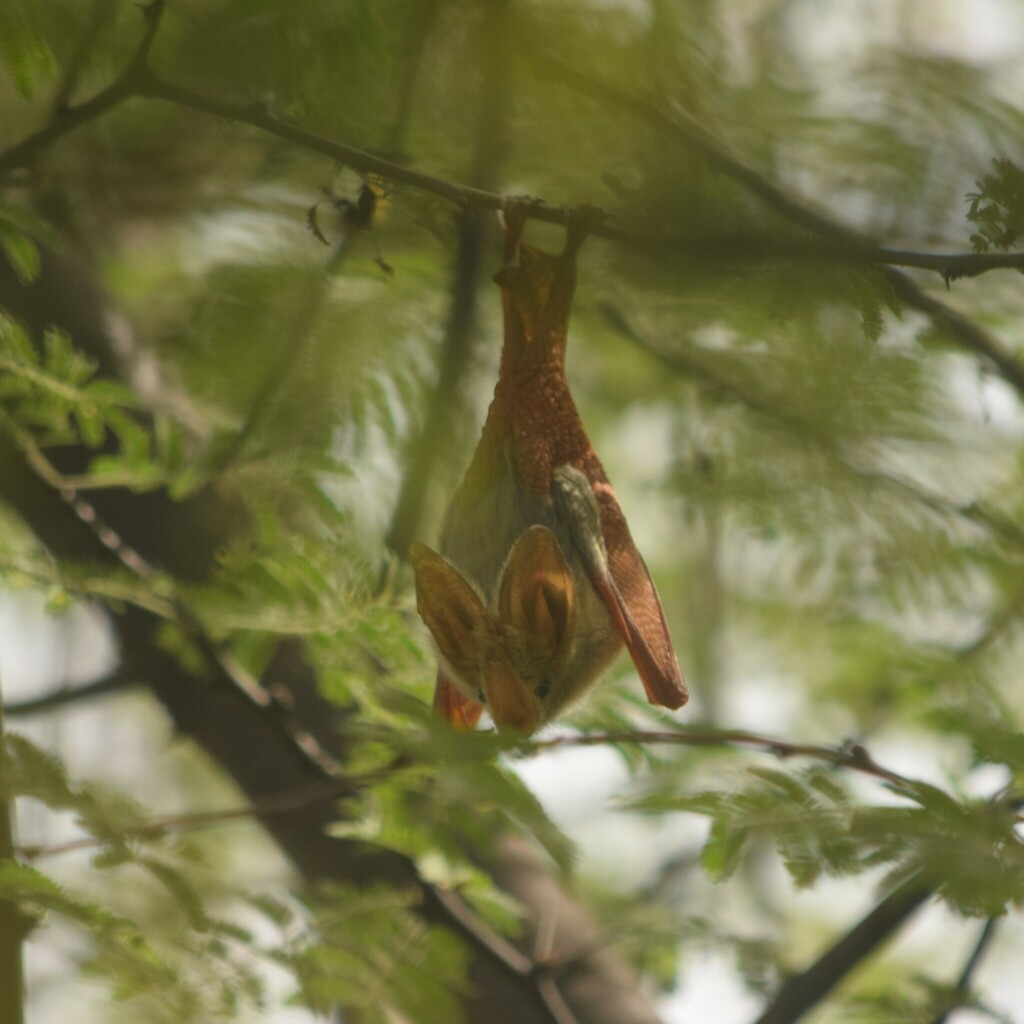
Yellow-winged False-vampire
Photo © Chiara
Photo © Chiara — CC BY 4.0 — Source: iNaturalist #216340530Identification
The yellow-winged false-vampire is a small bat, measuring 58–80 mm in total length with a wingspan averaging 36 cm and weighing 28–36 grams. Females are slightly larger than males. The most distinctive feature is the bright reddish-yellow colouration of the wings and all wing membranes, which contrasts sharply with the body's pearl grey or slaty grey pelage. Males display greenish-yellow fur on the hindparts and ventral surfaces. The bat has fairly long ears with a spiky tragus and an elongated, blunt-tipped noseleaf that is also reddish-yellow. Notable anatomical features include an advanced interfemoral membrane but no external tail, and males possess distinctive glands on the lower back that discharge a yellow substance.
Range & Habitat
The yellow-winged false-vampire has an extensive range throughout sub-Saharan Africa, extending south to northern Zambia. It inhabits woodland and savannah ecosystems at elevations below 2,000 metres. The species shows a strong preference for acacia trees and thorn bushes positioned near bodies of water, where it hunts over open ground. These bats favour well-spaced vegetation that allows them to maintain visual awareness of their surroundings. They roost primarily in small trees and shrubs, though they may also shelter in tree cavities and buildings, typically maintaining both a primary roost used in morning and evening hours and a peripheral roost visited during hotter parts of the day.
Behaviour & Diet
The yellow-winged false-vampire is monogamous, with pairs forming during breeding season and establishing shared foraging territories. Roosting partners remain within one metre of each other, with one individual maintaining vigilance and possessing the remarkable ability to turn its head 225 degrees. Unlike other false vampire bats, this species feeds exclusively on insects rather than small vertebrates, hunting both soft- and hard-bodied prey including termites, scarab beetles, orthopterans, lepidopterans, and dipterans. It employs a sit-and-wait hunting strategy, perching and listening for prey before launching attacks. The species is highly alert despite potential predation from eastern green mambas, bat hawks, Blanding's cat snakes, and common kestrels. Reproduction varies by region: in Zambia, young are born in October at the close of the dry season, while at Lake Baringo in Kenya, birth coincides with the start of the long rains in April. Females carry a single young for approximately three months, with young becoming self-sufficient in flight after about a week at the roost and weaning at around 55 days old.
Best Time & Places to See It
The yellow-winged false-vampire is most active during early morning and evening foraging periods. Males and females show maximum social interaction between May and early June, when insect abundance peaks and young are developing their hunting skills—potentially the best window for observing family groups. Visit acacia woodlands and savannah habitats near water bodies in sub-Saharan Africa, particularly in regions with well-spaced vegetation. Though not particularly threatened, the species is likely uncommon, requiring patience and local knowledge to locate.
Photography Tips
The species' distinctive reddish-yellow wings and membranes make it visually striking but challenging to photograph in flight. Early morning and evening light will best illuminate the characteristic yellow coloration. Since the bat employs a sit-and-wait hunting strategy from perches, patient positioning near known roosting trees may yield opportunities for perched shots. The bat's ability to turn its head dramatically and move its ears independently offers compelling portrait possibilities. Remember that this species is alert and vigilant, so approach carefully and avoid sudden movements that might trigger evasion.
Serengeti National Park
Tanzania
+558 birds+57 mammals
Across Tanzania's northern plateau, where volcanic soils meet acacia woodland and open grassland, unfolds one of Earth's most dynamic ecosystems. The Serengeti National Park sprawls across…
VIEW NATIONAL PARKMurchison Falls National Park
Uganda
+608 birds+33 mammals
Where the Victoria Nile compresses through a narrow gorge and explodes across a 45-meter precipice, the landscape speaks in thunder. Murchison Falls National Park sprawls across…
VIEW NATIONAL PARKTsavo East National Park
Athi ward, Kenya
+468 birds+50 mammals
Across the semi-arid lowlands of southeastern Kenya, where acacia woodland fragments into scrubland and the landscape rolls toward the Indian Ocean horizon, lies one of Africa's…
VIEW NATIONAL PARKAmboseli National Park
Etonet/Lenkism ward, Kenya
+501 birds+43 mammals
Where the Amboseli basin opens toward the Tanzanian frontier, a shallow alkaline lake mirrors vast skies across one of East Africa's most iconic savanna landscapes. The…
VIEW NATIONAL PARKTarangire National Park
Tanzania
+527 birds+50 mammals
Acacia woodland and grassland sweep across the Manyara Region where the Tarangire River carves through low hills and volcanic soils, creating one of East Africa's most…
VIEW NATIONAL PARKNgorongoro Conservation Area
Tanzania
+626 birds+55 mammals
Volcanic calderas and open grassland dominate this high plateau in northern Tanzania, where the landscape rises above 2,000 metres and ancient geological forces have shaped both…
VIEW WILDLIFE MANAGEMENT AREAQueen Elizabeth National Park
Uganda
+672 birds+30 mammals
Across the southwestern escarpment of Uganda, where the Western Rift Valley descends through ancient volcanic terrain, Queen Elizabeth National Park sprawls across more than 8,300 square…
VIEW NATIONAL PARKSamburu National Reserve
Samburu, Kenya
+430 birds+42 mammals
Across the arid plains of northern Kenya, where scattered acacia woodland gives way to rocky outcrops and dry riverbeds, Samburu National Park unfolds as one of…
VIEW NATURE RESERVENo community photos yet. Log in to add the first one.
No community observations of this species yet.