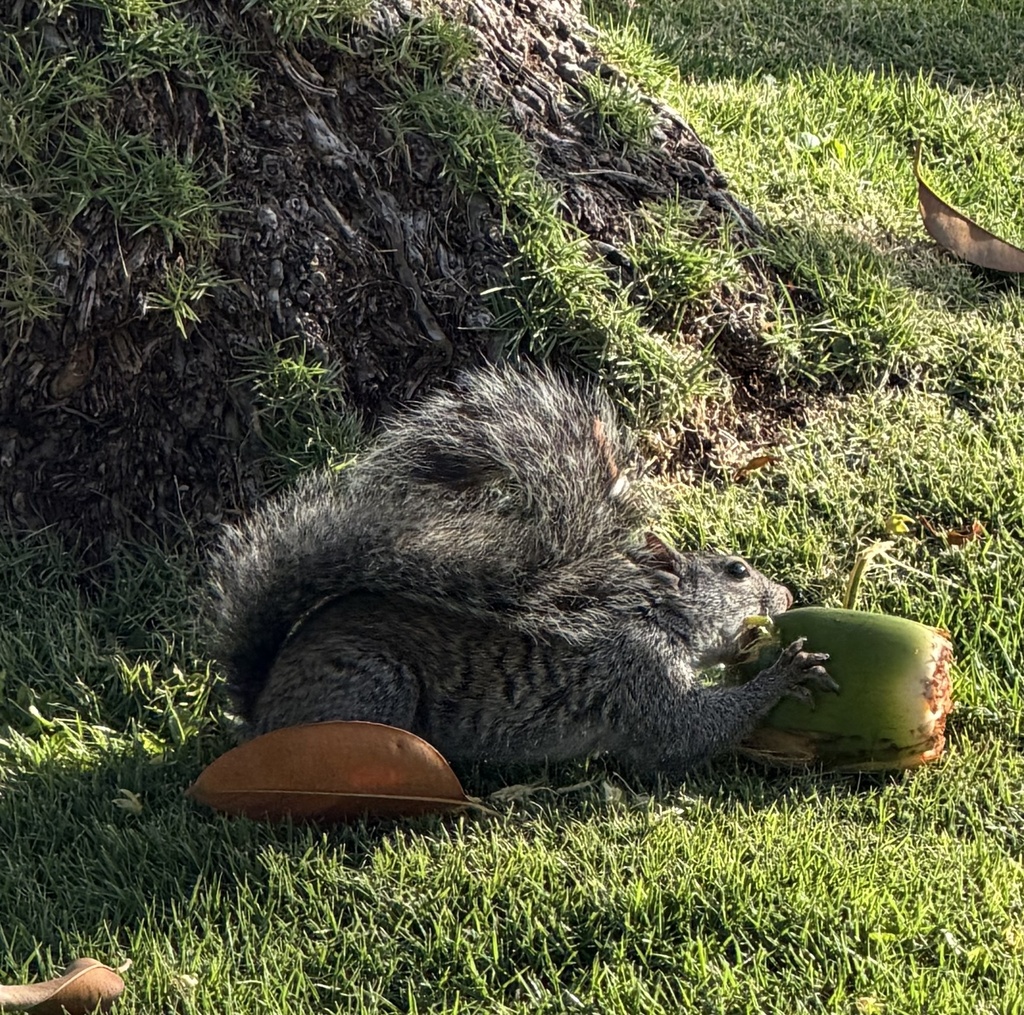
Yucatán Squirrel
Photo © Irina Mitine
Photo © Irina Mitine — CC BY 4.0 — Source: iNaturalist #341521069Identification
The Yucatán squirrel is a robust tree squirrel measuring 450–500 mm in body length with a distinctive 240 mm tail, making it larger than the eastern gray squirrel. Both sexes are similar in size, weighing 341–475 grams. The species has coarse, harsh pelage with black and grey upper parts marked by yellow to ochraceous buff coloring. The underparts are off-white, yellow-grey, and black. Its most distinctive feature is the white tail with well-defined black lines and black on either side of the central white stripe. The face bears a buff-colored patch above the nose, with mainly black sides. Narrow, pointed ears are tufted and off-white from November to February in northern populations and February to April in southern populations. Three subspecies are recognized, with S. y. phaeopus being notably darker, possessing black legs and tail, while S. y. baliolus displays darker pelage than the nominate form.
Range & Habitat
Native to northern Belize, northeastern Guatemala, and southeast Mexico, the Yucatán squirrel is found throughout the Yucatán Peninsula and adjacent areas. The nominate subspecies (S. y. yucatanensis) has the largest distribution, occurring in the Mexican states of Yucatán, Campeche, and Quintana Roo, extending south to Orange Walk and Corozal districts in northern Belize, where it inhabits arid woodlands. S. y. baliolus occurs in a band across the peninsula from Campeche and eastern Tabasco through northeastern Petén in Guatemala to Cayo and Belize districts, preferring more moist evergreen woodlands. S. y. phaeopus is found at the peninsula's base from northwestern and eastern Chiapas through southern Petén and Alta Verapaz to coastal Belize, historically inhabiting pine-oak woodlands. The species occurs in dry deciduous and evergreen forests, semiarid pine-oak woodlands, and secondary forest in formerly logged areas, always in lowlands below 750 metres altitude.
Behaviour & Diet
Yucatán squirrels are diurnal, spending most of their time in trees where they build dreys (nests) from leaves and twigs high in the branches. They are most active in early morning but may be observed sunning on branches later in the day before resting at night. Their diet consists primarily of flowers, buds, and shoots, supplemented by soft fruit, nuts, and seeds. Females give birth to two or three young during the April to August dry season. The species faces predation from birds of prey, wild cats, dogs, procyonids, primates, and snakes.
Best Time & Places to See It
Early morning hours offer the best opportunities to observe Yucatán squirrels, when they are most active. Throughout the day, they may be spotted resting or sunning on branches. The nominate subspecies is best sought in arid woodlands of Yucatán, Campeche, and Quintana Roo, Mexico, and northern Belize. S. y. baliolus inhabits the moister evergreen woodlands spanning Campeche, Tabasco, Guatemala's Petén, and central Belize. The darker S. y. phaeopus occurs in pine-oak woodlands of Chiapas, Guatemala's Alta Verapaz and southern Petén, and coastal Belize. Their preference for tall trees in forests and woodlands means scanning the canopy throughout the day will yield sightings.
Photography Tips
Photograph Yucatán squirrels in early morning light when they are most active and often more tolerant of approach. Position yourself to capture the species' distinctive white tail with its striking black lines and lateral markings—this is a key identifying feature. The buff-colored facial patch above the nose and contrasting black sides of the head are excellent diagnostic details to document. Use a telephoto lens to capture detail from a distance, allowing natural behavior to unfold without disturbance. Secondary forest and logged areas may offer more accessible subjects than dense evergreen forest. Regional subspecific variations in pelage darkness are worth documenting, particularly the black legs and tail of S. y. phaeopus.
Sian Ka’an
Chunyaxché, Mexico
+350 birds+16 mammals
Where the Yucatán Peninsula dissolves into wetland and mangrove, a vast mosaic of forest, lagoon, and coastal margin creates one of Mexico's most biodiverse strongholds. Across…
VIEW BIOSPHERE RESERVEMontes Azules
Candelaria, Mexico
+395 birds+47 mammals
Where jungle-clad limestone plateaus plunge into canyon systems carved by the Usumacinta River, Mexico's most pristine rainforest reserve unfolds across the Lacandón region of Chiapas. Montes…
VIEW BIOSPHERE RESERVETikal National Park
Tikal, Guatemala
+399 birds+16 mammals
Dense rainforest canopy rises above the limestone plateau of Petén, where archaeological wonder and ecological richness merge seamlessly across one of Central America's most biodiverse landscapes.…
VIEW NATIONAL PARKLaguna del Tigre National Park
Petén, Guatemala
+399 birds+29 mammals
Where the Petén lowlands dissolve into wetland and forest, Laguna del Tigre National Park protects one of Guatemala's most ecologically vital landscapes. This sprawling reserve encompasses…
VIEW NATIONAL PARKNo community photos yet. Log in to add the first one.
No community observations of this species yet.