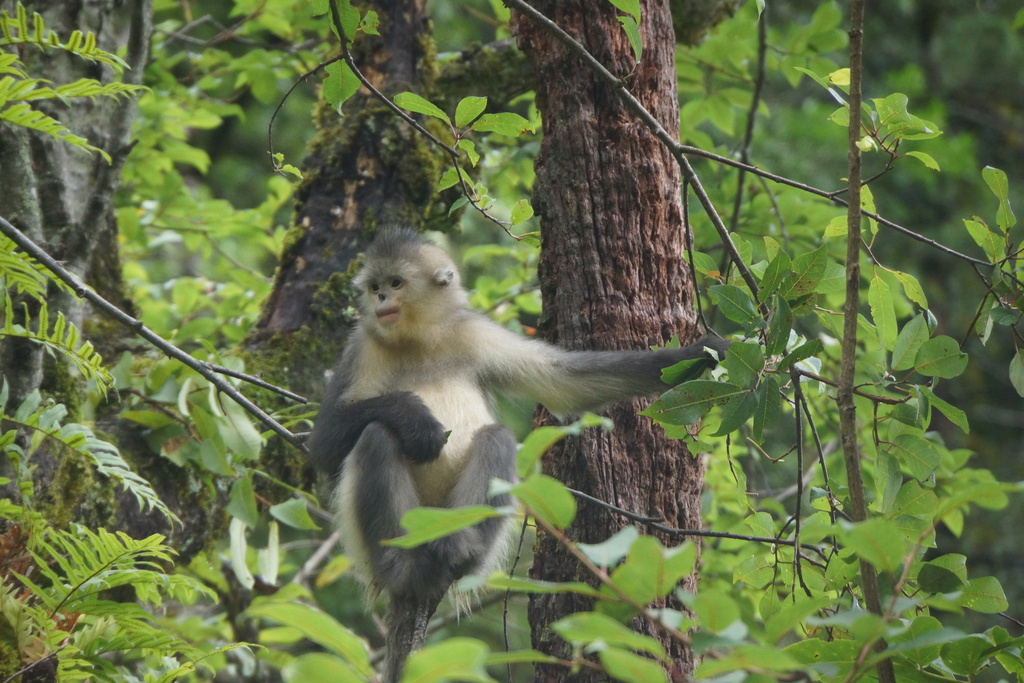
Yunnan Snub-nosed Monkey
Photo © Tom Wang
Photo © Tom Wang — CC BY 4.0 — Source: iNaturalist photo #476935714Identification
The Yunnan snub-nosed monkey is a striking large primate with distinctive black-and-white coloration. Adults display grayish-black fur across most of the body, with white underbelly and facial zone. Both sexes share this pattern, though females are noticeably smaller, weighing around 20 lbs compared to males at approximately 30 lbs. All individuals possess thick fur providing insulation against freezing temperatures, and distinctive hairless, vibrant pink lips that are immediately recognizable in the field.
The species' most characteristic feature is the absence of nasal bones, giving these monkeys their "snub-nosed" designation. Infants are born with white fur that darkens with age, making juveniles somewhat easier to distinguish from adults in mixed groups.
Range & Habitat
This highly restricted species is found only in the Nujiang Langcang Gorge alpine forests of northwest Yunnan, China, within the greater Hengduan Mountains. Fewer than 1,700 individuals survive in just 17 groups across this remote region and neighboring areas of the Tibetan Autonomous Prefecture. Each group maintains a territory ranging from 20 to 135 square kilometers.
They inhabit deciduous and coniferous mountain forests at extraordinary altitudes—the highest recorded at 4,700 meters—making them the highest-altitude dwelling non-human primate known to science. These forests provide year-round availability of lichens, their primary food source.
Behaviour & Diet
Unlike most primates, Yunnan snub-nosed monkeys have evolved to subsist primarily on lichens, which grow abundantly in their mountainous terrain. They possess specialized digestive enzymes similar to those of cattle, enabling them to safely process lichens that are toxic to most animals. Seasonally, they supplement their diet with bamboo leaves, rhododendron flowers, and other available plants depending on location and season.
Reproduction follows patterns similar to other snub-nosed monkeys, with births typically occurring two to three months later than related species due to the harsh climate. Births occur at night, though rare daytime observations have documented females assisting during childbirth in a practice reminiscent of human midwifery.
Best Time & Places to See It
Viewing opportunities are extremely limited due to the species' remote distribution and endangered status. The monkeys are confined to the Nujiang Langcang Gorge region of northwest Yunnan, one of China's most biodiverse and geographically challenging areas. Access requires specialized permits and experienced local guides familiar with the high-altitude terrain and group locations.
The year-round availability of lichens means the monkeys can be found throughout the seasons, though extreme winter conditions at high altitude present significant challenges for field observation. Visits should only be undertaken with proper logistical support and respect for conservation protocols.
Photography Tips
The striking black-and-white contrast and pink facial features offer excellent photographic subjects in their natural habitat. However, the remote, high-altitude terrain and dense forest canopy present considerable technical challenges. Wide-angle shots capturing the dramatic alpine landscape context can be as compelling as close portraits. The thick fur texture photographs well, particularly in diffused mountain light.
Patience and respectful distance are essential—these are endangered animals with low genetic diversity, making disturbance particularly harmful. Early morning and late afternoon light in mountain gorges can produce dramatic images. Given the species' extreme rarity in international awareness, any ethical documentation contributes valuable knowledge to global conservation efforts.
No community photos yet. Log in to add the first one.
No community observations of this species yet.