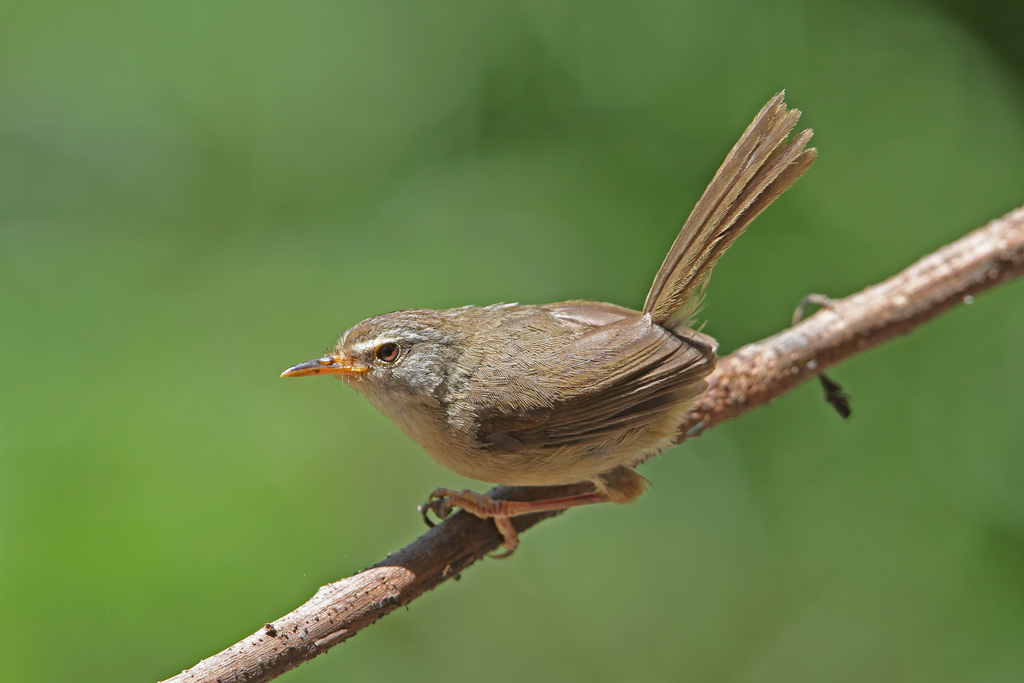
Aberrant Bush Warbler
Photo © Christoph Moning
Photo © Christoph Moning — CC BY 4.0 — Source: iNaturalist photo #103269912Identification
The Aberrant Bush Warbler is a small passerine warbler with plumage that reflects its scientific name: predominantly olive-green upperparts contrasting with yellowish underparts. Like many bush warblers in the Cettiidae family, it is a cryptic species that can be challenging to observe in the field. Its subtle coloration provides excellent camouflage in dense vegetation, making visual identification difficult without close views. The species shares many characteristics with related bush warblers, though its specific combination of yellow and olive tones helps distinguish it from congeners across its range.
Range & Habitat
This species is distributed across a vast region of central and southern Asia, with populations found in China, Myanmar, Vietnam, Laos, Thailand, Nepal, Bhutan, India, Malaysia, Indonesia, and the Philippines, with possible occurrences in Bangladesh. Thirteen recognized subspecies occupy different portions of this extensive range, each adapted to local conditions. The species shows a marked preference for montane habitats, particularly in forested regions at elevation. Several subspecies are restricted to montane zones in Indonesia, including populations in Sumatra, Java, Bali, Lombok, Sumbawa, Timor, Borneo, and Palawan, highlighting the species' association with highland forest environments across Southeast Asia.
Behaviour & Diet
As a member of the bush warbler family, the Aberrant Bush Warbler is primarily insectivorous, foraging for small invertebrates in dense undergrowth and foliage. Like other bush warblers, it is skulking and secretive in habit, preferring to remain concealed within vegetation rather than expose itself in open areas. The species' cryptic behavior, combined with its preference for dense montane forest, makes it difficult to study in the wild and limits direct observations of its feeding ecology and social behavior.
Best Time & Places to See It
Birdwatchers and naturalists seeking this species should focus on montane forest regions throughout its range. The extensive subspecific variation and broad geographic distribution mean that opportunities to find the Aberrant Bush Warbler exist across multiple countries and habitat types in Asia. However, the species' cryptic nature and preference for dense vegetation make it an elusive target. Patience, knowledge of local subspecies, and familiarity with bush warbler calls and behavior significantly improve chances of detection in appropriate montane forest habitats.
Photography Tips
Photographing the Aberrant Bush Warbler presents considerable challenges due to its secretive habits and preference for dense vegetation. Photographers should focus on montane forest areas where the species is most likely to occur and be prepared for prolonged waiting in appropriate habitat. Early morning or late afternoon sessions may yield better visibility as the bird moves through undergrowth. Given the species' tendency to remain hidden, recording vocalizations and using playback techniques—if ethically appropriate—may help draw birds closer to observation points. A telephoto lens and patience are essential tools for capturing images of this elusive warbler.
Bardiya National Park
Chitwan National Park
Doi Inthanon National Park
Gangotri National Park
Gaoligong Mountain National Nature Reserve
Gunung Ciremai National Park
Gunung Merbabu National Park
Gunung Mulu National Park
Huanglong Scenic and Historic Interest Area
Nothing matches these filters.
No community photos yet. Log in to add the first one.
No community observations of this species yet.