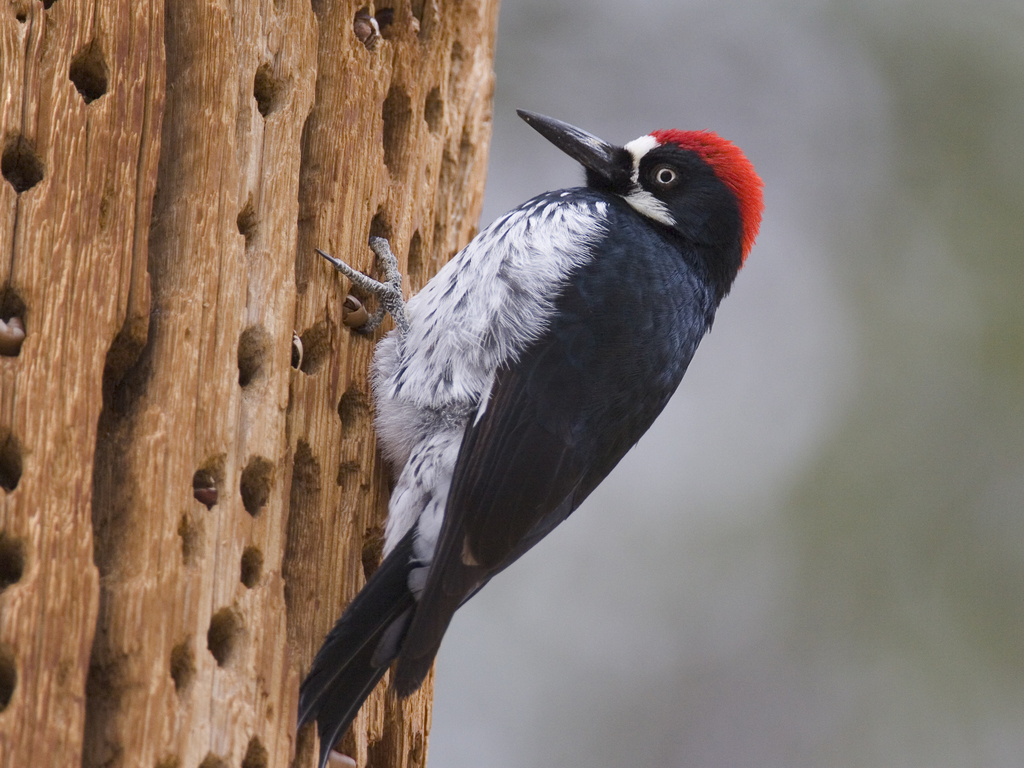
Acorn Woodpecker
Photo © Dmitry Mozzherin
Photo © Dmitry Mozzherin — CC BY 4.0 — Source: iNaturalist photo #3085Identification
The acorn woodpecker is a medium-sized woodpecker measuring 19–23 cm in length and weighing 65–90 g. It is unmistakable in the field, characterized by its striking plumage pattern: a brownish-black head, back, wings, and tail contrasted with a white forehead, throat, belly, and rump. Adult males sport a distinctive red cap beginning at the forehead, while females have a black area between the forehead and cap. The white neck, throat, and forehead patches are particularly distinctive field marks. In flight, look for prominent white circles on the wings, visible as the bird employs its characteristic flight pattern of a few rapid wing flaps followed by a short drop. The eyes of fledglings are initially dark but turn white within a few months. A small patch of greenish feathers appears on the lower back. Their loud, almost laughing call is often the first indication of their presence.
Range & Habitat
The acorn woodpecker is found across a wide range spanning from Oregon and California in the western United States, through the southwestern states, and south through Central America to Colombia. Seven recognized subspecies occupy different portions of this range. The species shows a strong preference for forested areas with oak trees, particularly in coastal areas and foothills. In the northern part of its range, it may occur at low elevations, but in Central America it rarely descends below 1,000 m. The species breeds up to the timberline where suitable habitat exists. Nests are excavated in cavities within dead trees or dead portions of living trees.
Behaviour & Diet
Acorn woodpeckers are highly social cooperative breeders, living and breeding in family groups of up to 15 individuals. These groups exhibit remarkable social flexibility, ranging from monogamous pairs to complex polygynandrous breeding collectives consisting of up to eight males and four females, supplemented by nonbreeding helpers at the nest—offspring from previous breeding seasons. Within groups, all breeder males (typically brothers or fathers with sons) compete for matings with all breeder females (usually sisters or mothers with daughters), who lay eggs communally in a single nest cavity. This combination of helping behavior and cooperative polygamy is exceptionally rare among birds. Limited territories and the availability of acorn storage granaries appear to drive this unusual social system.
Acorn woodpeckers are omnivorous, but acorns form a substantial portion of their diet. In California, acorns comprise 50% or more of their food intake, sourced from valley oak, blue oak, coast live oak, California black oak, and canyon live oak. In Arizona and New Mexico, acorns account for 25–50% of their diet. They supplement their diet with tree sap and insects. The relative importance of different oak species varies geographically and annually with acorn production. At some locations in California, woodpeckers may breed twice in a year—once in spring and again in August when new acorn crops mature—if acorn production is favorable.
Best Time & Places to See It
Acorn woodpeckers are year-round residents throughout most of their range, making them accessible to travelers and photographers throughout the year. They are best found in oak-dominated forests and woodlands from coastal California through the southwestern United States and southward into Central America. Look for them in areas where multiple oak species grow together, as these mixed oak woodlands provide the most stable food supply. The birds are social and often vocal, so their laughing calls will often lead you to them. Early morning typically offers the best viewing opportunities and lighting for photography.
Photography Tips
The acorn woodpecker's distinctive plumage makes it a rewarding subject for wildlife photography. The contrasting pattern of black and white plumage, combined with the males' red cap, provides excellent visual interest. Capture their characteristic undulating flight pattern, which is distinctive and photogenic. Early morning light will best render the white facial patches and cap coloration. Since these birds are social and vocal, patience near oak groves will often reward you with opportunities to photograph multiple individuals. The white circles on the wings visible in flight are a particularly striking detail worth attempting to capture.
Baru Volcano National Park
Big Bend National Park
Bosque del Apache National Wildlife Refuge
Braulio Carrillo National Park
Bryce Canyon National Park
Carlsbad Caverns National Park
Cave Creek Canyon
Channel Islands National Park
Chiricahua Mountains
Nothing matches these filters.
No community photos yet. Log in to add the first one.
No community observations of this species yet.