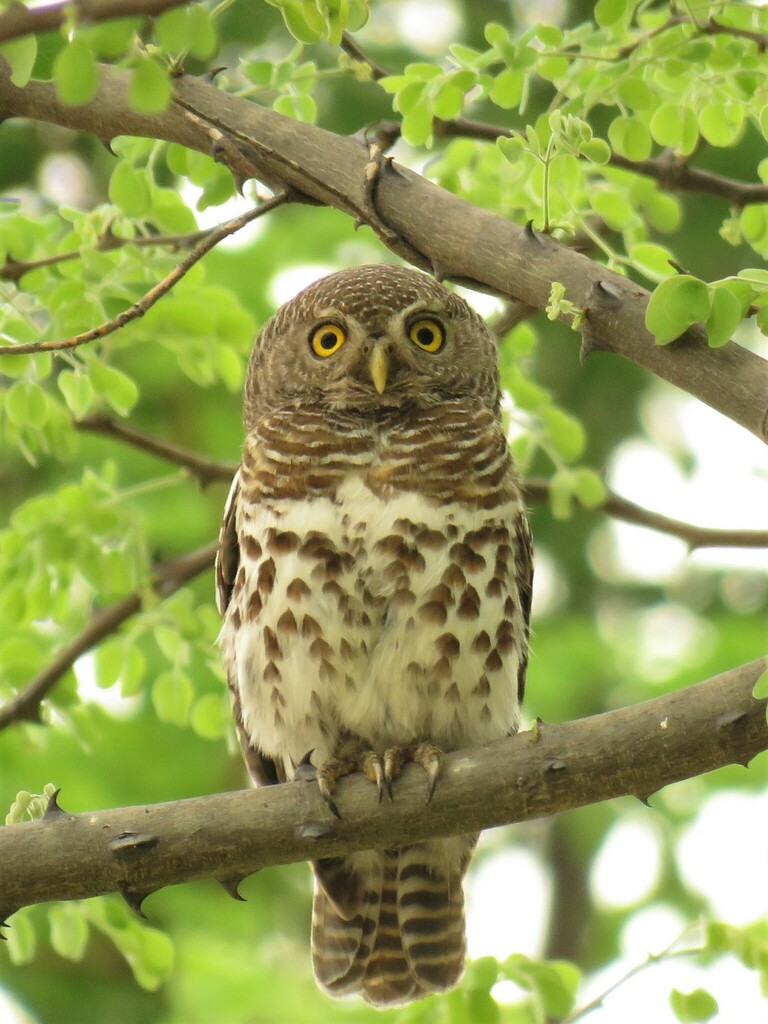
African Barred Owlet
Photo © Christiaan Viljoen
Photo © Christiaan Viljoen — CC BY 4.0 — Source: iNaturalist photo #223434260Identification
The African Barred Owlet is a small owl, measuring approximately 17 cm in length with a wingspan of about 40 cm. The nominate subspecies displays greyish-brown plumage above with fine buff barring, distinguished by a narrow white eyebrow stripe. A striking feature is the white stripe across the shoulder and folded wing, formed by white outer webs of the scapulars and greater wing coverts with dark brown tips. The brown chest is finely barred with buff, while the breast and flanks are white with brown spots. Flight feathers and tail are brown barred with rufous. The underwing coverts, legs and vent are white. The bird has a dull greenish-yellow bill and cere, with yellow eyes, legs and feet. Geographic variation exists across its range, and the taxon may actually comprise four separate species rather than one.
Range & Habitat
The African Barred Owlet is endemic to southern and eastern Africa, with its range extending from Kenya and the Eastern Cape through to western Angola. It shows a preference for open habitats with scattered trees, including gallery forests, woodland, forest edges and areas of secondary growth. This habitat choice reflects the species' hunting strategy, as it requires accessible perches from which to scan for prey.
Behaviour & Diet
Unusually for an owl, the African Barred Owlet is partly diurnal and frequently observed on open perches during daylight hours, scanning for food. Its distinctive call comprises a series of single-pitched purring notes, typically heard at dusk and dawn, though it may also call throughout calm, clear nights. The species is territorial, with both sexes calling to proclaim their domain, particularly before the breeding season. During daylight, detected owlets often fall victim to mobbing by other bird species.
The diet is varied and includes small mammals, birds, reptiles, frogs, insects, scorpions and caterpillars, typically captured following short flights from a perch. Breeding occurs in tree cavities located 3–6 meters above ground, where females lay two or three eggs between September and November. Both parents feed the young exclusively during darkness; chicks fledge after 30–33 days and remain dependent on their parents for 7–12 months before achieving independence.
Best Time & Places to See It
The African Barred Owlet can be found across much of southern, central and eastern Africa in suitable woodland and forest-edge habitats. Early morning and dusk offer the best opportunities for observation, particularly when calling activity is highest. However, the species' partial diurnal nature means daytime sightings on open perches are also possible. The breeding season from September to November may increase visibility as territorial calling peaks.
Photography Tips
The African Barred Owlet's habit of perching openly during daylight hours makes it relatively approachable for photography compared to strictly nocturnal owls. Early morning light will best reveal the fine barring and subtle plumage details, particularly the distinctive white shoulder stripe. Patient observation of likely perches in suitable habitat—open woodland and forest edges—will reward photographers with opportunities to capture this small but striking owl scanning for prey. The species' yellow eyes and facial markings are distinctive photographic features worth highlighting.
Mapungubwe National Park
Musina Local Municipality, South Africa
+358 birds+29 mammals
Where the Limpopo River cuts through sandstone ridges at the convergence of South Africa, Botswana, and Zimbabwe, Mapungubwe National Park preserves a landscape of profound ecological…
VIEW NATIONAL PARKChobe National Park
Botswana
+446 birds+45 mammals
Where the Chobe River cuts a sinuous path through northern Botswana, the landscape transforms into one of Africa's most dynamic wetland-savanna mosaics. This national park encompasses…
VIEW NATIONAL PARKNxai Pan National Park
Botswana
+226 birds+16 mammals
Across the northwestern reaches of Botswana stretches a landscape of profound seasonal transformation—a sprawling pan system where shallow depressions fill and empty with the rains, creating…
VIEW NATIONAL PARKKhaudum National Park
Botswana
+213 birds+13 mammals
Where the Okavango's northern tributaries meander through miombo woodland and riverine forest, Khaudum National Park unfolds across a landscape of profound ecological richness and isolation. This…
VIEW NATIONAL PARKTarangire National Park
Tanzania
+527 birds+50 mammals
Acacia woodland and grassland sweep across the Manyara Region where the Tarangire River carves through low hills and volcanic soils, creating one of East Africa's most…
VIEW NATIONAL PARKNgorongoro Conservation Area
Tanzania
+626 birds+55 mammals
Volcanic calderas and open grassland dominate this high plateau in northern Tanzania, where the landscape rises above 2,000 metres and ancient geological forces have shaped both…
VIEW WILDLIFE MANAGEMENT AREAKruger National Park
Ba-Phalaborwa Local Municipality, South Africa
+540 birds+91 mammals
Across the low-lying savanna of northeastern South Africa unfolds one of Africa's largest and most ecologically intact protected areas, where acacia woodlands merge into mopane scrub…
VIEW NATIONAL PARKAddo Elephant National Park
Sundays River Valley Local Municipality, South Africa
+388 birds+55 mammals
Where the Eastern Cape's semi-arid scrublands meet transitional woodland, Addo sprawls across 13,478 square kilometres of one of southern Africa's most biodiverse landscapes. The terrain rises…
VIEW NATIONAL PARKKhaudum National Park
Namibia
+221 birds+13 mammals
Where the Kavango River flows through northeastern Namibia, vast miombo woodlands and riverine forests create one of southern Africa's most remote and biodiverse wilderness corridors. Khaudum…
VIEW NATIONAL PARKNkasa Rupara National Park
Namibia
+283 birds+17 mammals
Where the Zambezi's floodplains spill across the border between Namibia and Botswana, Nkasa Rupara National Park unfolds across 518 square kilometers of wetland and woodland mosaic.…
VIEW NATIONAL PARKBwabwata National Park
Namibia
+377 birds+35 mammals
Where the Kavango River winds through northeastern Namibia, vast floodplains and dense riparian woodland create one of southern Africa's most ecologically dynamic protected landscapes. Spanning 14,249…
VIEW NATIONAL PARKEtosha National Park
Namibia
+356 birds+58 mammals
Across northern Namibia's stark semi-arid plateau, a vast shallow depression transforms seasonally into one of Africa's most dramatic wildlife theaters. Etosha National Park, encompassing more than…
VIEW NATIONAL PARKMakgadikgadi Pans National Park
Gucta, Botswana
+272 birds+27 mammals
Where salt-crusted flatlands stretch endlessly toward a shimmering horizon, one of Africa's most extraordinary ecosystems awakens with the rains. The Makgadikgadi Pans comprise vast mineral-rich basins…
VIEW NATIONAL PARKArabuko Sokoke Forest Reserve
Kilifi, Kenya
+383 birds+29 mammals
Coastal forest rises from the Indian Ocean plains of Kilifi County, where sandy soils and seasonal rainfall have sculpted a woodland ecosystem unlike anywhere else on…
VIEW NATURE RESERVENo community photos yet. Log in to add the first one.
No community observations of this species yet.