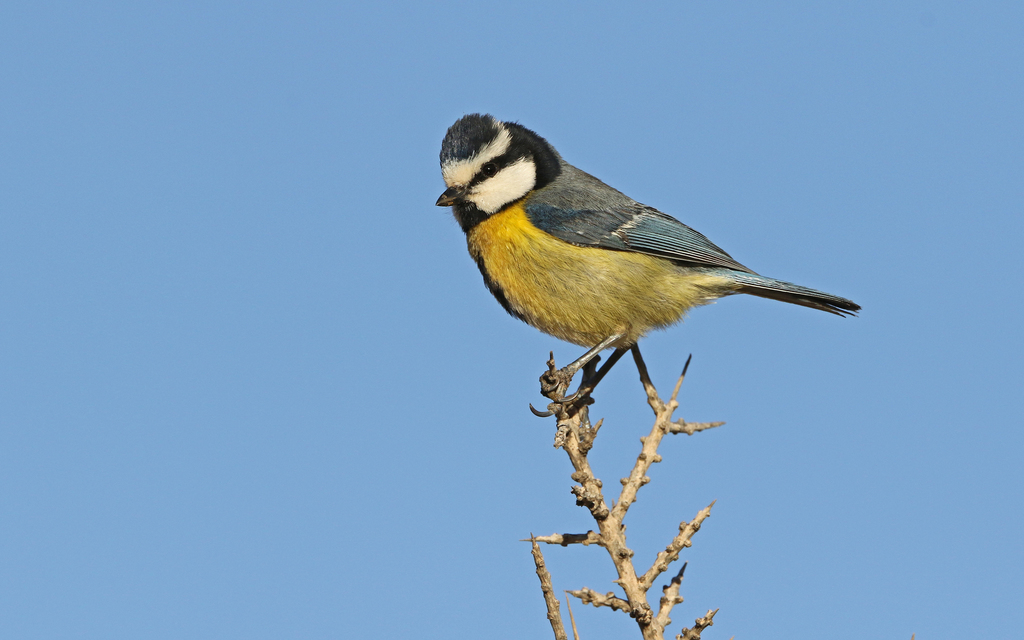
African Blue Tit
Photo © Christoph Moning
Photo © Christoph Moning — CC BY 4.0 — Source: iNaturalist photo #184052513Identification
The African blue tit is a small, compact bird measuring 11–12 cm in length, with a characteristic sharp, pointed bill. The nominate race displays striking plumage: a white forehead and supercilium (eyebrow stripe) extending to the centre of the nape, a deep glossy blue crown that darkens to blackish on the neck, a blue back, and yellow underparts. The song is a variable, repetitive pattern of one or two notes, making it recognizable by ear as well as sight.
Range & Habitat
This species has a remarkably fragmented distribution across northern Africa, the Italian island of Pantelleria, and the Canary Islands. Within the Canaries, it is widespread and common on Tenerife and Gran Canaria, but becomes scarce on Fuerteventura and Lanzarote. The African blue tit favours temperate forests at both low and high elevations, though preferences vary geographically. On the lower-lying Canary Islands of Fuerteventura and Lanzarote, lowland areas are preferred, while populations on Tenerife and Gran Canaria show a strong preference for montane forests.
Behaviour & Diet
The African blue tit is a resident species with highly philopatric juveniles—young birds remain at their natal site and do not disperse after fledging. The species has a distinctive breeding season spanning February to July, with a possible secondary breeding period from October to January. Breeding timing correlates with photoperiod length and is synchronized with peak availability of caterpillars, its primary food source. The diet is not significantly different from that of its closest relative, the Eurasian blue tit, though specific caterpillar preferences vary with local availability.
Best Time & Places to See It
The breeding season from February to July offers the best opportunities to observe this species, particularly in montane forest habitats on Tenerife and Gran Canaria, where populations are most abundant. The extended daylight hours during this period coincide with increased breeding activity and caterpillar availability, making birds more active and visible. Visitors to the Canary Islands should seek out temperate forest areas at suitable elevations, where the species' preference for these habitats makes encounters more likely.
Photography Tips
The African blue tit's small size and preference for forest canopies present the primary challenge for photographers. Focus on montane forest areas during the breeding season when birds are most active and vocal. The striking blue and yellow plumage photographs well in natural light, but patience is essential given the species' compact form and habit of foraging among foliage. Early morning sessions often yield the best results, as birds are most active at this time while searching for caterpillars.
Teide Natural Monument
La Orotava, Spain
+41 birds+4 mammals
High on the volcanic slopes of Tenerife, where the landscape transforms from lush laurel forests into lunar terrain, the Teide Natural Monument preserves one of Spain's…
VIEW NATURE RESERVETeide National Park
La Orotava, Spain
+83 birds+7 mammals
At nearly 3,900 metres, Spain's highest peak rises from the Canary Islands as a singular volcanic monument, its slopes sweeping through five distinct climate zones in…
VIEW NATIONAL PARKCaldera de Taburiente National Park
El Paso, Spain
+40 birds+1 mammals
Where volcanic ramparts rise nearly two kilometres above the Atlantic, Caldera de Taburiente reveals one of the Canary Islands' most dramatic geological narratives. This national park…
VIEW NATIONAL PARKGarajonay National Park
Hermigua, Spain
+68 birds+1 mammals
Laurel forests cloak the volcanic ridges of this Canarian national park, their evergreen canopy so dense that mist clings to the moss-draped branches even on cloudless…
VIEW NATIONAL PARKNo community photos yet. Log in to add the first one.
No community observations of this species yet.