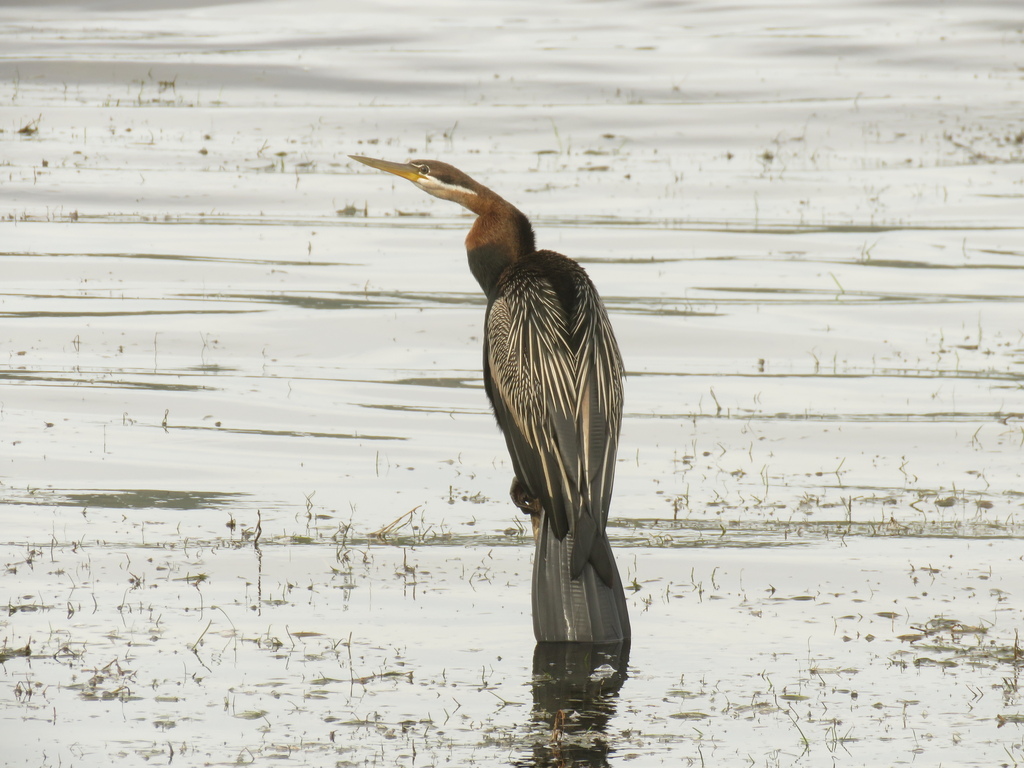
African Darter
Photo © Christiaan Viljoen
Photo © Christiaan Viljoen — CC BY 4.0 — Source: iNaturalist photo #398905228Identification
The African darter is a sleek water bird measuring 80 cm (31 inches) in length, immediately recognizable by its exceptionally long, slender neck. Males are predominantly glossy black with white streaking, while females and immature birds display browner plumage. The species is most easily distinguished from the similar American darter by a distinctive thin white lateral stripe running along its rufous-colored neck. Its pointed bill provides a reliable way to separate it from cormorants, which share similar aquatic habitats.
Range & Habitat
The African darter is found throughout Sub-Saharan Africa wherever large bodies of water occur, making it a widespread and common species across the continent. Historically, a non-African subspecies, the Levant darter, inhabited wetlands in the Middle East including Lake Amik in Turkey, the Hula Valley and marshes in Israel, and the Mesopotamian Marshes of the lower Euphrates and Tigris rivers in Iraq. However, this population has been severely impacted by habitat loss—the Turkish population disappeared in the 1930s and the Israeli population during the drainage of the Hula in the 1950s. A small population persists in Iraq's Hawizeh Marshes following conservation efforts to reverse marsh drainage.
Behaviour & Diet
The African darter is a specialist fish-eater that catches its prey by diving. It frequently swims with only its neck visible above water, a behavior that earned it the alternative common name "snakebird." Unlike most other waterbirds, the African darter's feathers lack oils and are not waterproof. This unique characteristic actually enhances its diving ability by reducing buoyancy, allowing deeper underwater pursuits. However, waterlogged feathers necessitate regular drying sessions, making the bird a common sight perched along waterside vegetation with wings spread to dry in the wind and sun, often alongside cormorants.
The species is colonial and nests in trees, building stick nests and typically laying 3–6 eggs. It frequently nests alongside herons, egrets, and cormorants, forming mixed-species breeding colonies.
Best Time & Places to See It
The African darter is widespread and common throughout Sub-Saharan Africa wherever suitable wetland habitats exist. Lakes, large rivers, marshes, and coastal lagoons all support populations. The species' year-round presence across much of its range means visitors may encounter it during any season, though local movements may occur in response to water levels and food availability.
Photography Tips
Photograph the African darter during its frequent perching sessions when it spreads its wings to dry—these moments offer excellent opportunities to capture the bird's distinctive posture and plumage patterns. Early morning and late afternoon light work well for highlighting the males' glossy black feathers and white markings. Patience near water margins, particularly around nesting colonies, increases chances of capturing behavior shots including diving sequences and interaction with other waterbird species.
Lake Mburo National Park
Mabamba Swamp
Murchison Falls National Park
Queen Elizabeth National Park
Abijata-Shalla Lakes National Park
Addo Elephant National Park
Agulhas National Park
Amboseli National Park
Arabuko Sokoke Forest Reserve
Nothing matches these filters.
No community photos yet. Log in to add the first one.
No community observations of this species yet.