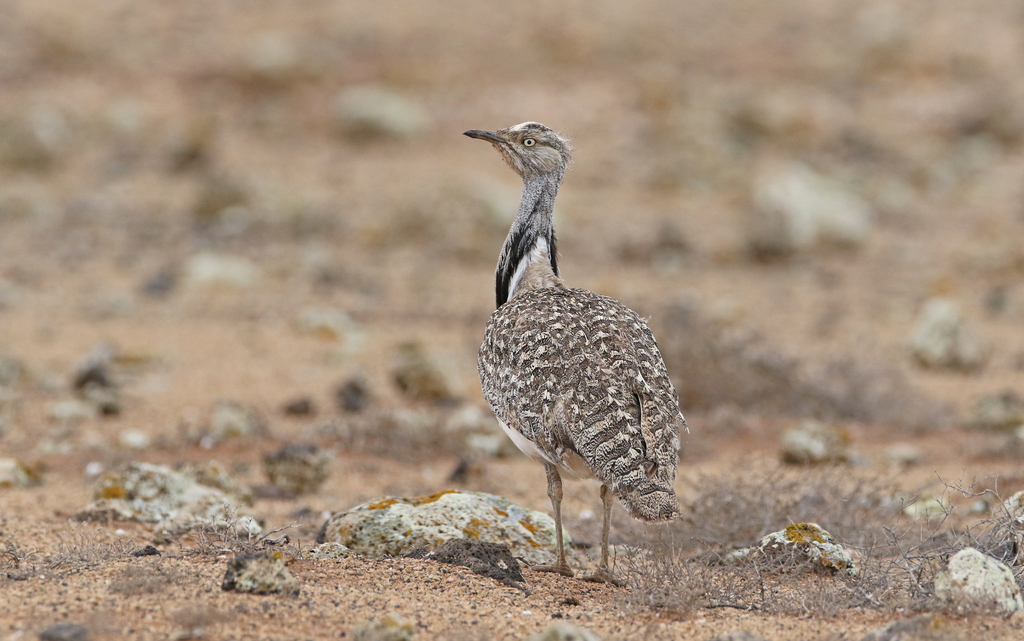
African Houbara
Photo © Christoph Moning
Photo © Christoph Moning — CC BY 4.0 — Source: iNaturalist photo #183144254Identification
The African houbara is a small to mid-sized bustard, measuring 55–75 cm in length with a wingspan of 135–170 cm. It is brown above and white below, with a distinctive black stripe running down the sides of its neck and a black ruff along the side of the neck. In flight, its long wings reveal large areas of black and brown on the flight feathers. The plumage is dull brown with black markings on the wings and a greyish neck. Males are noticeably larger and heavier than females, with males standing 65–75 cm tall and weighing 1.8–3.2 kg, while females measure 55–65 cm and weigh only 1.2–1.7 kg. Females also tend to be greyer above than males.
Range & Habitat
The African houbara is found across North Africa west of the Nile, primarily in the western Sahara desert region of Algeria, Egypt, Libya, Mauritania, Morocco, Tunisia, and Western Sahara. A small and highly restricted population survives in the Canary Islands, with a 1997 survey estimating around 500 birds in that archipelago. Unlike migratory populations of related species found east of the Sinai Peninsula, the North African houbara is sedentary, remaining in its arid habitat year-round.
Behaviour & Diet
The African houbara is known for its flamboyant breeding display, during which males raise the white feathers of the head and neck while withdrawing the head in an impressive posture. Males vocalize infrequently, producing 3–5 low booming notes during these breeding displays. Females are ground-nesters, laying two to four eggs directly on the ground. The species is omnivorous, feeding on seeds, insects, and other small creatures to sustain itself in its harsh desert environment.
Best Time & Places to See It
Travellers seeking the African houbara should focus on arid regions of North Africa, particularly within the western Sahara, where the bird remains year-round. The Canary Islands population, though small and endangered, offers another opportunity for dedicated birdwatchers, though sightings are rare. The species' sedentary nature means birds can be found in their preferred habitats throughout the year, though the breeding season may offer the best opportunity to observe the males' flamboyant displays and hear their distinctive booming calls.
Photography Tips
Photographers should be prepared for the challenging desert environments where this bustard lives, bringing appropriate equipment for arid conditions and heat. The species' ground-nesting behaviour and preference for open desert terrain mean that wide-angle shots capturing the bird in its natural habitat can be particularly effective. During breeding season, patient observers may be rewarded with images of the spectacular male display, with its raised neck and head feathers creating a distinctive silhouette. Early morning or late afternoon light will enhance the bird's brown plumage and highlight the striking black markings on the wings and neck.
No community photos yet. Log in to add the first one.
No community observations of this species yet.