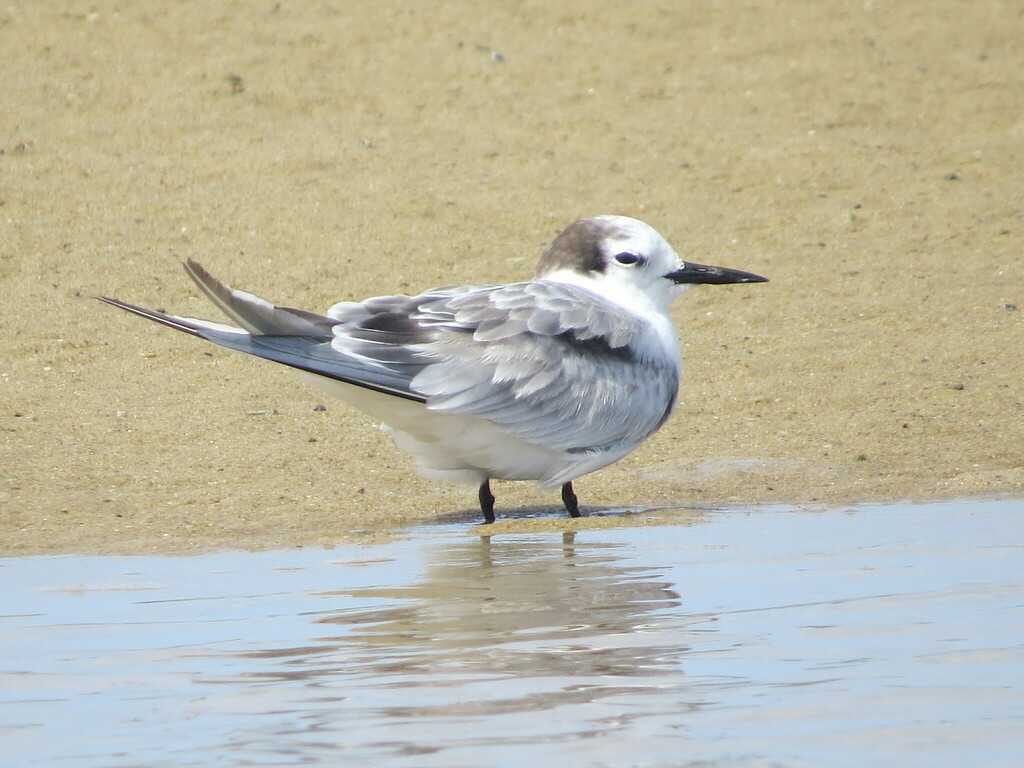
Aleutian Tern
Photo © ian_mcallan
Photo © ian_mcallan — CC BY 4.0 — Source: iNaturalist photo #364402948The Aleutian tern (Onychoprion aleuticus) is a migratory bird living in the subarctic region of the globe most of the year. It is frequently associated with the Arctic tern, which it closely resembles. While both species have a black cap, the Aleutian tern may be distinguished by its white forehead (although juvenile Arctic terns also have white foreheads). During breeding season, the Arctic terns have bright red bills, feet, and legs while those of the Aleutian terns are black. Onychoprion aleuticus has not been thoroughly studied yet. If its winter migratory range was completely unknown until the late 1980s; it is now known that many Aleutian terns spend the winter near the Equator in the western Pacific. The Aleutian tern breeds in wide-ranging coastal colonies only in Alaska and eastern Siberia. Although Alaskan and Siberian populations are not well monitored, both are thought to be in significant decline. == Taxonomy == The Aleutian tern is in the family Laridae, a family of seabirds in the order Charadriiformes that includes the gulls, terns and skimmers. The generic name is from Ancient Greek onux, "claw" or "nail", and prion, "saw". The specific epithet aleuticus refers to the Aleutian Islands. It was formerly…
Kenai Fjords National Park
Kenai Peninsula Borough, United States
+164 birds+19 mammals
Granite peaks and tidewater glaciers dominate Alaska's Kenai Peninsula, where nearly 7,900 square kilometers of pristine coastal wilderness descend from the Harding Icefield toward the Gulf…
VIEW NATIONAL PARKKatmai National Park
Lake and Peninsula Borough, United States
+160 birds+19 mammals
Across southwestern Alaska's Lake and Peninsula Borough, nearly 27,000 square kilometers of subarctic wilderness sprawl between volcanic peaks and coastal wetlands, anchored by the confluence of…
VIEW NATIONAL PARKGlacier Bay National Park
Unorganized Borough, United States
+221 birds+15 mammals
Tidewater glaciers calving into fjords of impossible blue, where temperate rainforest rises steeply from the water's edge and alpine peaks pierce the clouds—this is the ecological…
VIEW NATIONAL PARKSt. Paul Island
Saint Paul, United States
+255 birds+8 mammals
Windswept tundra rolls across this remote Pribilof island, where volcanic basalt cliffs plunge into the Bering Sea and fog rolls in thick enough to erase the…
VIEW PROTECTED LANDSCAPEKodiak National Wildlife Refuge
United States
+221 birds+22 mammals
Where temperate rainforest meets subarctic coast, Kodiak National Wildlife Refuge sprawls across Alaska's largest island, a sanctuary defined by steep valleys carved by tidewater glaciers and…
VIEW WILDLIFE SANCTUARYKenai National Wildlife Refuge
United States
+152 birds+16 mammals
Across Alaska's Kenai Peninsula, where glacial valleys descend toward the Cook Inlet and the Gulf of Alaska, lies one of North America's most expansive subarctic wildlife…
VIEW WILDLIFE SANCTUARYAlaska Maritime National Wildlife Refuge
Alaska, United States
+391 birds+58 mammals
Where the North Pacific collides with Alaska's rugged coastline, a sprawling archipelago of islands, rocky outcrops, and coastal headlands forms one of North America's most remote…
VIEW WILDLIFE SANCTUARYYukon Delta National Wildlife Refuge
Bethel, United States
+156 birds+12 mammals
Across the Yukon Delta sprawls one of North America's most expansive coastal wetland sanctuaries, where the boreal subarctic climate strips down existence to essentials. This vast…
VIEW WILDLIFE SANCTUARYIzembek National Wildlife Refuge
Cold Bay, United States
+138 birds+9 mammals
Where the Aleutian archipelago reaches westward into the Bering Sea, subarctic tundra and shallow coastal waters converge to create one of Alaska's most ecologically vital wildlife…
VIEW WILDLIFE SANCTUARYNo community photos yet. Log in to add the first one.
No community observations of this species yet.