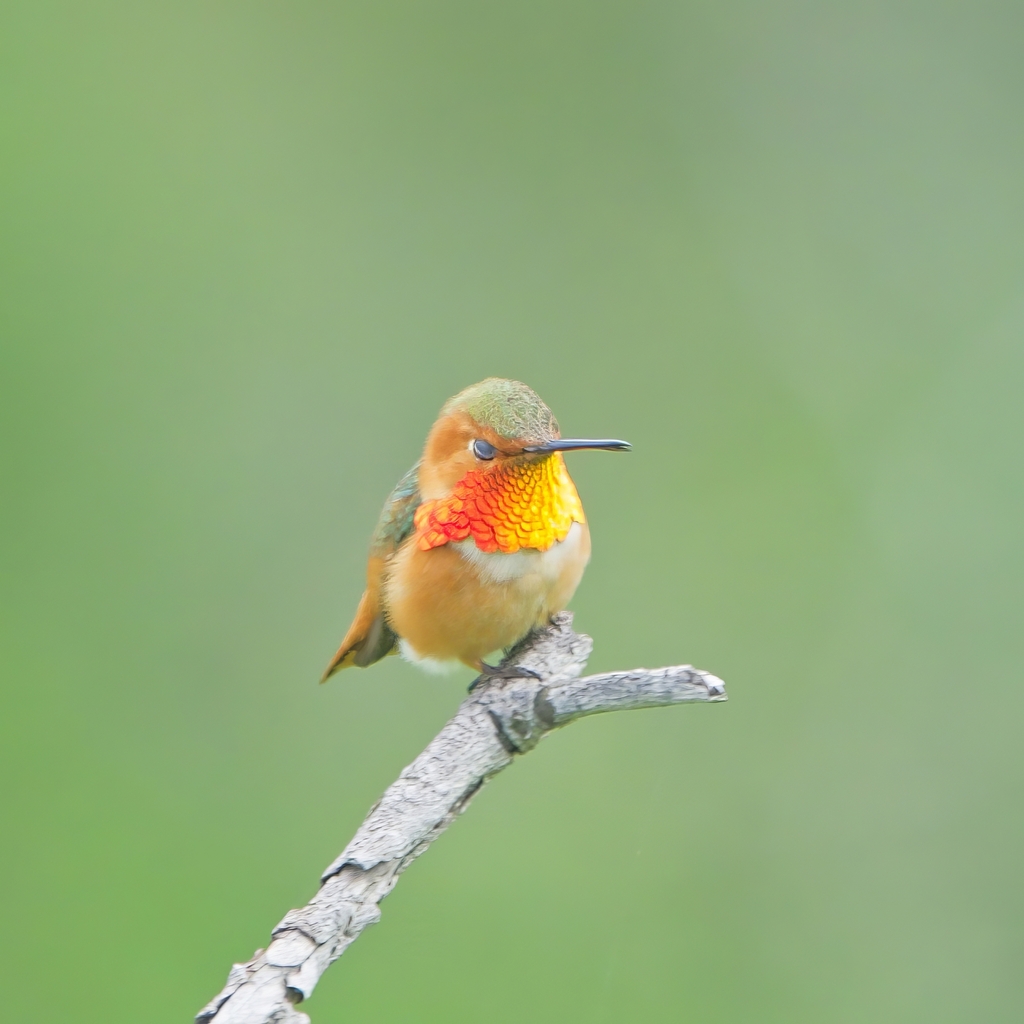
Allen’s Hummingbird
Photo © Bill Levine
Photo © Bill Levine — CC BY 4.0 — Source: iNaturalist #151657773Identification
Allen's hummingbird is a tiny species, measuring just 3 to 3.5 inches in length and weighing only 2 to 4 grams—making it one of nature's most delicate jewels. Males are particularly striking, with a brilliant iridescent orange-red throat, a green back and forehead, and distinctive rust-colored flanks, rump, and tail. Females and immature birds are more subdued, displaying mostly green plumage with rufous coloring restricted to the tail, which features white tips. Rather than an iridescent throat patch, females show a series of speckles instead. Immature Allen's hummingbirds can be nearly impossible to distinguish from female rufous hummingbirds in the field, though the lack of a notch in the adult male's second rectrix (tail feather) provides a reliable field mark for identification.
Range & Habitat
Allen's hummingbird breeds along the coastal regions of western North America, primarily in brushy woods, gardens, and meadows from Santa Barbara, California, north through southern Oregon. Two subspecies exist: the migratory sasin, which winters in south-central Mexico, and the sedentarius, a year-round resident on the Channel Islands and southern California. Since the 1960s, the species has expanded its range dramatically inland, now found across much of Los Angeles and Orange Counties, through San Diego County, and east to western Riverside County, typically at elevations around 1,000 feet.
The migratory timing of this species is fascinating: males return north early in the year, while females arrive closer to spring, reducing competition for resources during breeding season. Females prefer nesting in forests with large trees such as oak-pine, Douglas fir, and redwood, which provide both shelter and nesting materials. However, the species faces significant conservation challenges, with populations declining by approximately 80% since the 1960s due to habitat loss and human impacts.
Behaviour & Diet
Male Allen's hummingbirds are boldly aggressive and territorial, fiercely defending their feeding areas from rival males and other hummingbird species. They have even been documented attacking and driving off much larger predatory birds such as kestrels and hawks. Their famous courtship display is spectacular: males perform a frantic back-and-forth pendulum-like flight arc spanning about 25 feet, followed by a dramatic high-speed dive from 100 feet during which their tail feathers create a characteristic sharp flutter designed to captivate females. Both sexes use high-pitched vocalizations in social and territorial encounters.
Like all hummingbirds, Allen's require frequent feeding to sustain their extraordinarily high metabolic rate, relying on nectar from flowers as their primary food source. Females construct delicate cup-shaped nests from plant fibers, down, and weed stems, reinforcing them with lichens and spider webs—a process taking about a week to complete. Nests are typically placed above ground on tree branches or plant stalks for protection. Females lay one or two white eggs, incubating them for 15 to 17 days, with young fledging approximately three weeks after hatching. Mothers continue feeding fledglings for several additional weeks before youngsters become independent. Females often reuse or repair previous nests when breeding again.
Best Time & Places to See It
The best opportunity to observe Allen's hummingbirds is during breeding season along the California and southern Oregon coasts. The migratory subspecies returns north early in the year, making late winter and early spring ideal times for viewing. Coastal brushy areas, gardens with flowering plants, oak-pine and redwood forests, and meadows throughout their range offer the best chances for encounters. The expanded southern California population, now established in Los Angeles, Orange, San Diego, and Riverside Counties, provides additional viewing opportunities for travelers unable to reach more northern coastal regions.
Photography Tips
Photographing Allen's hummingbirds demands patience, quick reflexes, and proper equipment. Fast shutter speeds of at least 1/2000th of a second are essential to freeze their rapid wing beats and movements. Position yourself near flowering plants or feeders where they habitually visit, and use a telephoto lens to maintain distance while capturing detail. The males' iridescent orange-red throat is most vibrant when struck by direct, angled light—position yourself so the sun illuminates this key field mark. Early morning light is often ideal for hummingbird photography. Watch for their spectacular courtship displays during breeding season, which provide unforgettable photo opportunities if you're patient enough to anticipate their movements. Their small size and rapid flight make them challenging subjects, but the rewards of capturing these jewel-like birds are immeasurable.
Big Bend National Park
Brewster County, United States
+345 birds+34 mammals
Where the Chisos Mountains rise abruptly from the Sonoran Desert floor, Big Bend National Park spans over 7,300 square kilometers of one of North America's most…
VIEW NATIONAL PARKSaguaro National Park
Rincon Valley, United States
+354 birds+40 mammals
Where the Sonoran Desert meets sky-island mountains, two geographically separated districts of Saguaro National Park sprawl across nearly two thousand square kilometers of Arizona's most iconic…
VIEW NATIONAL PARKPinnacles National Park
San Benito County, United States
+197 birds+33 mammals
Jagged volcanic spires thrust from chaparral-covered ridges across 222 square kilometers of central California's inner Coast Ranges, their pale stone crowns catching the afternoon light like…
VIEW NATIONAL PARKYosemite National Park
Mariposa County, United States
+224 birds+28 mammals
Granite cliffs soar nearly a kilometer above the valley floor in this expanse of high Sierra wilderness, where glacial U-shaped valleys sculpt a landscape of dramatic…
VIEW NATIONAL PARKRedwood National Park
Humboldt County, United States
+343 birds+43 mammals
Where the Pacific fog rolls deep into northern California's coastal valleys, some of the tallest trees on Earth rise from a landscape shaped by tectonic forces…
VIEW NATIONAL PARKChannel Islands National Park
Santa Barbara County, United States
+330 birds+15 mammals
A chain of eight volcanic islands rises from the cold Pacific waters off the California coast, their rugged sea cliffs and windswept terrain shaped by millions…
VIEW NATIONAL PARKDon Edwards San Francisco Bay National Wildlife Refuge
Fremont, United States
+286 birds+20 mammals
Where the San Francisco Bay's shallow margins dissolve into tidal salt marshes and mudflats, this wildlife sanctuary preserves one of California's most ecologically vital estuarine systems.…
VIEW WILDLIFE SANCTUARYNo community photos yet. Log in to add the first one.
No community observations of this species yet.